
Ethics Eye

This week in The Media Analysis...
01. ‘Yukthiya’ operation: High on social antipathies and anxieties
02. The Language Divide
03. The TV coverage of the issues
04. This week’s cartoons
05. This week’s memes
06. Other topics covered in reportage
Past issues can be viewed here
01. ‘Yukthiya’ operation: High on social antipathies and anxieties

Event: Commencement of ‘Yukthiya’ operation
On December 17, 2023, Sri Lanka Police commenced the anti-drug operation titled ‘Yukthiya’ (trans. Justice) under the directives of the Minister of Public Security Tiran Alles and Acting IGP Deshbandu Tennakoon.[1][2] Over 38,000 individuals involved in drug distribution and over Rs. 4.7 billion worth of narcotics were seized during the first month of the operation.[3][4]
Concerns over police and underworld shootings
During the past two weeks several shootings took place, for which both the underworld and the police were held responsible.
On January 18, a 40-year-old was killed when a police officer in civilian clothing allegedly discharged his firearm accidently during an attempt to search a vehicle in Narammala.[5][6]
On January 20, a 22-year-old was killed in a targeted shooting at a shop in Telijjawila, Matara.[7][8]
On January 22, five persons including the Leader of the Ape Janabala Party (Our Power of People Party) Saman Perera were killed in a shooting in Beliatta.[9][10]
Concerns over the ‘Yukthiya’ operation
During the past week, several local and international organisations expressed their concerns over the ‘Yukthiya’ operation being carried out by Sri Lanka Police.
On January 22, experts from the UN issued a statement calling for the immediate suspension of the ‘Yukthiya’ operation and for a review of the legislation on drug offences so as to be in line with international human rights law and standards.[11][12]
On January 23, Jana Aragale Purawesiyo (Citizens of the People’s Struggle) engaged in a silent demonstration in front of the UN office in Sri Lanka against police suppression of the people carried out in the name of the ‘Yukthiya’ operation.[13][14]
On January 25, a silent protest against the ‘Yukthiya’ operation was disrupted by a group of masked men.[15][16]
On February 2, in an open letter to the Minister of Public Security Tiran Alles, the Lawyers’ Collective emphasised the need to carry out the ‘Yukthiya’ operation in accordance with the rule of law, devoid of personal interests.[17][18]
Analysis
Over the past few weeks, Sinhala press reporting, TV coverage and social media commentary were on the increased activities of the underworld and shootings by the underworld and police.[1] In addition to the above incidents, the media reporting was focussed on the ‘Yukthiya’ operation–underway since December 2023–to ‘control the drug menace’. Despite the government championing the ‘Yukthiya’ operation, the Sinhala media reporting diverged in its views on the same.
Privately-owned newspapers Lankadeepa and Anidda, along with TV channels Sirasa and Siyatha, were critical of the ‘Yukthiya’ operation. By contrast, state-owned newspaper Dinamina and privately-owned newspapers Aruna and Divaina expressed either explicit or implicit support for the ‘Yukthiya’ operation. Mawbima newspaper, owned by Minister of Public Security Tiran Alles,[2] neither supported nor criticised the operation overtly. Meanwhile, social media commentary was primarily on the recent killings but featured some critical commentary on the ‘Yukthiya’ operation.
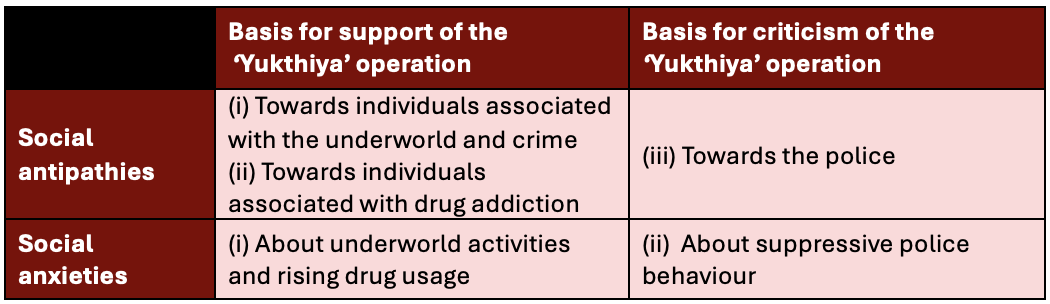
A closer observation of Sinhala media reporting on the ‘Yukthiya’ operation shows that support for or criticism of the operation appears to draw on existing social antipathies and anxieties. The antipathies and anxieties are in relation to three groups: the underworld, drug ‘addicts’ and the police. This week’s TMA aims to unpack these, with this analysis attempting to demonstrate how these antipathies and anxieties have been leveraged in the media to either justify and endorse the ‘Yukthiya’ operation or to oppose it (see Table 1 for a summary).
Table 1: Mapping out of the social antipathies and anxieties towards the three groups of actors that serve as the basis for support or criticism of the ‘Yukthiya’ operation
Entrenched social antipathies
The following section briefly expands on entrenched social antipathies within certain segments of Sri Lankan society towards three groups of actors. They include (i) those associated with the underworld and crime, (ii) those associated with drug addiction and (iii) the police. As mapped out in Table 1, media voices in support of the ‘Yukthiya’ operation appear to leverage the pre-existing antipathy towards groups (i) and (ii). By contrast, the existing antipathy towards group (iii) appears to serve as the basis for criticism of the ‘Yukthiya’ operation.
i. Antipathy towards individuals associated with the underworld and criminal activities
In the Sinhala media, individuals involved with the underworld and criminal activities are frequently depicted as a form of ‘evil’ that needs to be ‘done away with’.[1] In the past, especially during the administration of former President Mahinda Rajapaksa, this antipathy towards these individuals was leveraged to justify extrajudicial killings of suspected underworld figures, and it was popularly viewed as a ‘necessary evil’.[2]
At present, the same justificatory sentiment seems to undergird the endorsement of the ‘Yukthiya’ operation by certain media voices. These voices argue that the elimination or incarceration of individuals associated with crime and the underworld will remove evil and vices from society. For example, the privately-owned Divaina editorial openly contented that murder could be ‘justified’ when used to suppress underworld activities. Divaina newspaper has often justified police violence and/or extrajudicial killing of criminals and/or other individuals deemed as ‘evil’.[3] Similarly, state-owned Dinamina newspaper implied that the underworld can only be controlled through violent means.
ii. Antipathy towards individuals associated with drug addiction
In reportage on the topic of drugs in Sri Lanka, the Sinhala media periodically portrays the issue as a ‘drug menace’ afflicting the country, and that it needs to be eradicated.[4] This draws on the general antipathy within the Sri Lankan psyche towards drugs and other intoxicants closely associated with vice, criminality and a range of social ills.[5] This societal attitude (of disdain) has led to derogatory labelling of individuals associated with drug addiction as ‘kudda’ (trans. ‘druggie’ or ‘junkie’).[6]
Media voices supportive of the ‘Yukthiya’ operation appear to have leveraged this antipathy towards ‘drug addicts’ to endorse the operation as a necessary measure that could potentially eliminate the threat posed by drugs and free the country from the ‘drug menace’. For example, privately-owned Aruna newspaper explicitly stated that the ‘Yukthiya’ operation serves the purpose of creating a future that is unaffected by the danger of drugs. Similarly, Minister of Public Security Tiran Alles claimed that the ‘Yukthiya’ operation will be carried out until all traces of drug distribution and use have been eliminated from the country. These views mirror the long-standing public antipathy towards drug users, a sentiment that remains pervasive in society.
iii. Antipathy towards the conduct of the police
Criticism of the ‘Yukthiya’ operation in the Sinhala media primarily centred around the conduct of the police. Media voices criticised the police for its inability to safeguard ordinary citizens, suggesting that they act more as perpetrators of crime than protectors. This line of criticism appears to be rooted in underlying antipathy towards law enforcement on two grounds: (a) the mistrust of the police over its equal application/enforcement of the law and (b) the perceived nexus between politics, police and crime.
The first grounds is underscored by the perception that ‘Yukthiya’ disproportionately targets small-scale drug dealers and users rather than focusing on large-scale drug operations and organised crime. For instance, the privately-owned Lankadeepa editorial highlighted the incident in Narammala where a police officer allegedly accidentally discharged his firearm resulting in the death of an individual. This incident was portrayed as an example of the police’s heavy-handed approach towards ordinary citizens, indicative of a broader issue of unequal law enforcement and problematic police conduct.
The second grounds for antipathy is rooted in a long-standing perception of an overlap between the political, criminal and law enforcement spheres. In the past, politicians have been accused of maintaining ‘mutually beneficial relationships’ with the underworld for political ends, and that law enforcement personnel offer protection for such activities.[7] For example, privately-owned Siyatha[8] contended that there is a politician behind each underworld criminal, and that law and order is silenced before their influence. This line of reporting highlights the widespread scepticism about the integrity of the relationship between politics, crime and law enforcement in the country.
Voices supportive of the ‘Yukthiya’ countered the above lines of criticism of the police by reducing the police misbehaviour to individual misbehaviour. For example, Acting IGP Deshabandu Tennakoon condemned the actions of the police officer responsible for the Narammala shooting. Similarly, privately-owned Divaina newspaper framed the police officer responsible for the death as behaving ‘eccentrically’ on prior occasions as well. However, these views garnered only limited coverage.
Emerging social anxieties
Parallel to the social antipathies reflected in Sinhala media reporting, two social anxieties emerged in relation to underworld activities and police conduct. These anxieties also appeared to form a basis for support or resistance to the ‘Yukthiya’ operation (as illustrated in Table 1).
i. Anxiety related to underworld activity and drugs
Media coverage of underworld and criminal activities seems to have heightened a sense of fear and anxiety among people. For instance, privately-owned TV channels such as Hiru and Derana have consistently featured–and at times sensationalised–news relating to underworld activities and shootings. This regular coverage seems to have leveraged support to eliminate such unlawful activities.
Supporters of the ‘Yukthiya’ operation such as Deshabandu Tennakoon and Tiran Alles appear to use this heightened sense of anxiety to justify and endorse the operation. This heightened state of anxiety leads to the actions of the government being portrayed as ‘effective and necessary’, thereby potentially and gradually ‘normalising’ the methods employed in the ‘Yukthiya’ operation.
ii. Anxiety related to ‘Yukthiya’ as a tool of suppression by the police
Critics of the ‘Yukthiya’ operation expressed concerns that it is being used as a suppressive tool to oppress people through unequal application of the law and excessive use of police power. These viewpoints aired through TV channels such as Siyatha and Sirasa as well as memes circulated on social media scrutinised the functionality of law enforcement and highlighted issues of corruption and abuse of power within the police force, especially within the politics-crime-police nexus described above. An anxiety that the arrests taking place under the ‘Yukthiya’ operation may continue to operate beyond legal boundaries, potentially leading to an overreach of police power, appears to emerge from the criticism of the ‘Yukthiya’ operation being used as a suppressive tool.
Overall, Sinhala media coverage of the ‘Yukthiya’ operation has reflected an interplay of three entrenched social antipathies and two social anxieties associated with the underworld and criminal activities, the prevalence of the drug ‘menace’ and police conduct. While there is a strong negative sentiment towards criminals and drug addicts, seen as symbols of moral decay, there is also a notable resistance and mistrust towards the police. However, the prevailing social anxiety about underworld activities and the drug problem may lead to a ‘normalisation’ of the ‘Yukthiya’ operation and its tactics deployed to arrest individuals connected to the underworld and criminal and drug-related activities.
[1] In accordance with TMA’s methodology to monitor social media, the TMA team filtered the 10 posts with the highest interactions on Facebook in Sinhala for the terms Yukthiya operation, police and murder using CrowdTangle, from January 22 to February 2.
[2] For more information, see https://sri-lanka.mom-gmr.org/en/owners/individual-owners/detail/owner/owner/show/alles-family/.
[3] See TMA Vol.02, #41; Vol.07, #09; Vol.08, #32.
[4] See TMA Vol.07, #09.
[5] For more information, see https://web.facebook.com/ethicseye/posts/pfbid02vFerAewmEh9DJsKijG9sfBCryH8U7y9YEpiZ4bSLv7oQFzu8otP9FXVC7FokPQzPl and https://web.facebook.com/ethicseye/posts/pfbid0rThrfhopwBq3PmzLijadJxqasEec49gdaxpZkFci5jrMJhs2MqzcuYwkJ1RryAG3l.
[6] See TMA Vol.09, #04 and Vol.09, #14.
[7] See TMA Vol.09, #07 & 08 and Vol.13, #01.
[8] For more information, see https://twitter.com/EthicsEye/status/1522565594301669377 and https://www.instagram.com/p/C0g0uutBUTY/.
[9] See TMA Vol.04, #01; Vol.07, #09; Vol.08, #27.
[10] https://www.youtube.com/watch?v=zVZ1_ri_7xA&t=1192s.
02. The Language Divide
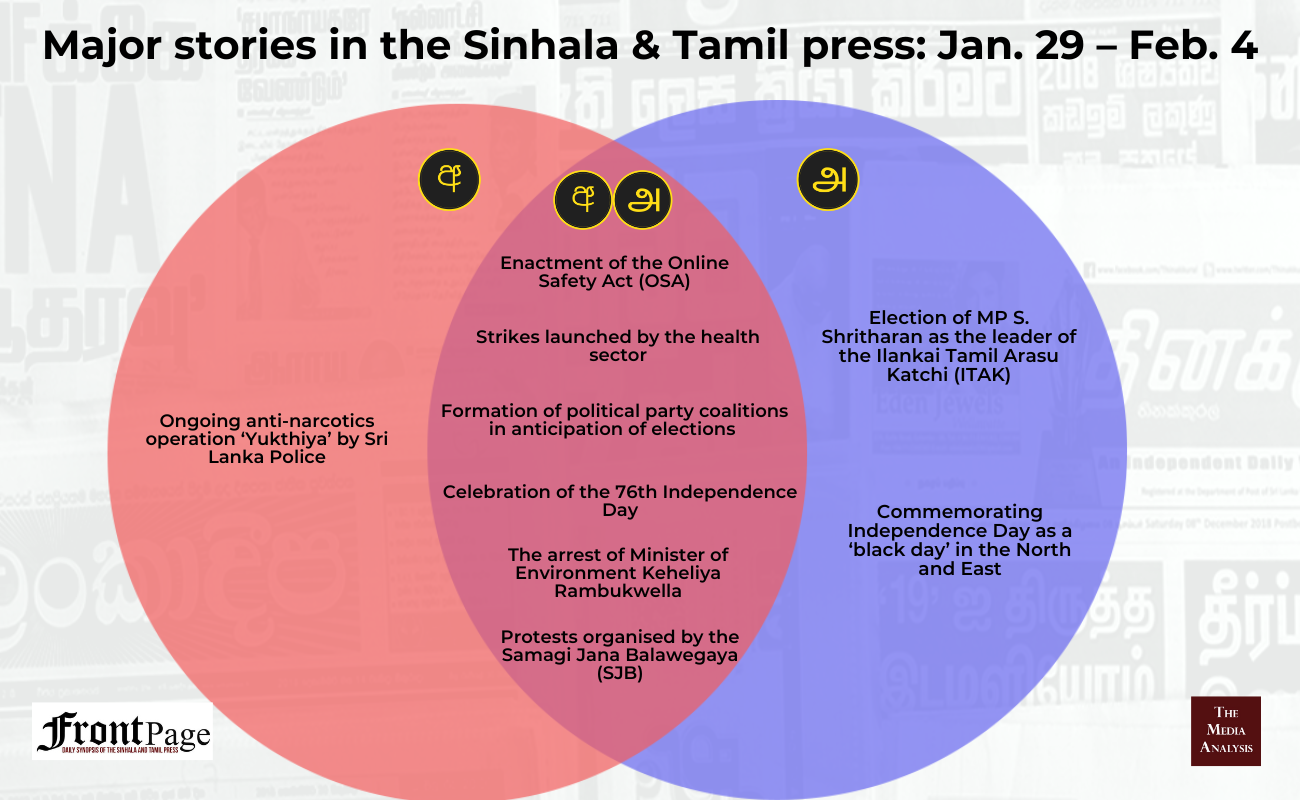
Do you want to see the divided priorities on a daily basis? Check out FrontPage. It captures the day’s headlines and features succinct summaries of the political news reported in the most widely read Sinhala and Tamil newspapers.
03. The TV coverage of the issue
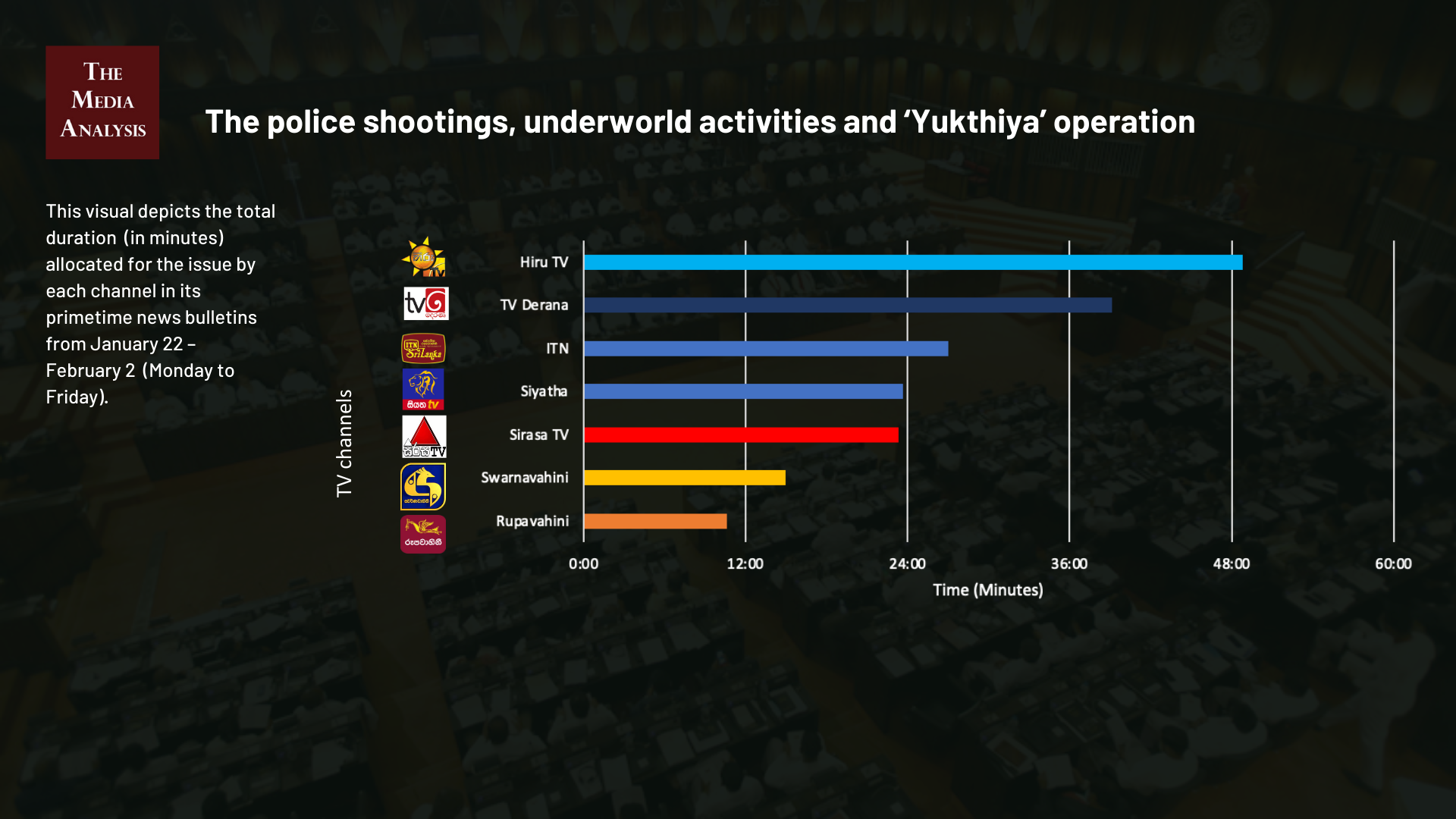
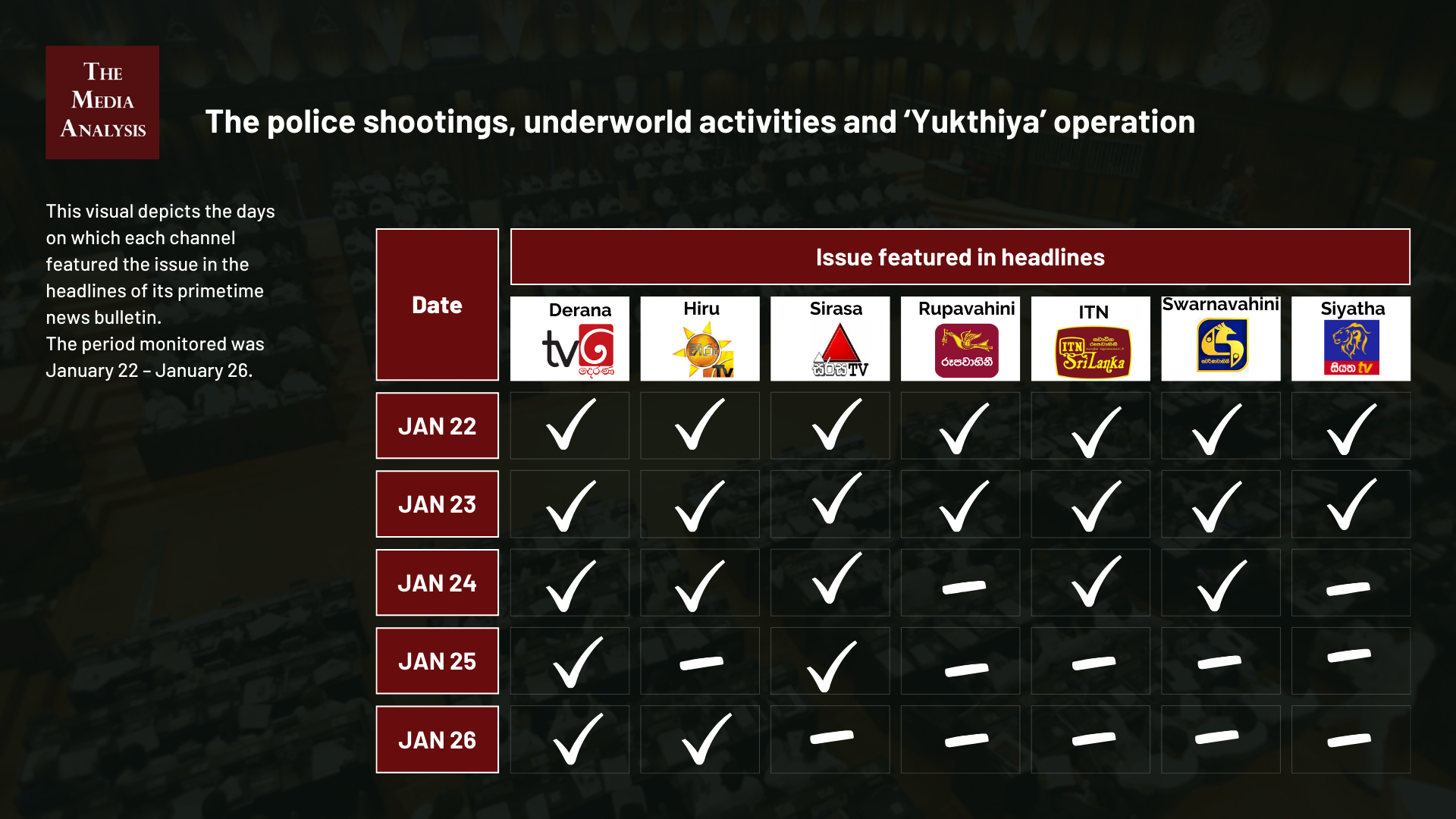
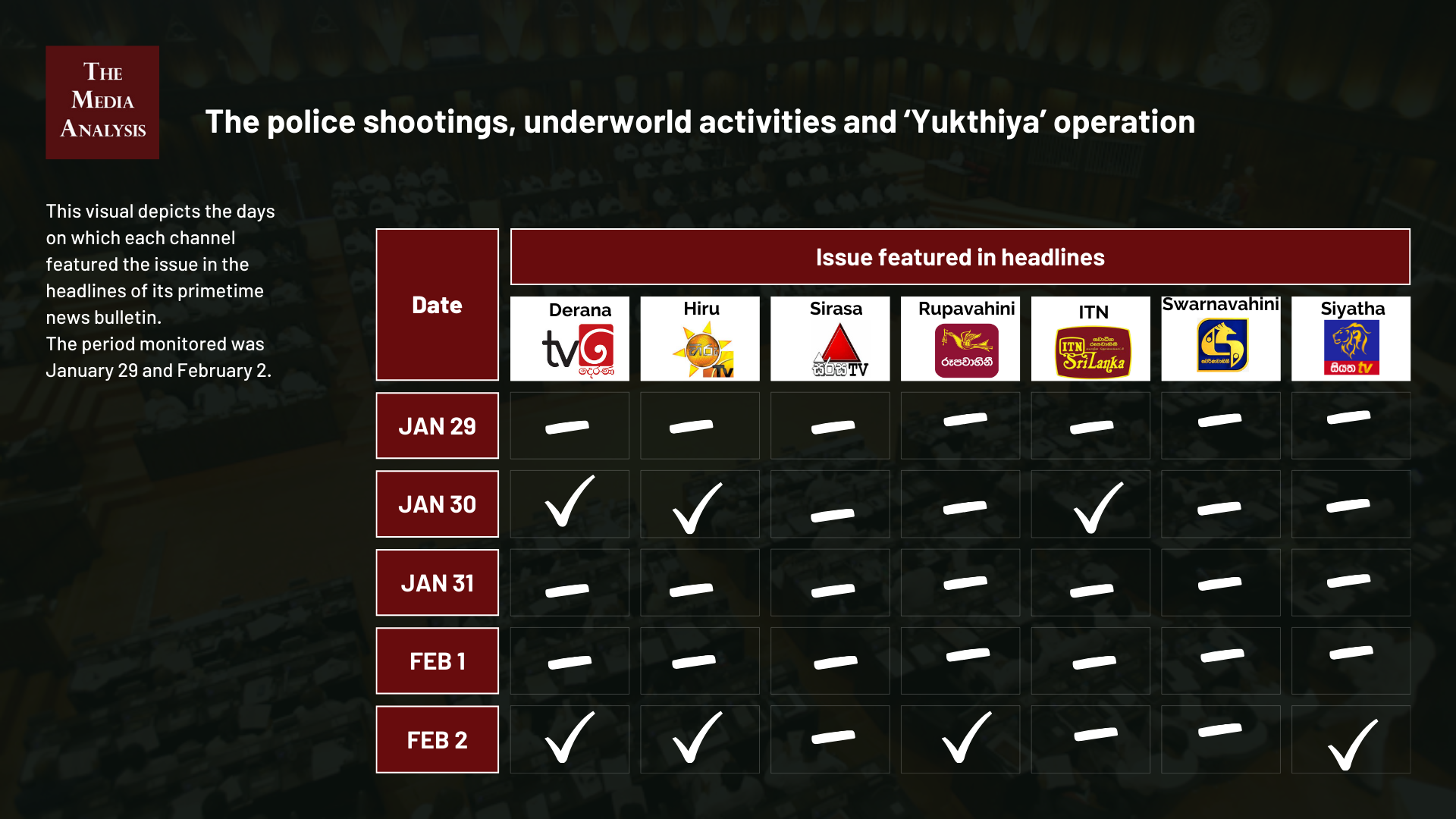
The data on television coverage is based on the monitoring of the primetime news telecasts of selected Sinhala language TV channels uploaded to YouTube.
04. This week’s cartoons
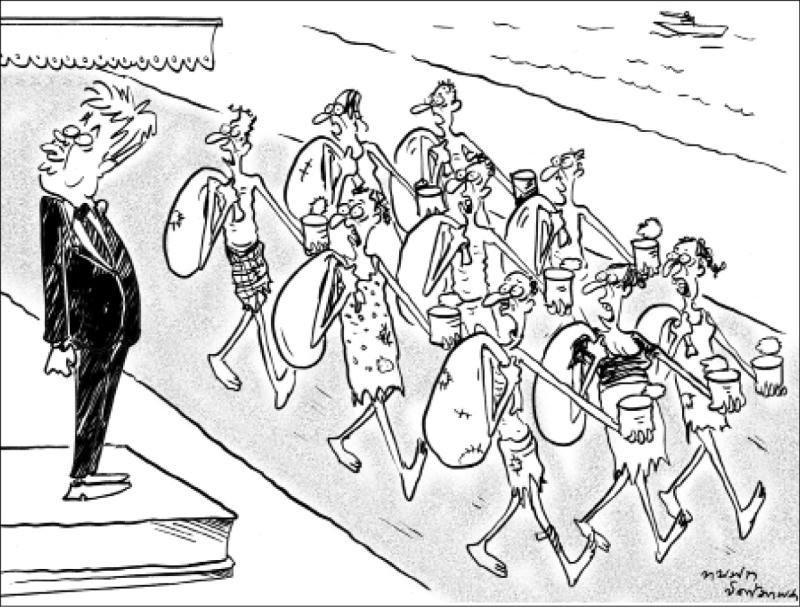
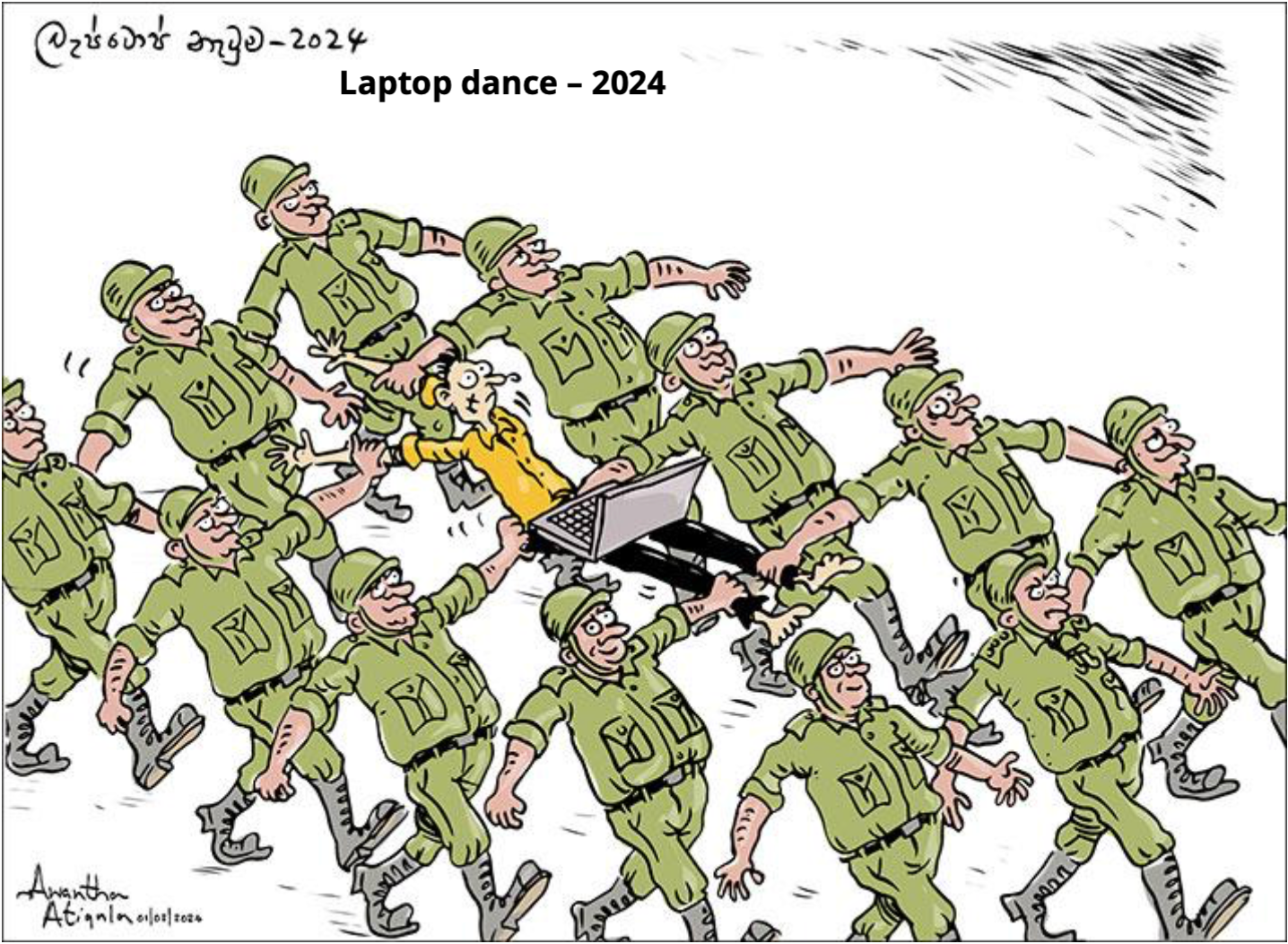
Courtesy of Ada, Jan.31, 2024
Context: In 2018, a video of a group of school students practicing a dance carrying laptops during Independence Day rehearsals was circulated on social media. The Sri Lankan authorities removed the dance item after it received criticism on social media.

05. This week’s memes
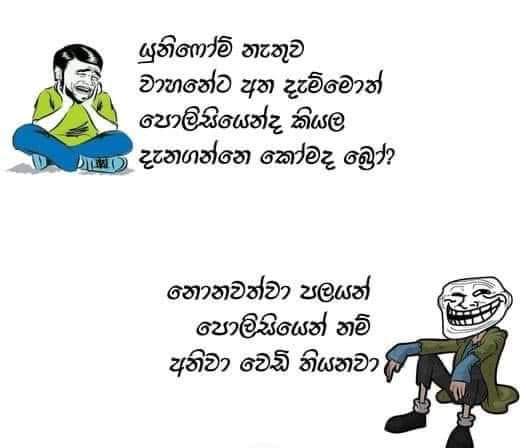
If someone who is not in [police] uniform signals to stop the vehicle, how do you know if it is the police, bro?
Just drive on without stopping
If it is the police, they will shoot for sure
Context: On January 18, 2024, a lorry driver was killed after a police officer in civilian clothing was reported to have ‘accidentally’ discharged his firearm during a vehicle inspection.
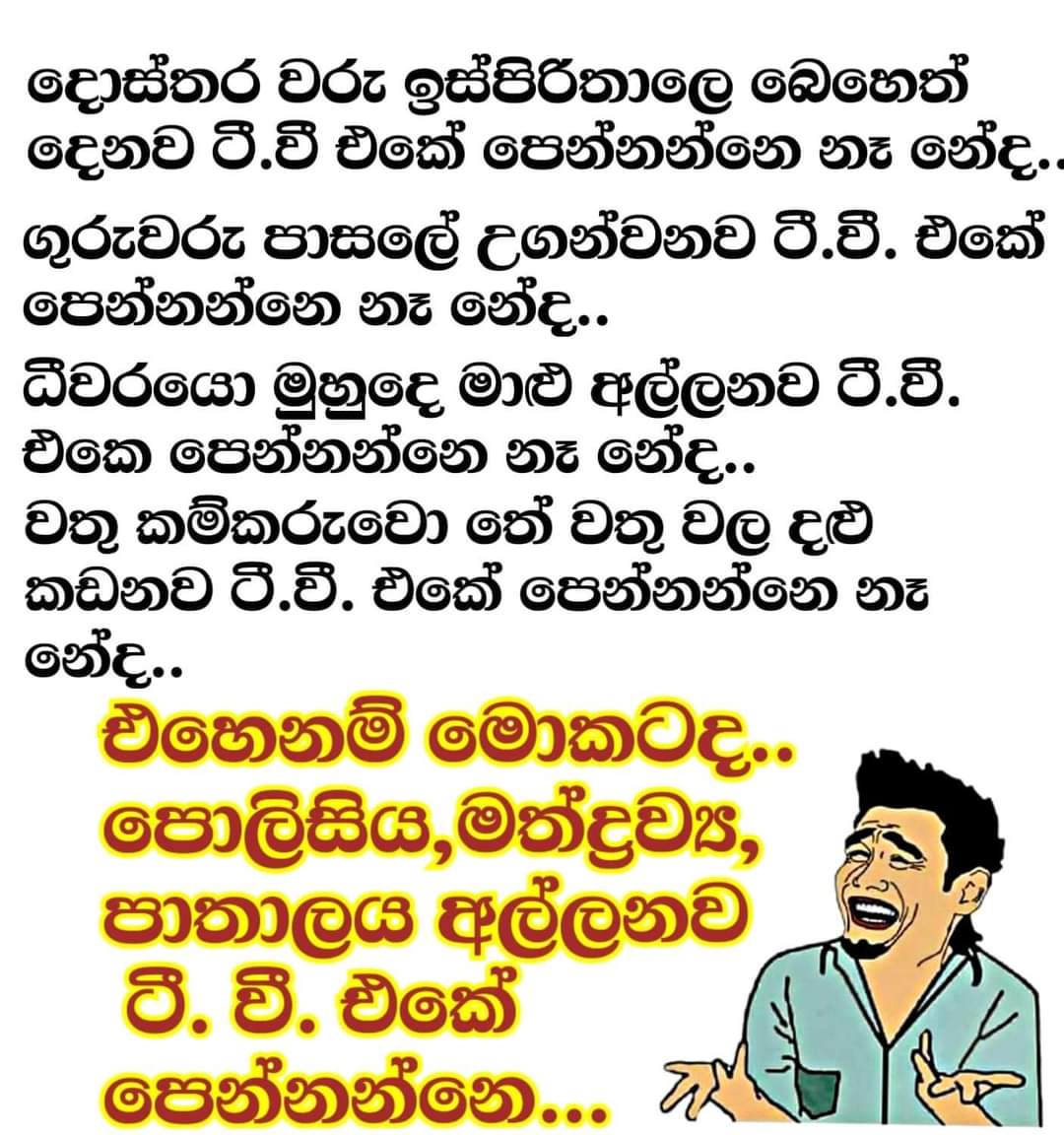
They do not show doctors treating patients in hospitals on TV, do they?
They do not show teachers teaching in schools on TV, do they?
They do not show fisherfolk fishing in the sea on TV, do they?
They do not show estate workers plucking tea leaves on the plantations on TV, do they?
If so, why on earth do they show the police apprehending drugs and the underworld on TV?
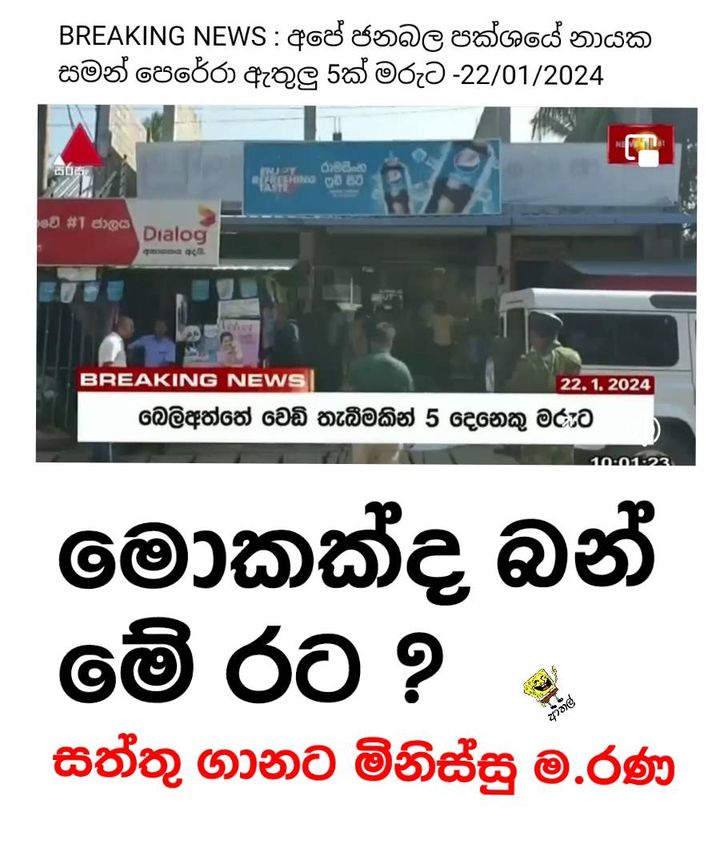
Breaking news: Five people including the Leader of the Our Power of People Party Saman Perera have been killed – 22/01/2024
Five people dead in the Beliatta shooting
What on earth is this country where people are killed like animals?
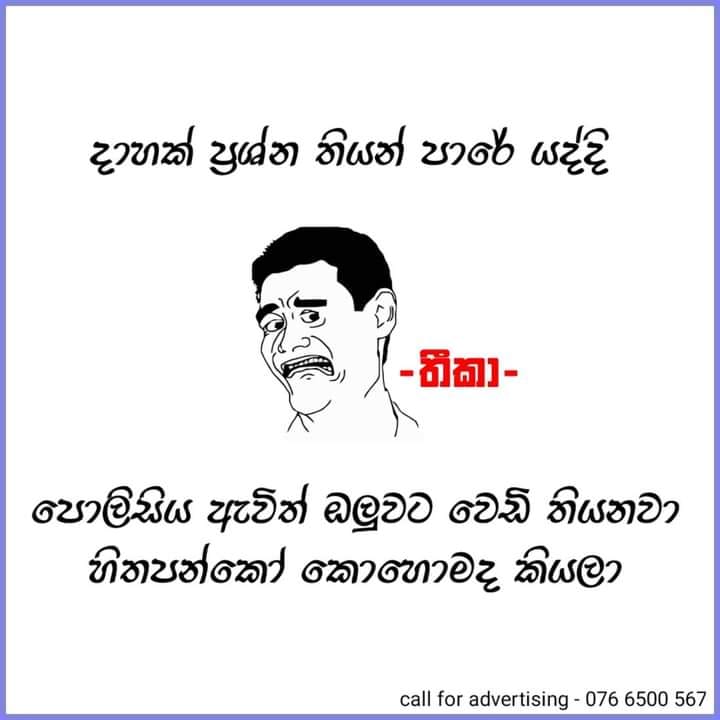
When you are walking on the road with a thousand worries in your head, the police come and shoot you in the head. How do you think that feels?
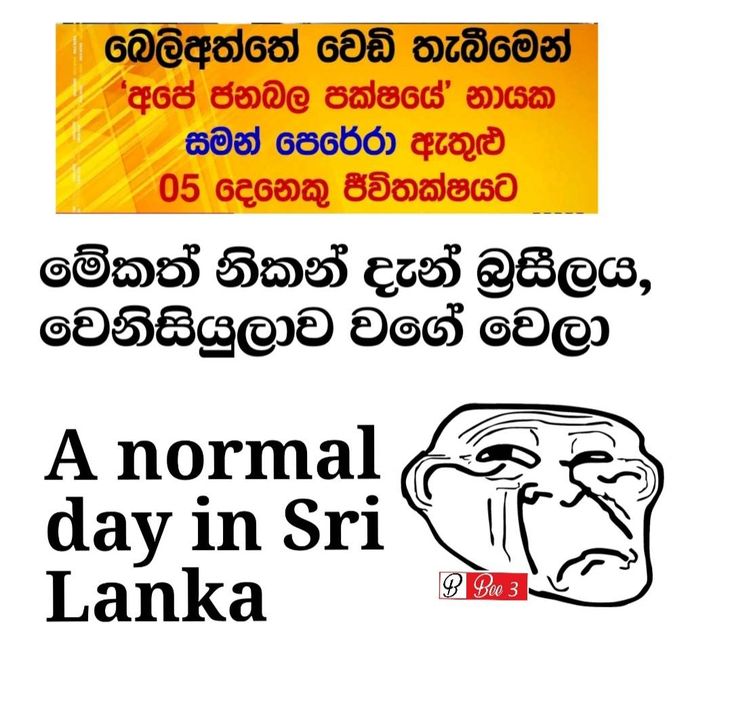
Five people including the Leader of the Our Power of People Party Saman Perera have been killed in the Beliatta shooting
This has also become just like Brazil and Venezuela now
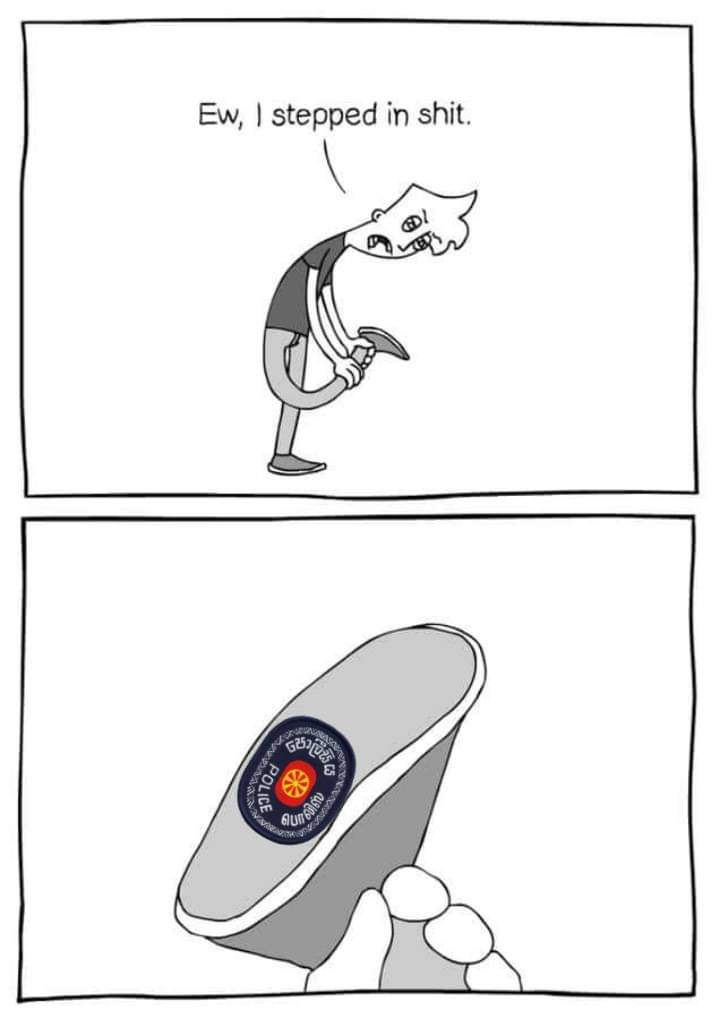
Sri Lanka Police
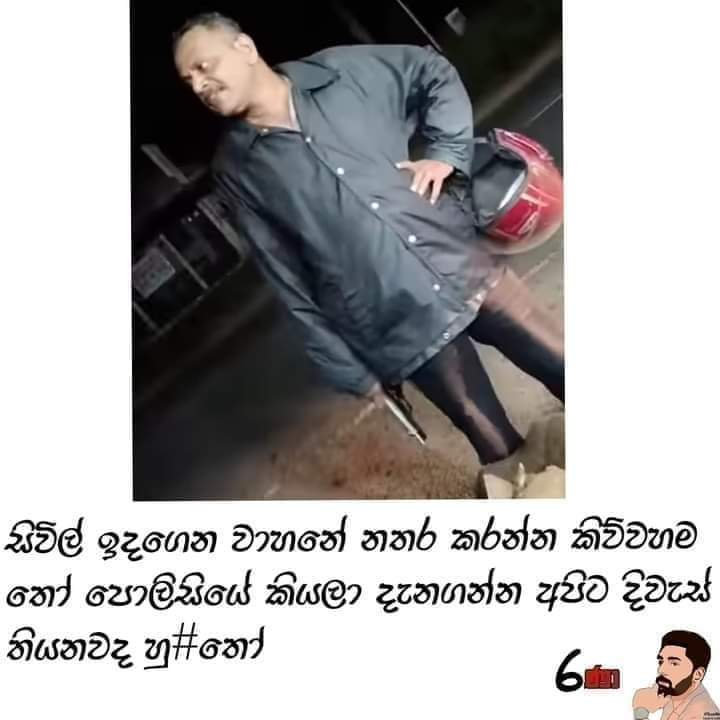
When you [police] dress in civilian garb and ask us to stop the vehicle, do we have clairvoyance to know that you are the police, you f*****?
06. Other topics covered in reportage
- Lifting of the ban on Sri Lanka Cricket (SLC) by the International Cricket Council (ICC)
- Increase in the prices of essential goods
- Reported increase in prices of fuel
- Death of State Minister Sanath Nishantha in a car accident
- Discussion about the economic crisis
To view this week’s news summaries, please click here