
PublicFinance.lk
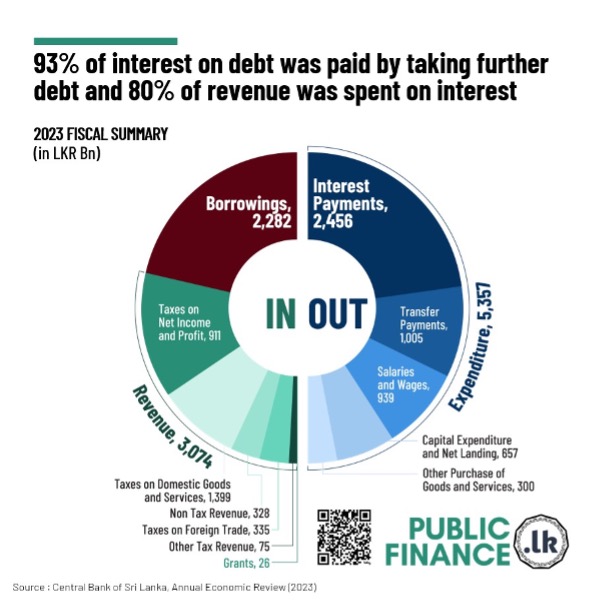
Interest payments amounted to LKR 2.5 trillion in 2023, 93 percent of which was financed through borrowings, and 80 percent of government revenue for 2023 was spent on interest on previously accumulated debt.
To find out how the government financed its other expenditure, click here
This week in The Media Analysis...
Double issue
01. Referendum story creates widespread anxiety
02. The Language Divide
03. The TV coverage of the issue
04. This week’s cartoons
05. This week’s memes
06. Other topics covered in reportage
Past issues can be viewed here
Disclaimer: This week’s TMA focuses on the preparations of political parties and coalitions in anticipation of an upcoming election.
01. Referendum story creates widespread anxiety
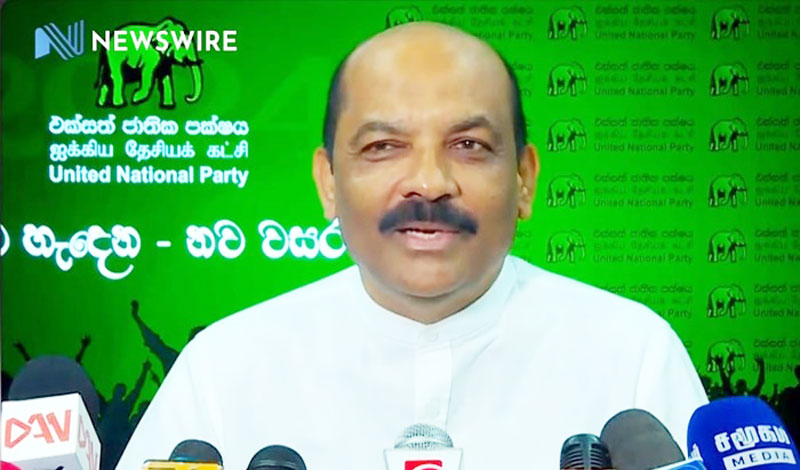
Photo credits: DailyFT
Event: At a press conference on May 28, UNP General Secretary Palitha Range Bandara called for a referendum to postpone both the presidential and parliamentary elections by two years.[1][2][3][4] He noted that this would allow President Ranil Wickremesinghe to continue the country’s economic transformation.[5][6][7][8] Calling on the SJB and the NPP to back the postponement, he stated that the delay would correspond with an extension of the current parliament’s tenure, along with the option of carrying out a referendum, if necessary.[9][10][11][12]
Analysis
Sinhala print reportage, TV coverage and social media commentary were overwhelmingly critical of the proposal made by Range Bandara to postpone the presidential and parliamentary elections by two years.[1]
This week’s TMA will explore in two parts the current dynamics of the Sinhala media discourse amid the heightened political competition leading up to the anticipated election. The first part will unpack three narratives on Range Bandara’s statement. Each narrative is centred around opposing perspectives, with one perspective dominating the Sinhala media discourse. The second part will briefly map out the positioning and media support of each political party/coalition.
Part I
Below is a brief analysis of the three narratives discerned from the media debate on Range Bandara’s statement.
Narrative I: Source of Range Bandara’s statement
The two contesting perspectives are that: (a) Range Bandara spoke on behalf of the president and (b) Range Bandara expressed a purely personal opinion.
Privately-owned Mawbima and NPP MP Vijitha Herath framed Range Bandara as a ‘pawn’ of President Wickremesinghe. These voices criticised the statement as a ‘tactic’ deployed by Wickremesinghe to test public acceptance of a potential referendum to extend his presidency without elections. This was the dominant view.
In what might be seen as ‘damage control’, voices within the UNP – including Director-General of Presidential Trade Unions Saman Rathnapriya and MP Wajira Abeywardana – distanced the party from Range Bandara’s statement, framing it as Range Bandara’s personal opinion. Except for the state media, the rest of the mainstream media did not back the counternarrative.
Narrative II: Presidential prospects of Ranil Wickremesinghe (RW)
The two contesting perspectives are that: (a) RW expects to win the presidential election and (b) RW expects to be defeated if there is a presidential election.
Up to the point of Range Bandara’s statement, the UNP was gaining momentum by exuding confidence that RW has been successful in his position and expected an endorsement of that at a presidential election.
Following Range Bandara’s statement, however, the view emerged that RW expects to be defeated and fears a presidential election for that reason. Since the dominant view is that Range Bandara’s statement was a ‘proxy move’ by RW, the view that he does not expect to win an election has become the more dominant view in that narrative.
Narrative III: Public reaction to Range Bandara’s statement
The two contesting perspectives are that: (a) Range Bandara’s proposal to postpone elections is democratic and (b) Range Bandara’s proposal to postpone elections is undemocratic.
Range Bandara’s statement positioned the referendum as not contrary to democratic principles. He proposed that it would entail elected representatives in parliament first passing a motion, followed by a referendum in which the democratic will of the people will have the final say.
But the dominant view characterised the proposal as one that would undermine a fundamental aspect of a healthy democracy, which is timely elections. This criticism is also rooted in a negative political memory. In 1982, under the first executive president of Sri Lanka (J. R. Jayewardene) a national referendum was held instead of a general election to continue with the then government. This move has since been etched in political memory as an infamous ‘anti-democratic act’ (referred to in Sinhala as the laampu kalagedi sellama – trans. lamp and pot game), and is viewed as a ‘black mark’ in Sri Lanka’s democratic history.[2]
Overall, the proposal to postpone elections has backfired, undermining the UNP’s narrative of gaining momentum and diminished media support for Wickremesinghe (refer to the cartoons featured in this TMA issue). It has also positioned Wickremesinghe as desperate and lacking a means to gain credibility.
Part II
Positioning of political parties/coalitions and media support
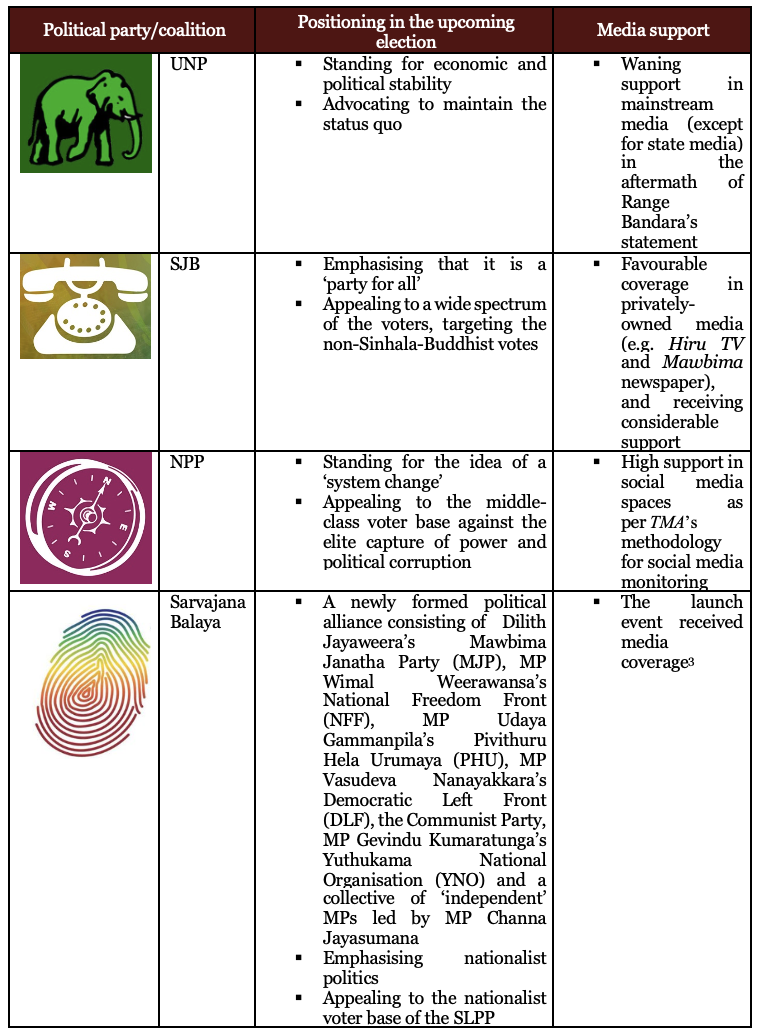
The following table maps out the political positioning of several parties/coalitions and the media support as discerned from media reporting over the last two weeks.
A negative narrative that has grown around Wickremesinghe in the last two years is that of a ‘power-hogging, manipulator’.[4] This is linked to his presidency which started with an unelected rise to office, and has been marked by heavy-handed suppression of democratic dissent, the introduction of suppressive laws, preventing local government elections by withholding funds[5] and bullying the judiciary into submission.
Therefore, the present proposal to avoid the presidential election has also caused a heightened sense of anxiety in the country. This is because the referendum proposal has made it clear that Wickremesinghe now also knows that he is unlikely to win an election, while being seen at the same time as diabolical and not willing to give up power.
Thus, Wickremesinghe’s ‘proxy move’ to test the waters of postponing the elections has significantly heightened the democratic anxiety and uncertainty within the Sri Lankan society over whether an election will take place on time. There seems to have been a negative reaction in the stock market as well.[6]
The Wickremesinghe-UNP position has been that it would be the party that can provide economic and political stability. But its ‘revealed fear’ of facing an election has now undermined that positioning. It might be seen as a high-risk source of instability, until the excessive uncertainty created is resolved by the holding of a presidential election by October 2024.
|
02. The Language Divide
Signposts the differences and nuances in reporting between Sinhala and Tamil language newspapers
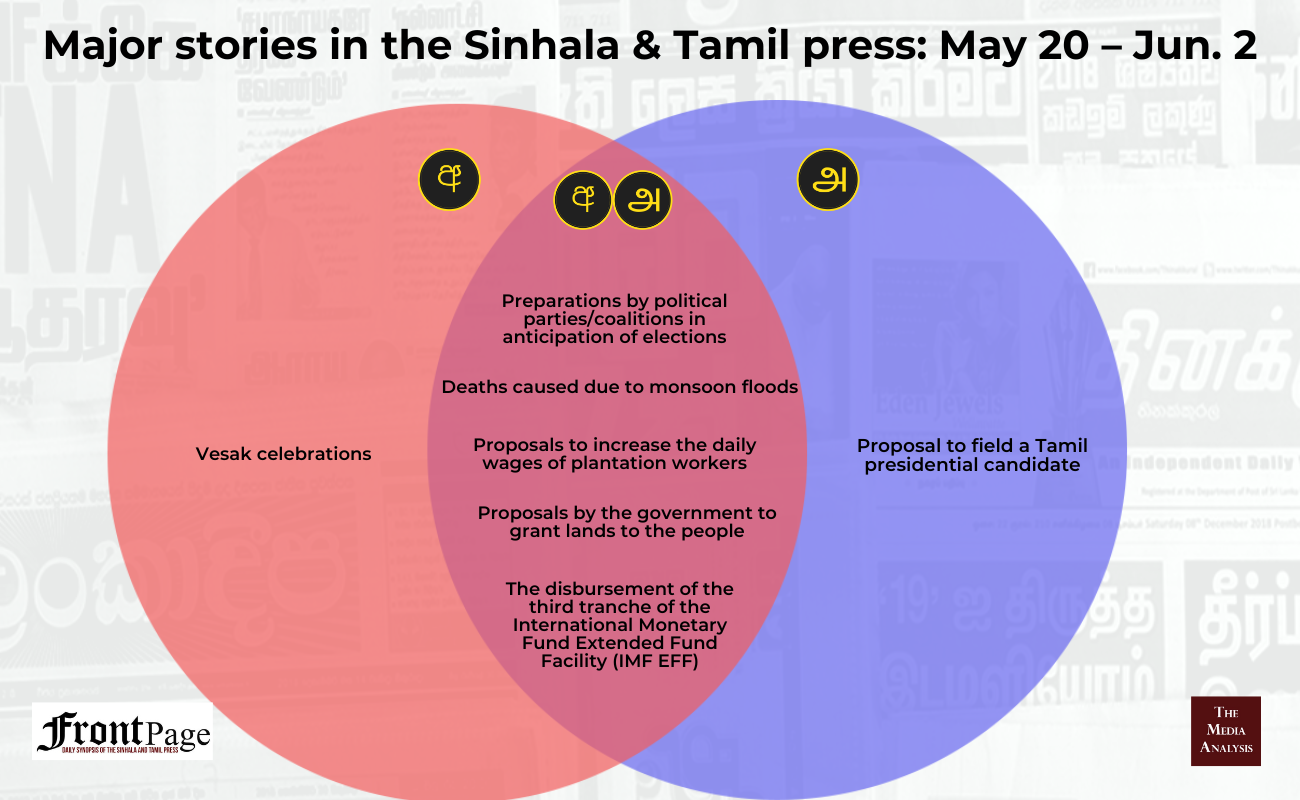
The last two weeks’ Sinhala and Tamil press converged in relation to five main stories. The five stories were on the: (i) preparations by political parties/coalitions in anticipation of elections; (ii) deaths caused due to monsoon floods; (iii) proposals to increase the daily wages of plantation workers; (iv) proposals by the government to grant lands to the people; (v) the disbursement of the third tranche of the International Monetary Fund Extended Fund Facility (IMF EFF)). The Sinhala press exclusively featured the Vesak celebrations and the Tamil press exclusively featured the proposal to field a Tamil presidential candidate.
Do you want to see the divided priorities on a daily basis? Check out FrontPage. It captures the day’s headlines and features succinct summaries of the political news reported in the most widely read Sinhala and Tamil newspapers.
Calls to boycott footwear with the karthigai poo: How did TV channels cover it?
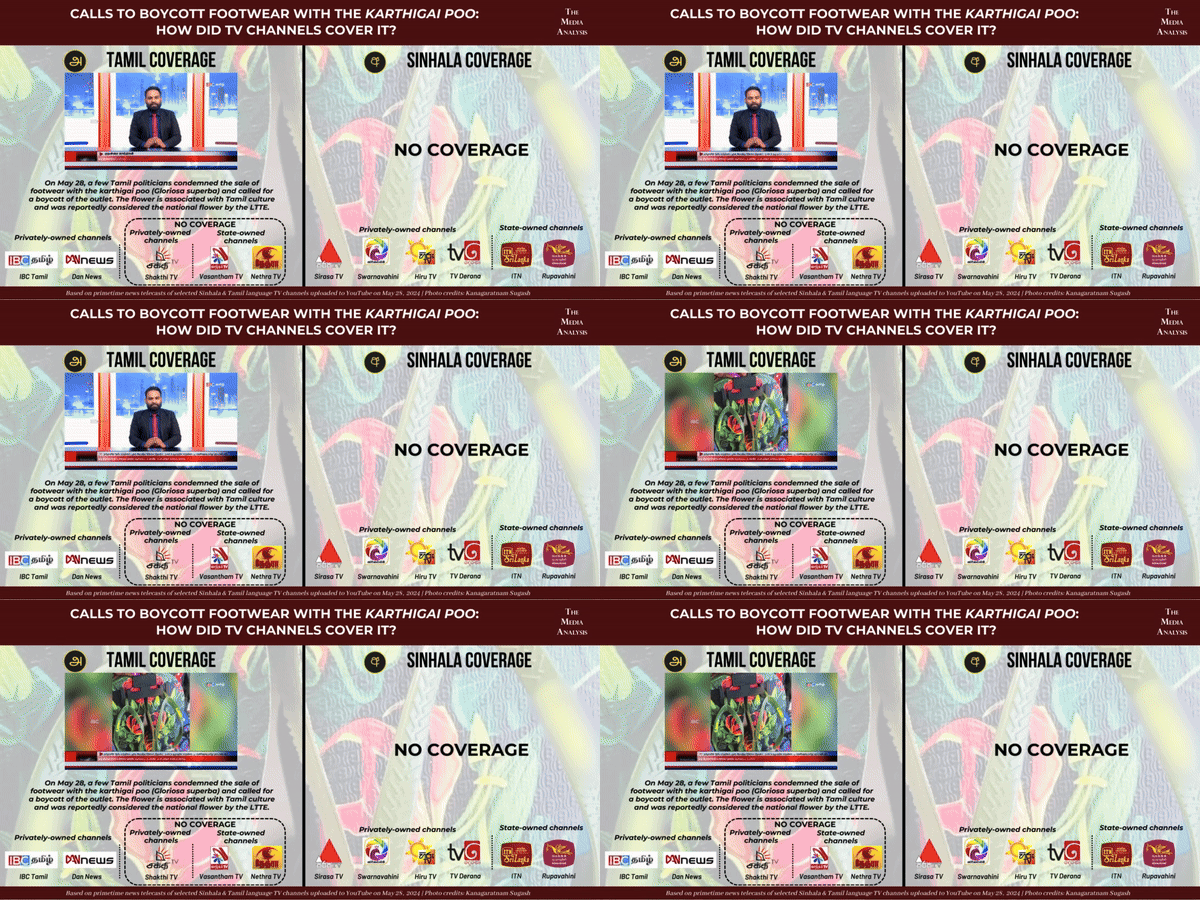
On May 28, a few Tamil politicians condemned the sale of footwear with the karthigai poo (Gloriosa superba) and called for a boycott of the outlet. The flower is associated with Tamil culture and was reportedly considered the national flower by the LTTE. Only privately-owned Tamil channels IBC Tamil and Dan News covered the incident.
03. The TV coverage of the issue
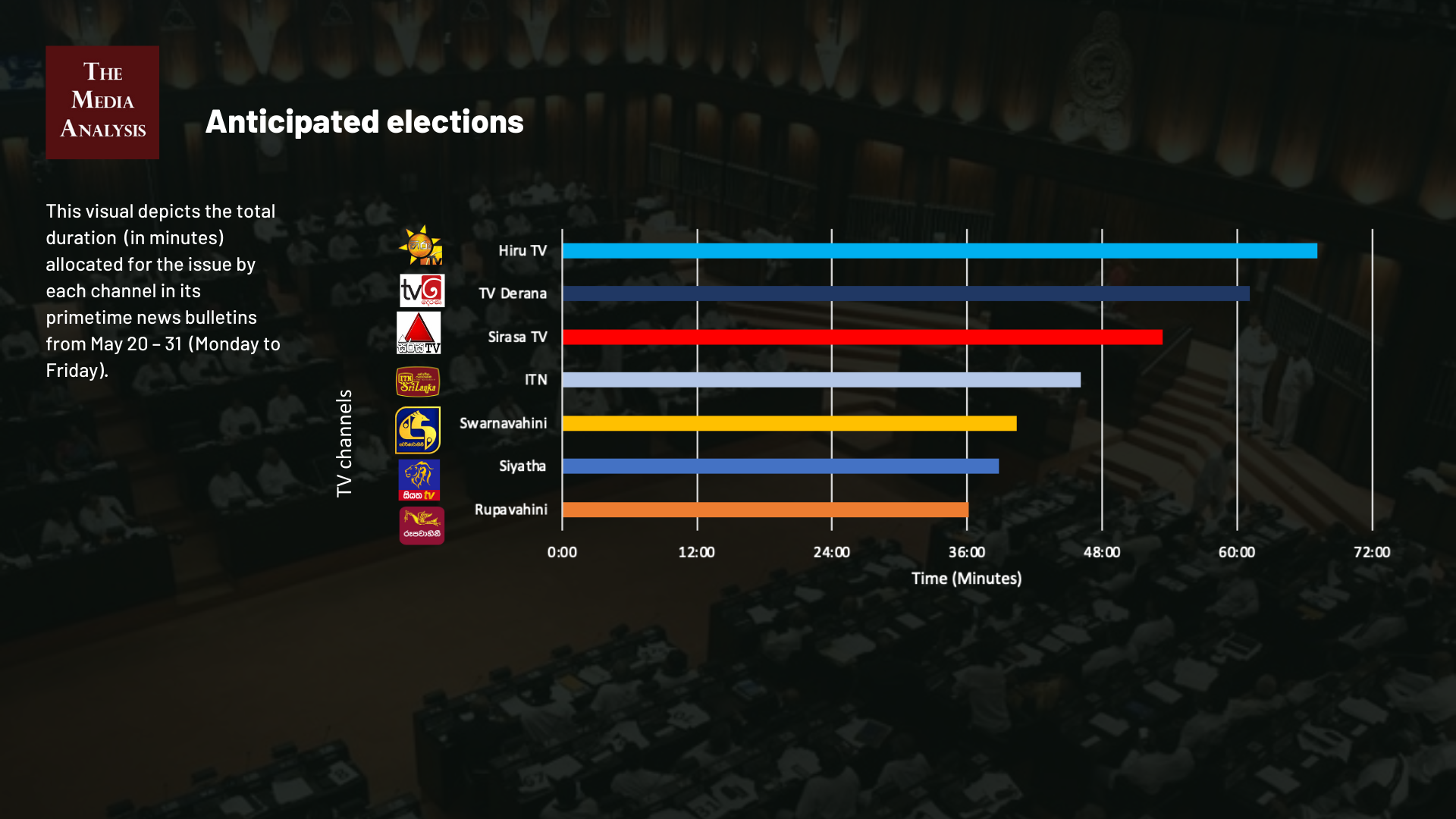
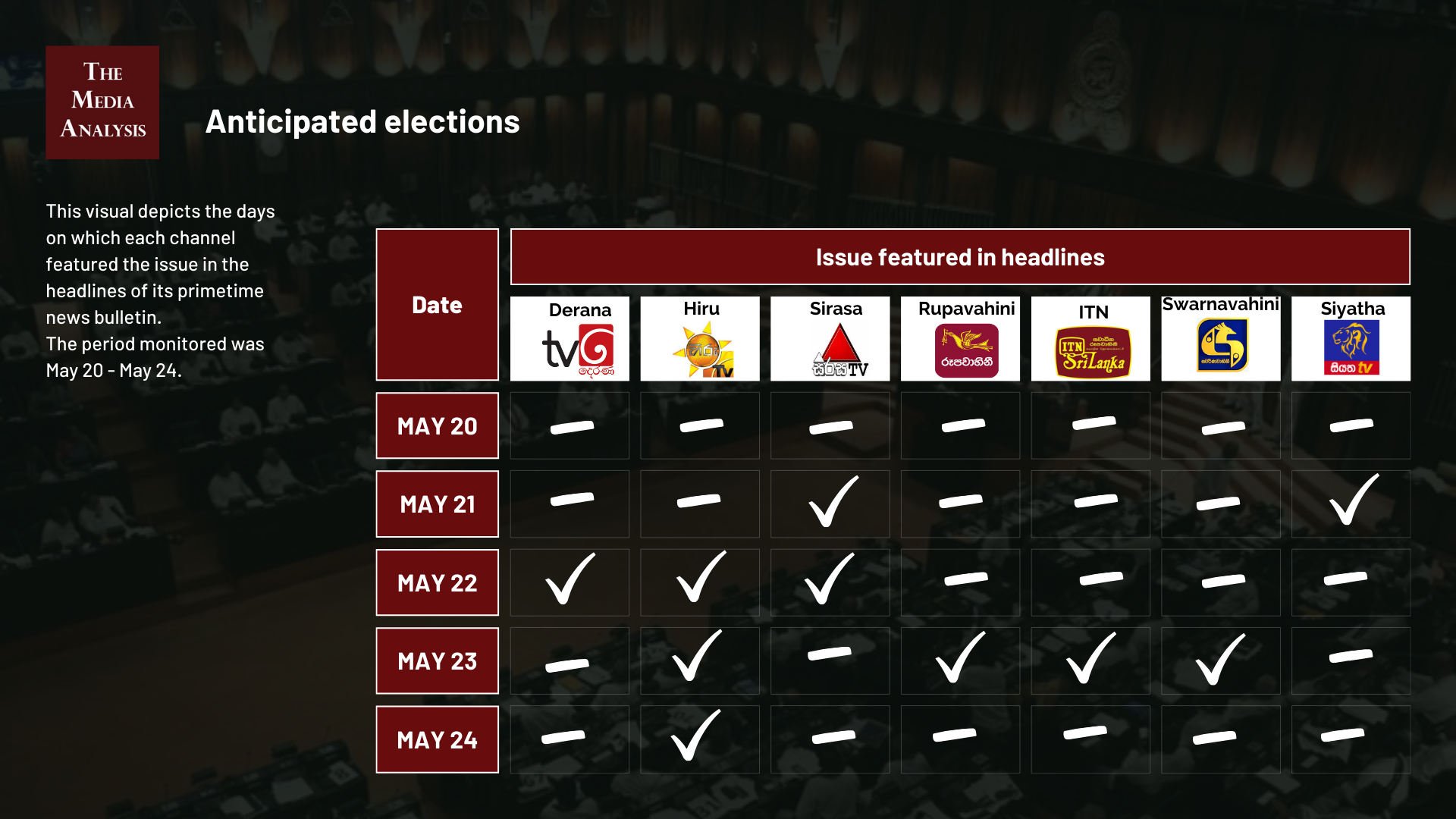
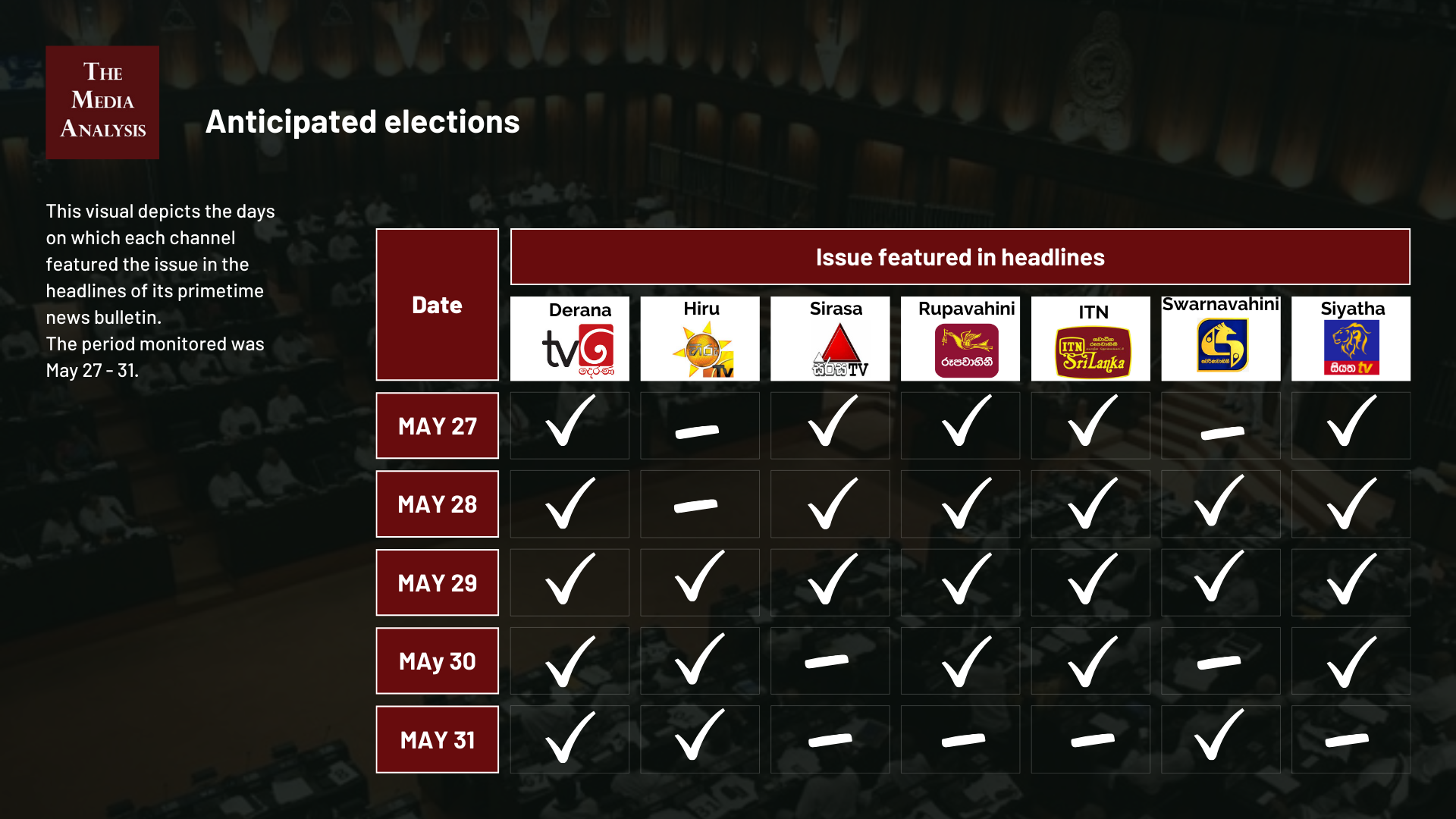
The data on television coverage is based on the monitoring of the primetime news telecasts of selected Sinhala language TV channels uploaded to YouTube.
04. This week’s cartoons
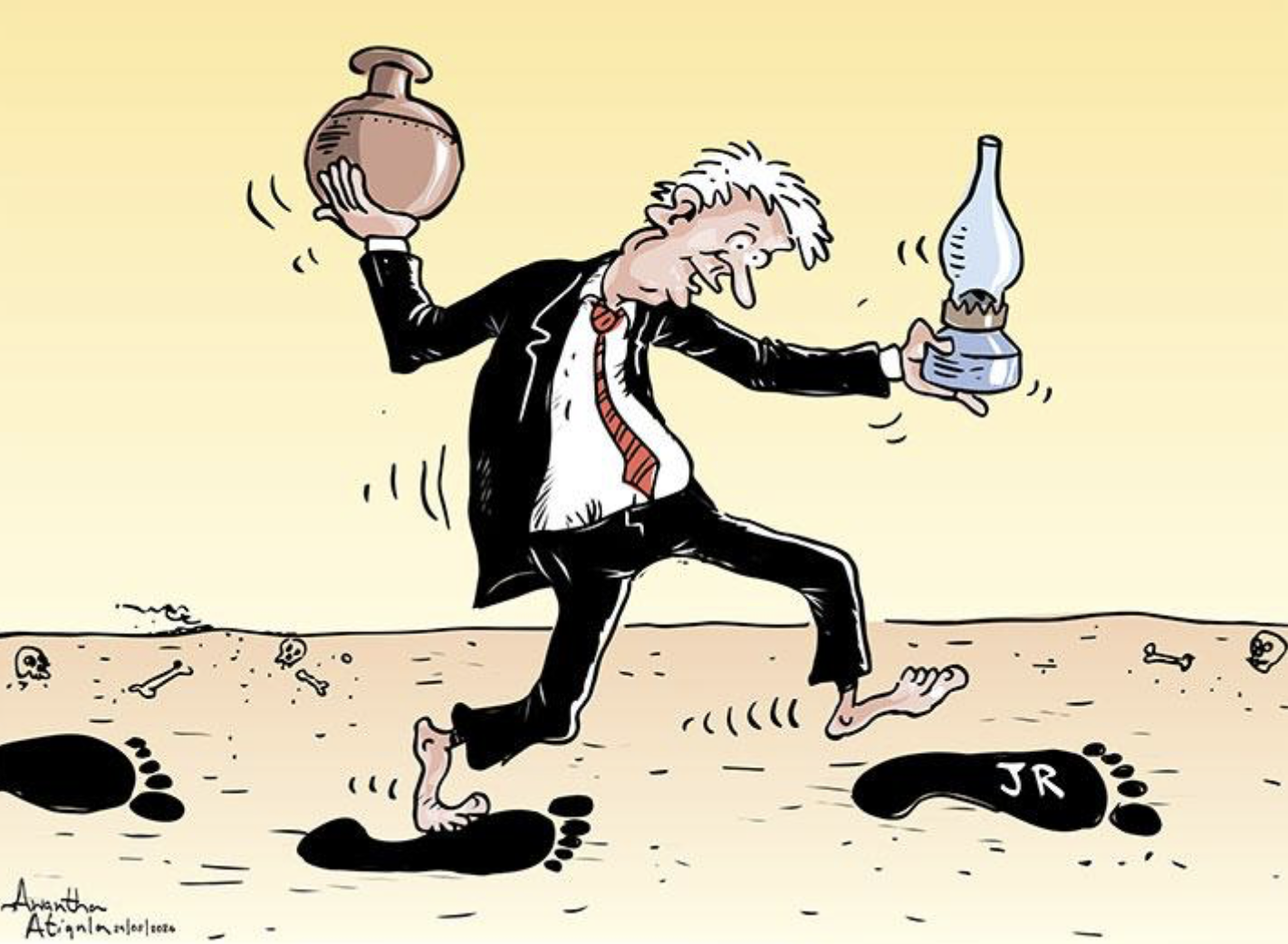
Courtesy of Ada, May 29, 2024
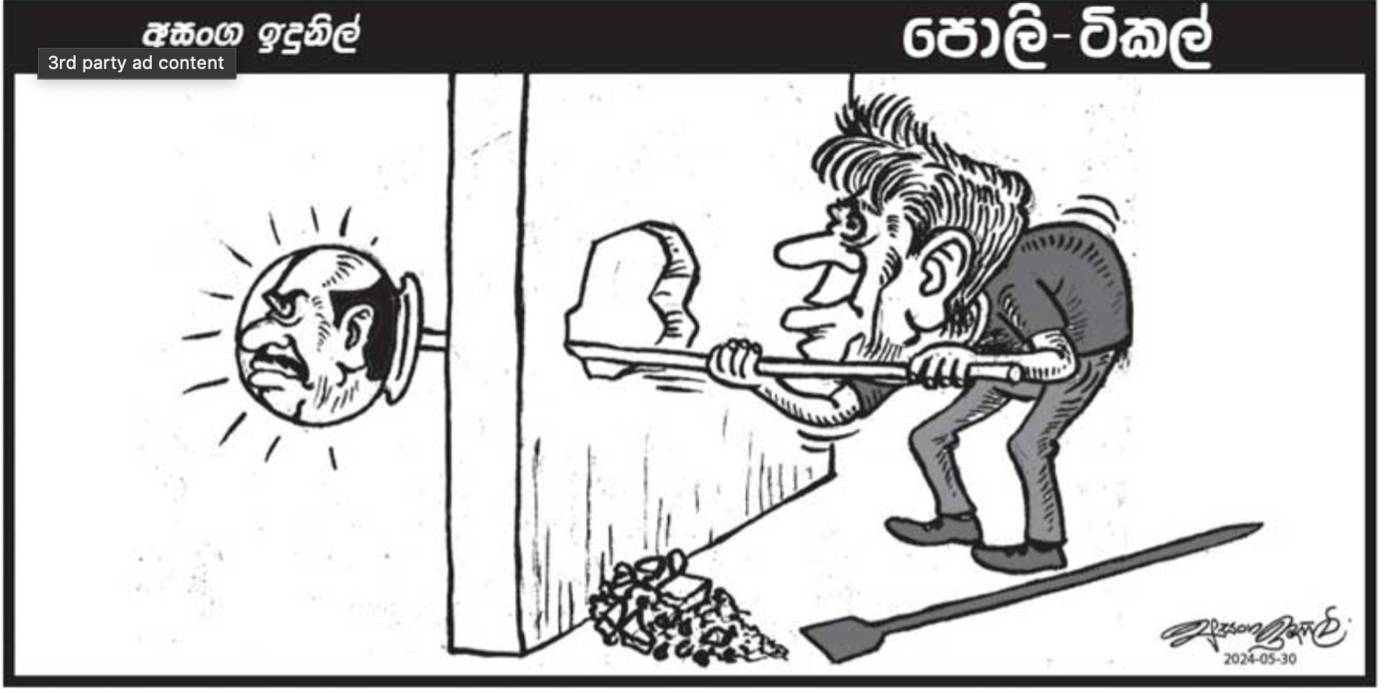
Courtesy of Lankadeepa, May 30, 2024
Context: Historically, burglars in Sri Lanka had a habit of first inserting a pot through the wall of the house they wished to rob. Vigilant residents would attack the pot indicating to the burglars that it was not safe to rob that particular house. This has translated in Sinhala into an analogy where “muttiya daanawa/putting the pot in” implies that someone (Ranil Wickremesinghe via Palitha Range Bandara in this case) is testing the waters/sending a trial balloon to take certain measures.
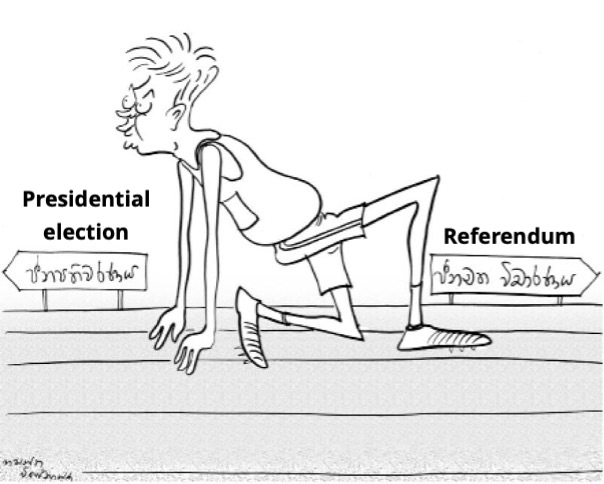
Courtesy of Aruna, May 29, 2024
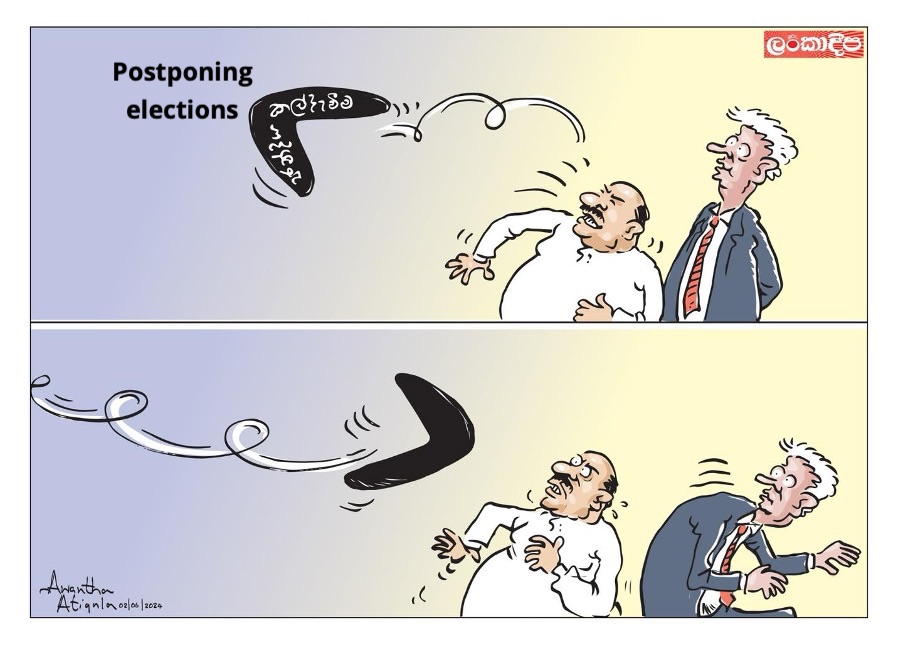
Courtesy of Sunday Lankadeepa, Jun.2, 2024
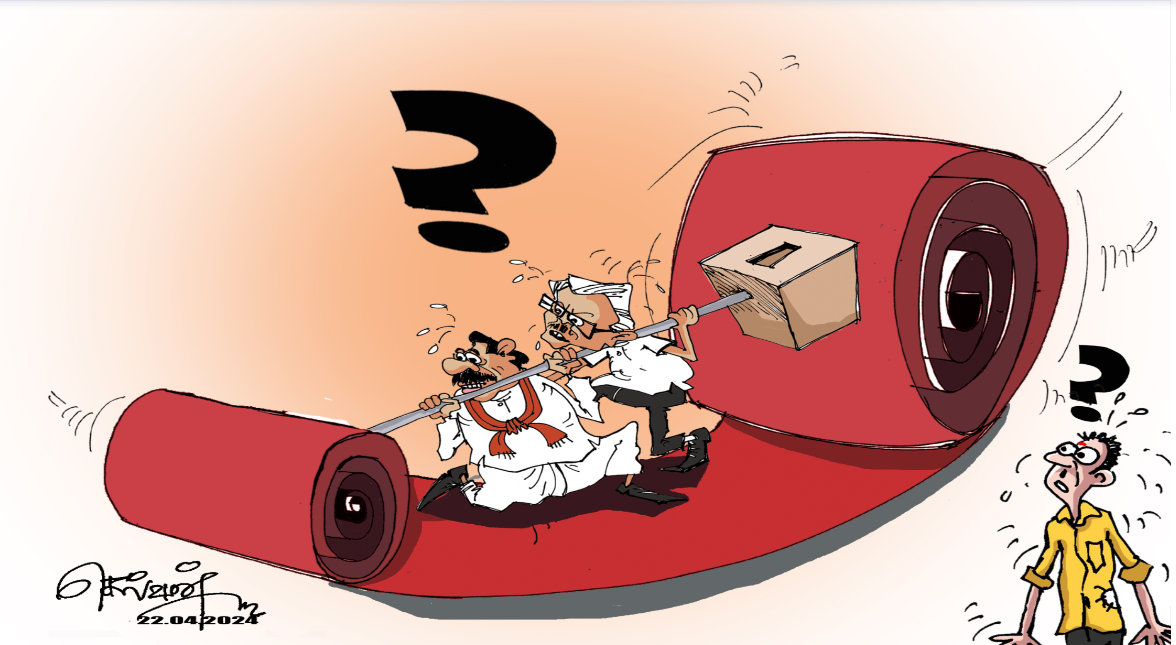
Courtesy of Virakesari, Apr.22, 2024
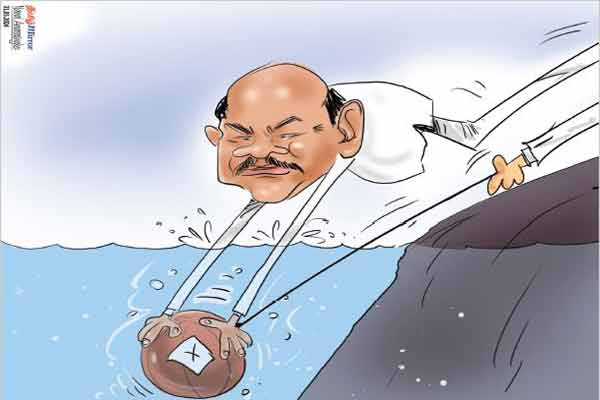
Courtesy of Tamil Mirror, May 31, 2024
05. This week’s memes
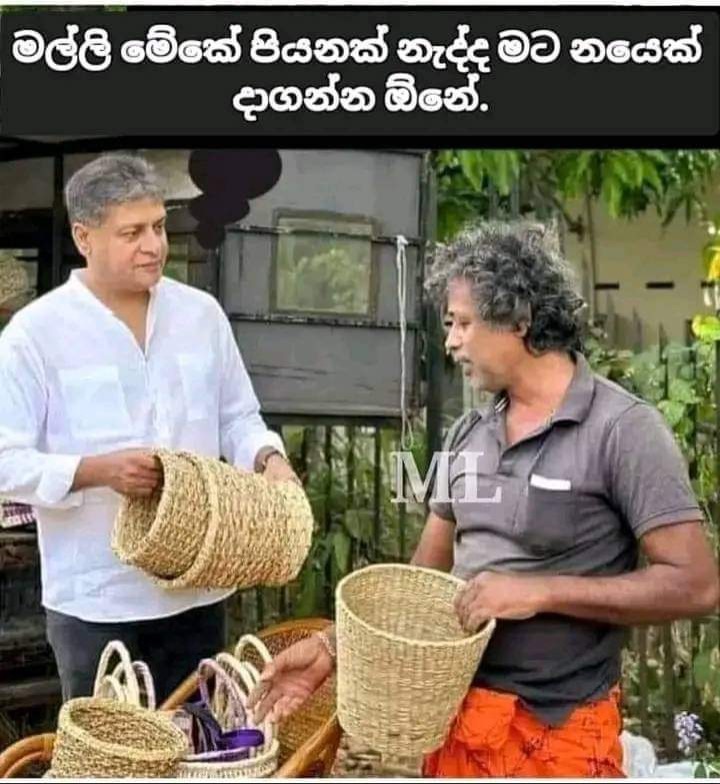
Malli (younger brother), is there no lid for this? I need to put a snake inside.
Context: Prior to the 2019 Presidential Election, TV Derana telecast a news segment on relics of Lord Buddha allegedly manifesting at the historic Kelaniya Raja Maha Viharaya accompanied by a cobra. The news also telecast the chief incumbent of the temple announcing that alongside the manifestation of the relics, they had received the message that the country would get a suitable leader the following year. This report came under strident criticism as an attempt to promote Gotabaya Rajapaksa’s presidency, and TV Derana was ridiculed on social media for advancing superstition for political objectives. This meme depicts co-owner of TV Derana and Leader of the Mawbima Janatha Party Dilith Jayaweera as asking whether there is a lid so as to put a cobra.
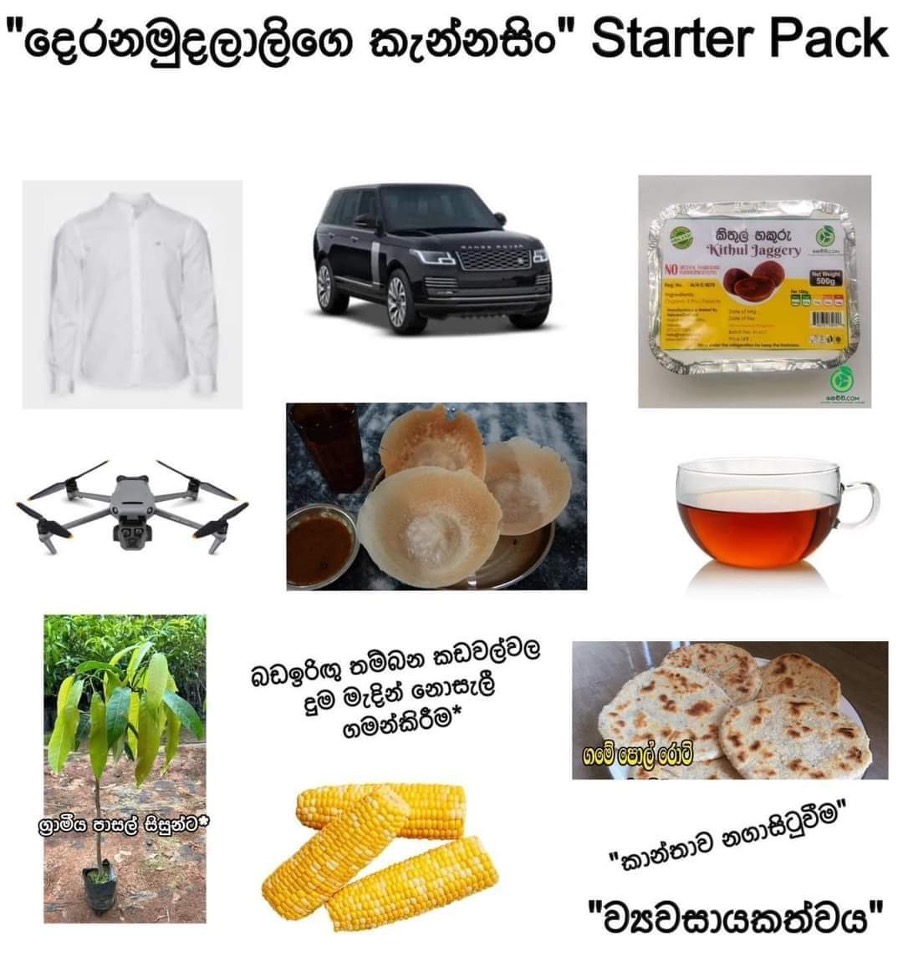
The Derana owner’s canvassing starter pack
For the students from rural areas
Walking undaunted through the smoke in the shops that boil corn
Coconut rotis of the village
“Empowering women”
“Entrepreneurship”
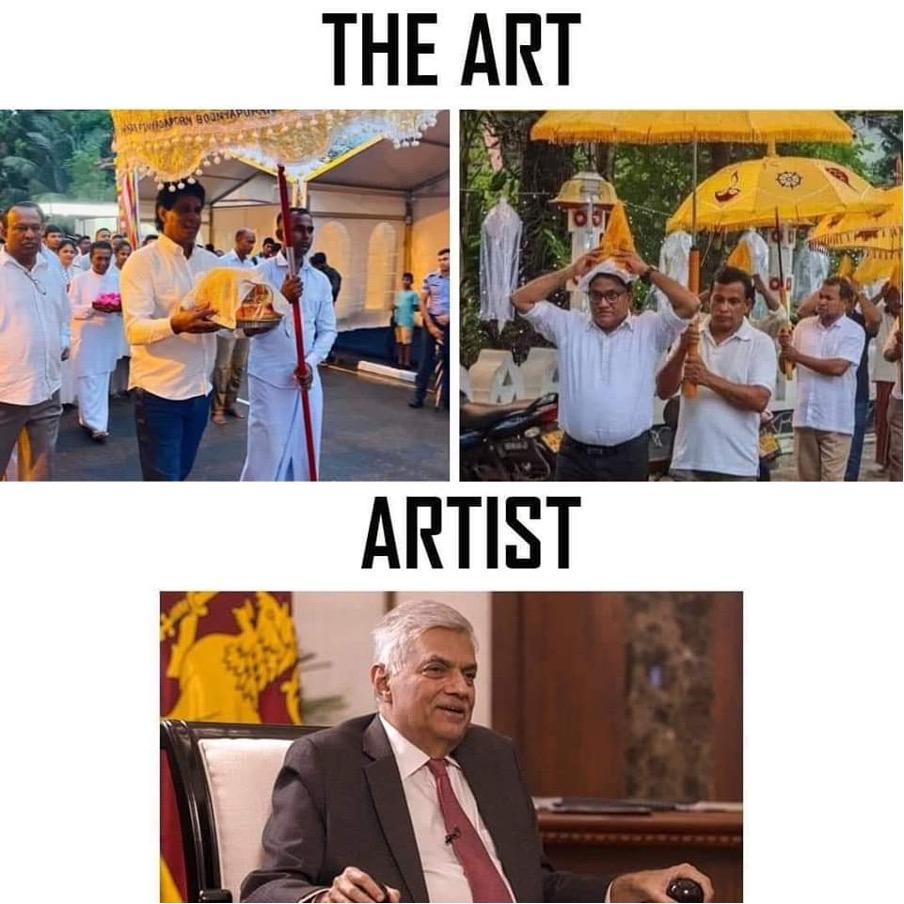
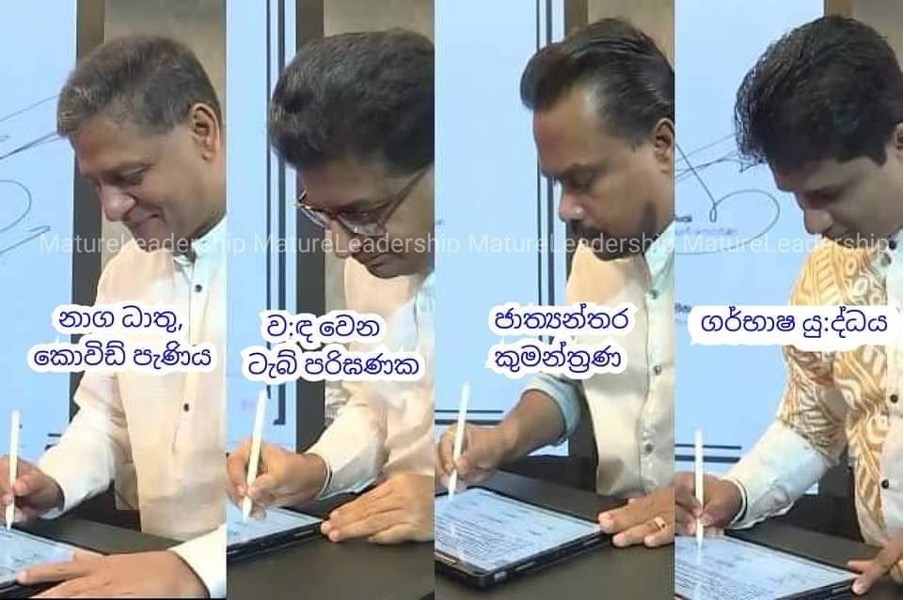
From left to right:
Dilith Jayaweera: Relics from a cobra (see first meme), COVID paniya (an ayurvedic potion introduced by Dhammika Bandara as an alleged cure for COVID-19, and widely promoted by the Gotabaya Rajapaksa-led government and its supporters at the time, before its licence was revoked)
Udaya Gammanpila: Sterilising tabs and computers (cited in relation to accusations that the Muslim community allegedly added sterilisation capsules (wanda pethi) to kottu roti meant for Sinhala people and Gammanpila’s rhetoric on “threats” to the Sinhala population from the Muslim community)
Wimal Weerawansa: International conspiracies (Weerawansa is frequently known to cite international conspiracies as reasons for problems occurring in Sri Lanka)
Channa Jayasumana: The war on the womb (Jayasumana was one of the individuals who strongly accused Dr. S. S. M. Shafi of sterilising Sinhala Buddhist women
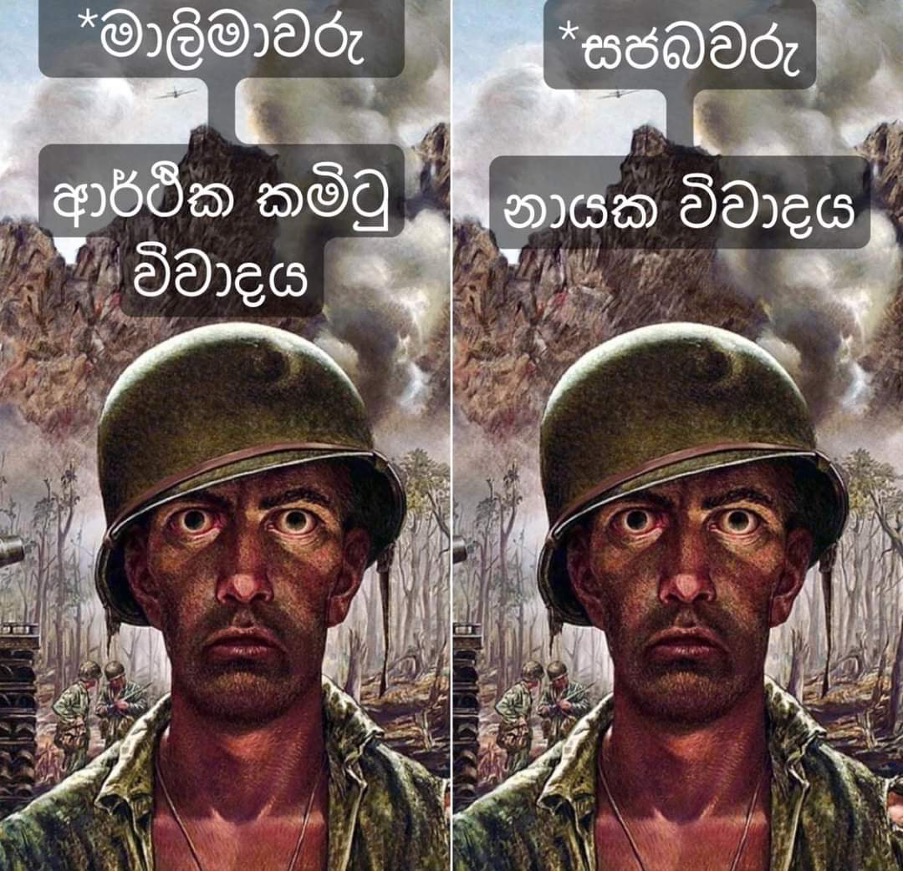
*NPP-ers
Economic council debate
*SJB-ers
Leaders’ debate
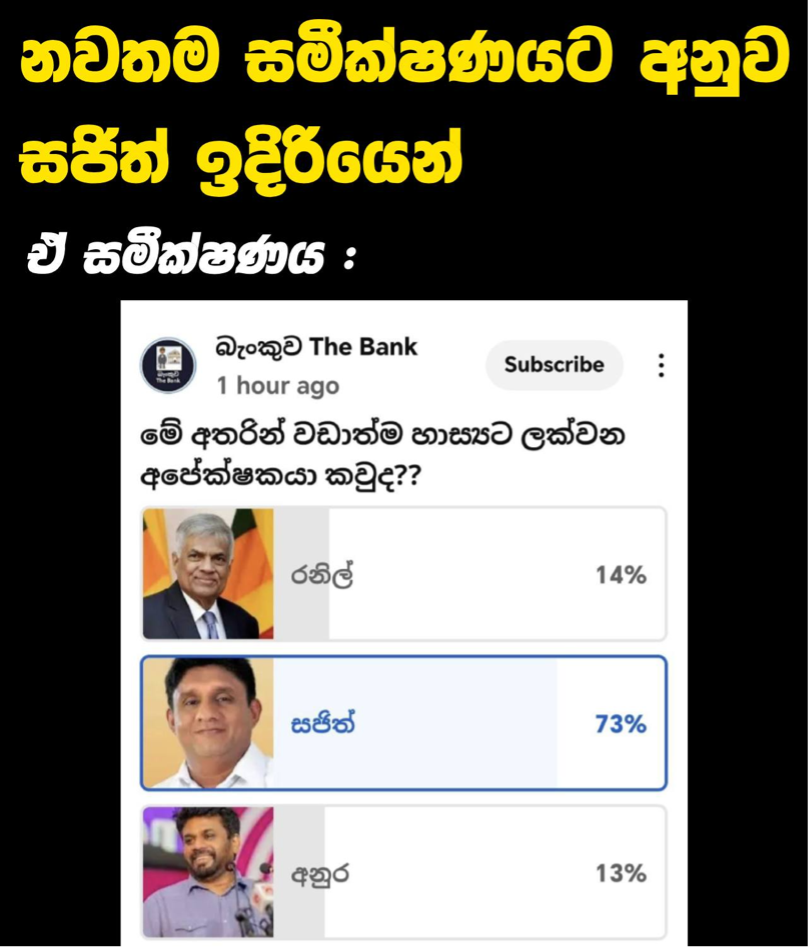
That poll:
Which one of these candidates is the most ridiculed??
- Ranil (14%)
- Sajith (73%)
- Anura (13%)
06. Other topics covered in reportage
- Death of the President of Iran Ebrahim Raisi
- Former State Minister Diana Gamage’s failure to appear in court
- Reported assault of Iran’s ambassador to Sri Lanka in Colombo
- Alleged halting of the Colombo Tea Auction due to threats by Minister Jeevan Thondaman
- Proposed debate between Sajith Premadasa and Anura Kumara Dissanayaka
To view this week’s news summaries, please click here