
Key highlights
Analysis
This week’s TMA issue is part of a series of election updates focusing on the upcoming presidential election (PE). Last week’s Sinhala media press reporting, TV coverage and social media commentary (findings from CrowdTangle, the social media monitoring tool used in TMA weekly)[1] on the upcoming PE reveal the emerging positionings of theleading presidential candidates.
This week’s analysis aims to present some of the key dynamics that are defining the emerging positionings surrounding these candidates. The first section will unpack the strategic moves and support attributed to the mainstream presidential candidates. The second section will aim to map the targeted voter bases of non-mainstream presidential candidates and their potential consequences for the mainstream political party candidates.
Part I: Mainstream presidential candidates
A closer evaluation of the Sinhala media reporting on the upcoming PE reveals two key dynamics shaping the current electoral landscape: (a) strategic moves attributed to Wickremesinghe amidst heightened political competition and (b) support for the mainstream presidential candidatesacross the mainstream and social media. These two dynamics are briefly explored below.
a) Strategic moves attributed to Wickremesinghe
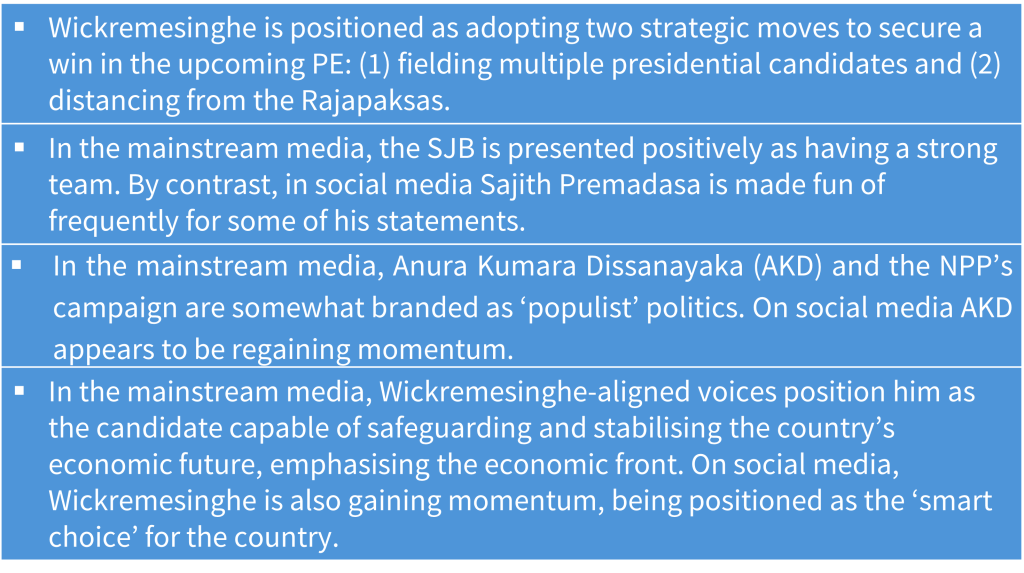
Political voices and commentators in last week’s reporting amplified their continuous and consistent concern over Wickremesinghe using any means necessary to stay in power.[2]Some of them implicitly positioned Wickremesinghe as adopting two strategic moves to secure a win in the upcoming PE: (1)fielding multiple presidential candidates and (2) distancing from the Rajapaksas.
(1) Strategic fielding ofmultiple presidential candidates
The recent announcements of multiple non-mainstream presidential candidates have been implicitly viewed with suspicion. It is generally thought that there are three candidates, with Wickremesinghe likely to be ranked third, and that no candidate will receive more than 50 percent of the votes. When that happens, there will be a second count of preference votes to select between the top two candidates. Wickremesinghe is viewed as orchestrating this strategic move to dilute the vote shares of the other main candidates, which would then increase his chances of becoming one of the top two candidates – and position him with a chance of winning.
(2) Strategic distancing by Wickremesinghe from the Rajapaksas
Wickremesinghe’s announcement to run as an independent candidate and the SLPP’s decision not to support him have been viewed as efforts to distance himself from the Rajapaksas. Two advantages of such a strategic move are highlighted: (i) it could bolster his vote share from non-majority communities that associate the Rajapaksas with ethnic and religious majoritarianism[3] and (ii) it distances Wickremesinghe from the positioning of “protecting” the Rajapaksas from investigations and prosecutions – a perception that has worked against Wickremesinghe overall, given the decline in popularity and loss of public legitimacy of the Rajapaksas over the last three years.
b) Support for presidential candidates: Mainstream media vs. social media
The following section will briefly unpack the positioning of the mainstream presidential candidates, as well as how they are portrayed across the mainstream media and social media.
Strong base for Premadasa – In the mainstream media (TV and print media), the SJB is positioned as a competent and clean (corruption-free) team of politicians that can lead the country forward effectively. This view is advanced by the SJB voices themselves as well as political commentators in the newspapers such as the privately-owned Mawbima. These voices also assert that Premadasa has a secure voter base of at least 5.5 million people who voted for him in the 2019 PE.[4]
By contrast, social media commentary on Premadasa suggests that he is not taken seriously. He is consistently subjected to ridicule for his actions and speeches.[5] For instance, Premadasa was mocked on social media for speaking to a student in Japanese at an event.[6]
‘System change’ through Anura Kumara – In the mainstream media, Anura Kumara Dissanayaka and the NPP’s campaign are positioned as focusing on the following: (1)against elite capture, (2) against corruption and (3) a movement for the people, by the people. By engaging in populist politics, Dissanayaka appears to position himself as a candidate committed to implementing ‘system change’ within Sri Lanka’s political culture – a slogan that has got into the political consciousness from the mass protests in 2022 known as the aragalaya.
On social media, Dissanayaka appears to be regaining momentum after a dip in traction. In March and April, according to TMA’s methodology, social media data showed that posts by Dissanayaka/NPP were gaining the most traction.[7] However, this trend had declined in recent weeks. Last week’s data, however, showed that links related to Dissanayaka had the highest interactions. A closer analysis reveals that Dissanayaka is well-received and portrayed positively by certain social media users as a corruption-free leader and a fresh face emerging from the non-elite.
Stability from Wickremesinghe – In the mainstream media, Wickremesinghe-aligned voices including lawyer and freelance writer Chandrasiri Seneviratne positioned Wickremesinghe as the candidate capable of safeguarding and stabilising the country’s future, with a particular emphasis on the economic landscape.[8] However, support for Wickremesinghe was mostly limited to the state-owned media.
In contrast to the marginal support for Wickremesinghe through the state-owned media, on social media Wickremesinghe was also gaining momentum, being positioned as the ‘smart choice’ for the country.
Part II: Non-mainstream presidential candidates
This section of the analysis unpacks the voter bases that the more prominent non-mainstream presidential candidates – Sarath Fonseka, Wijeyadasa Rajapakshe and Dilith Jayaweera – will likely be competing for.
First, Sarath Fonseka, a current member of the SJB and former army commander, with the highest-ranking military title in the country (after leading the military victory against the LTTE rebels in 2009), is likely to compete in the voter space of Premadasa and AKD. Fonseka is likely to campaign for a corruption-free country and prioritise national security. He will compete directly for the votes of both Premadasa and AKD.[9]
Second, Wijeyadasa Rajapakshe is likely to compete for the formal, clergy inspired, Sinhala-Buddhist vote, an area where Sajith Premadasa appears to be currently leading in comparison to Dissanayaka and Wickremesinghe.[10] He will likely be competition mainly for the vote share of Premadasa.
Third, Dilith Jayaweera is consistently positioned as a ‘businessperson’ or ‘entrepreneur’, indicating he will likely target the business/professional class of society. [11] In the past the SJB, with members such as Eran Wickramaratne and Harsha de Silva, has managed to attract businesspeople and professionals. Jayaweera may compete for this same demographic. In addition, he is also likely to compete for the Sinhala-Buddhist vote in which Premadasa is seen as leading.
Overall, Premadasa’s voter base is the most likely to be impacted by competition from non-mainstream candidates due to the similarities in their professed platforms. As a result, the advantage of splitting votes is seen to be favouring Wickremesinghe.
[1] In accordance with TMA’s methodology to monitor social media, the TMA team filtered the five posts with the highest interactions on Facebook in Sinhala for the name Ranil and the term president using CrowdTangle, from July 29 to August 2.
[2] See TMA Vol.14, #28, 29 & 30.
[3] For more information, please see https://election.adaderana.lk.
[4] For more information, please see https://election.adaderana.lk.
[5] For instance, please see https://www.youtube.com/watch?v=ZSHlN4CWp2Q, https://srilanka.factcrescendo.com/english/fake-claim-attributed-to-sajith-on-installing-underwater-camera-systems-in-public-bathing-ports/ and https://srilanka.factcrescendo.com/english/misrepresentation-of-sajith-premadasas-speech-on-proposed-debate-with-npp/.
[6] For more information, please see https://www.tiktok.com/@dailymirrorlk/video/7363610319240858888 and https://www.tiktok.com/@chaturaalwis/video/7363654529411288327.
[7] See TMA Vol.14, #12; Vol.14, #13; Vol.14, #15 & 16.
[8] See TMA Vol.14, #02 & 03.
[9] For more information, please see https://www.themorning.lk/articles/3Zyk8cnvSn22Cus8yM1L, https://www.dailymirror.lk/breaking-news/Sarath-Fonseka-to-split-from-SJB%3B-to-run-for-President/108-283142 and https://groundviews.org/2009/11/11/general-sarath-fonseka-and-politics/.
[10] For more information, please see https://english.theleader.lk/news/8042-sjb-is-a-party-committed-to-furthering-buddhism-sajithand https://archives1.dailynews.lk/2023/06/19/local/305918/conspiracy-undermine-work-buddhists-sajith.
[11] For more information, please see https://www.adaderana.lk/news.php?nid=97359.