
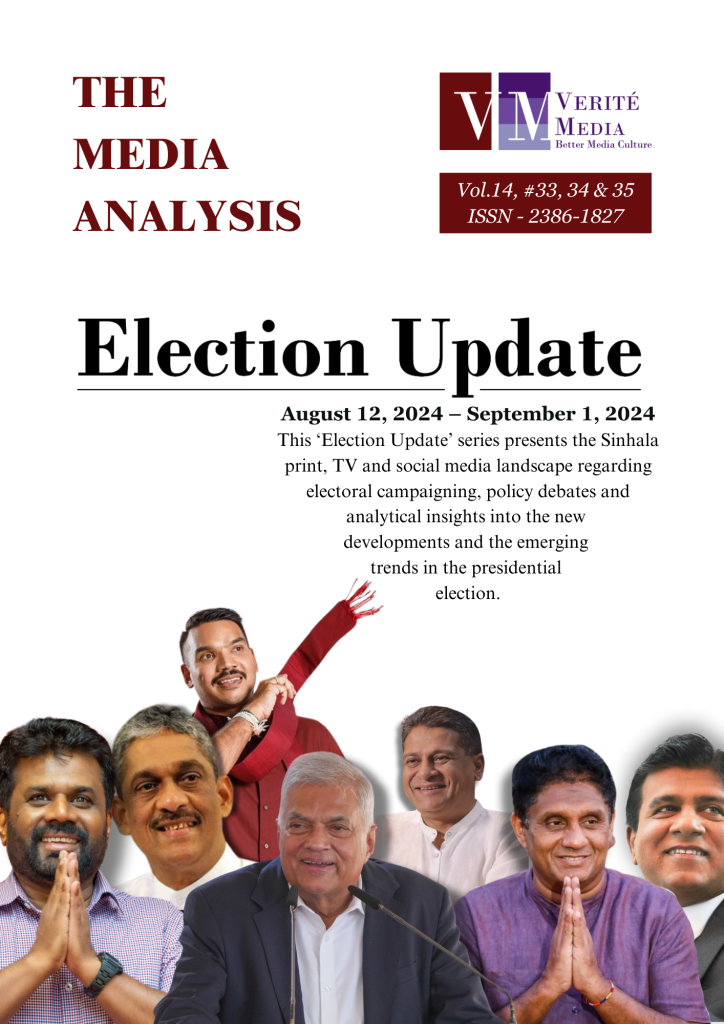
Issue: On July 26, the Election Commission (EC) announced that the presidential election will be held on September 21, 2024.[1][2] On August 15, the EC accepted the nominations of 39 presidential candidates.[3][4]
Analysis
This week’s TMA is part of a series of election updates focusing on the upcoming presidential election (PE). The previous update (TMA Vol.14, #32) analysed the apparent diminished sense of hope within the Sinhala psyche regarding the 2024 PE.
This week’s analysis is divided into two parts. The first part analyses the growing cynicism about voter behaviour ahead of the election. The second part maps out the positions of the three leading candidates – Wickremesinghe, Premadasa and Dissanayaka – on two key national interest issues ahead of the election.
Part I: Cynicism about voter behaviour
Political and media voices have expressed concern over voter behaviour potentially leading to an election outcome that may not serve the country’s best interests such as achieving substantial improvement in governance or economic stability (e.g. reduction in corruption and better fiscal management). This cynicism stems from two concerns.
First, Sinhala media commentary raised concerns that the electioneering process is more focused on appealing to the parochial interests of the people than on the national interest. Privately-owned outlets, including the Aruna editorial, expressed concerns that voters might prioritise these parochial interests, being swayed by handouts and benefits such as land allocations to specific voter groups and increases in public sector salaries, over the broader interests of the country.
Second, Sinhala press commentary raised concerns about the manipulation of social media to influence voter behaviour. Privately-owned outlets, including Aruna and Mawbima, were critical of voters potentially being swayed by the proliferation of unreliable surveys circulating on social media platforms regarding potential election outcomes as well as by targeted online ad campaigns from political parties. For example, a Meta Ad Library report shows that all the top 10 pages on Facebook are aligned with presidential candidates. In the past 30 days, six of the top 10 spenders on Facebook have been associated with either Wickremesinghe, Premadasa or Dissanayaka.[1]
Part II: Candidate positioning on national interests
The following section briefly examines how the Sinhala media portrays the positioning of the main presidential candidates along two key national interest axes.
Exhibit 1: Sinhala media positioning of presidential candidates on national interests
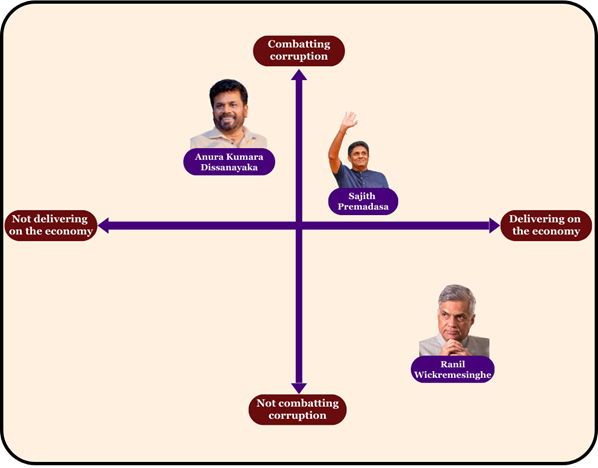
i. Ranil Wickremesinghe – high on delivering on the economy, low on combatting corruption
Since early 2024, the Sinhala media has portrayed Wickremesinghe as an individualwho can protect and stabilise the country’s future, by emphasising his ability to strengthen the economy and maintain positive foreign relations.[2] This positioning continues two weeks ahead of the PE, with Wickremesinghe ranking high on his ability to deliver a strong economy.
However, Wickremesinghe ranks low in combatting corruption. This perception is largely due to his association with and the ‘protection of’ the Rajapaksa family who lost significant public legitimacy post-aragalaya. Recent corruption scandals, such as those involving VFS, have further damaged Wickremesinghe’s credibility in fighting corruption. His reliance on support from the SLPP team, which is widely blamed for the economic crisis, during his two years in government has reinforced the perception that he is not committed to fighting corruption.[3]
ii. Anura Kumara Dissanayaka – low on delivering on the economy, high on combatting corruption
Within the Sinhala media discourse, Dissanayaka is ranked high on his ability to combat corruption. Dissanayaka is portrayed as a candidate dedicated to implementing ‘system change’ within Sri Lanka’s political culture – a slogan that gained prominence during the 2022 mass protests known as the aragalaya.[4]Two factors contribute to this ranking: (i) he is positioned as an alternative to traditional political candidates who have historically been associated with dynastic and family-based politics and (ii) he is placed as the only candidate untainted by corruption, in contrast to other political candidates.
However, Dissanayaka ranks low on the economic front. This ranking largely stems from his lack of a proven track record in a position of national economic management compared to Premadasa’s team and Wickremesinghe.
iii. Sajith Premadasa – inbetween Wickremesinghe and Dissanayaka on both economic management and combatting corruption
Within the Sinhala media discourse, Premadasa is ranked between Dissanayaka and Wickremesinghe in terms of his ability to strengthen the economy. This perception is based more on the competence associated with his team rather than with him.[5] The focus on Premadasa’s team is highlighted by the SJB’s own advertising campaign Sajith samaga pirisa(the team with Sajith), which underscores a collective effort rather than just his leadership.[6]
Premadasa also ranks between Dissanayaka and Wickremesinghe in public expectation of combatting corruption. The SJB has been subjected to criticism particularly in relation to crossovers and inclusion of certain political figures such as Thilanga Sumathipala in the Samagi Jana Sandhanaya (the SJB’s coalition party).[7]
***In conclusion, the Sinhala media discourse regarding the 2024 election reflects a lack of clarity and consensus among voters on whom to support. The election campaigns come under criticism for catering to narrow parochial interests rather than to national interests.
Overall, a closer analysis of the Sinhala media coverage suggests that Dissanayaka and Premadasa have an advantage over Wickremesinghe due to the strong desire for a change in society, especially in the aftermath of the aragalaya.
[1] For more information, please see https://www.facebook.com/ads/library/report/?source=onboarding.
[2] See TMA Vol.14, #02 & 03; Vol.14, #31.
[3] See TMA Vol.14, #31.
[4] See TMA Vol.14, #31.
[5] See TMA Vol.14, #31.
[6] For more information, please see https://www.facebook.com/sajithpremadasa/videos/526780909822458.
[7] For more information, please read https://economynext.com/sumathipala-can-be-tried-in-court-based-on-icc-anti-corruption-report-harin-47393/ and https://www.news.lk/news/sports-travel/item/27757-thilanga-banned-from-sports-administration.