
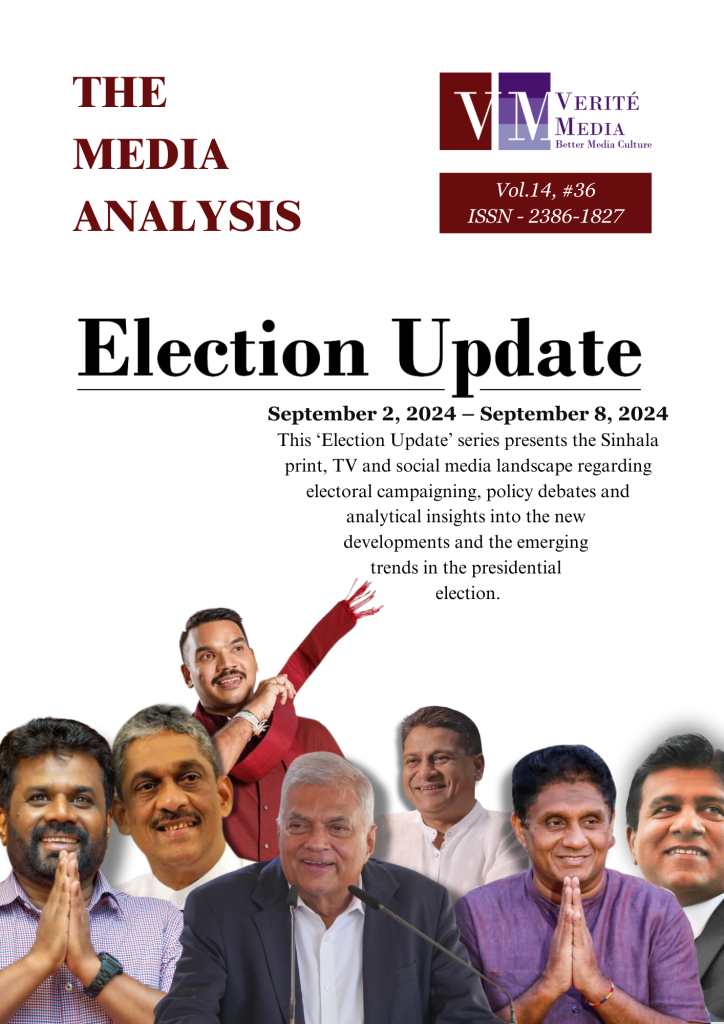
Issue: On July 26, the Election Commission (EC) announced that the presidential election will be held on September 21, 2024.[1][2] On August 15, the EC accepted the nominations of 39 presidential candidates.[3][4]
Analysis
This week’s TMA is part of a series of election updates focusing on the upcoming presidential election (PE). The previous update (TMA Vol.14, #33, 34 & 35) highlighted the apparent indecision and diminished sense of hope among voters regarding the 2024 PE. However, over the past week, Sinhala media commentary suggests that voter uncertainty about the presidential candidates is diminishing, as clearer positions emerge.
The analysis is divided into two parts. The first part analyses the emerging narratives reflected in the positions taken by the voters as discerned from Sinhala media reporting. The second part addresses three key questions surrounding the strengths and weaknesses of the three major candidates – Ranil Wickremesinghe, Sajith Premadasa and Anura Kumara Dissanayaka.
Part I – Narratives rallied around by voters
An evaluation of the Sinhala media outputs – including press, TV coverage and social media – on the 2024 PE reveals three narratives gaining momentum and shaping the electoral choices of Sinhala voters.[1]
Narrative 1 – Against the élite capture
Sri Lanka’s political leadership has long been dominated by a few prominent families including the Rajapaksas, Wickremesinghe/Jayewardenas and Bandaranaikes. However, during the aragalaya movement, the slogan “system change” – one of the central demands – gained momentum during the mass protests.
The discourse surrounding the 2024 PE reflects this demand, with a growing call to move away from corruption and élite capture, pushing for an overhaul of the country’s political culture. This shift in sentiment is largely contributing to the increasing popularity of Dissanayaka’s presidential campaign.
Narrative 2 – Absence of a common rival for the non-Sinhala Buddhist vote
In the 2024 PE, the Sinhala press discourse does not appear to have identified a common opponent of the majoritarian (Sinhala Buddhist) vote. This contrasts with the elections of 2010, 2015 and 2019, following the end of the armed conflict in 2009, when both Rajapaksa brothers, former Presidents Mahinda and Gotabaya Rajapaksa, were viewed as adversaries by the non-majoritarian voter base.
However, with no Rajapaksa running as a prominent candidate this year, a single figure for the non-majoritarian voter base to rally against seems to be absent. As a result, the non-Sinhala Buddhist vote appears to be going to the common Tamil candidate P. Ariyanethran and/or for the three main candidates.
Narrative 3 – Assessment of candidates through manifestos
The discourse surrounding the 2024 PE has increasingly focused on evaluating candidates based on the policies outlined in their manifestos. Significant in this post-aragalayaperiod, this reflects a growing emphasis on policy-based politics, with greater attention given to the specifics of candidates’ proposals.
Part II – Deconstructing the strengths and weaknesses of the candidates
This section will analyse the perceived strengths and weaknesses of each main candidate by addressing three questions.
Question 1: What perceived advantage does Premadasa have that Wickremesinghe and Dissanayaka lack?
Premadasa’s perceived advantage over Wickremesinghe and Dissanayaka lies in his broad, competent team. His campaign’s strength seems to be rooted in having a group of experienced individuals capable of leading the country, unlike Wickremesinghe, whose team is seen as tainted by corruption, and Dissanayaka, who appears to lack a strong team.
Incongruously, the weakness of Premadasa’s campaign also lies with his team. It includes former SLPP supporters and members of Viyathmaga (a group of professionals that supported former President Gotabaya Rajapaksa in the 2019 election), whose legitimacy has weakened in the post-aragalaya period. Their inclusion in the SJB camp is seen by some as diluting the party’s willingness to fight corruption.
Question 2: What perceived advantage does Dissanayaka have that Wickremesinghe and Premadasa lack?
Dissanayaka’s perceived advantage over Wickremesinghe and Premadasa is his untainted character, which positions him as a leader capable of driving change without the burden of corruption allegations. Dissanayaka is portrayed as a candidate dedicated to implementing ‘system change’ within Sri Lanka’s political culture (analysed in the previous section).
However, the weakness lies in the fear of radical changes to the status quo due to his historical political ideologies. Specifically, there is concern about the potential disruption of the economic progress achieved thus far, with worry about jeopardising the IMF programme.
Question 3: What perceived advantage does Wickremesinghe have that Dissanayaka and Premadasa lack?
Wickremesinghe’s perceived advantage over Premadasa and Dissanayaka is his political track record. Wickremesinghe is portrayed as an individual who has extensive political experience to protect and stabilise the country’s future, by emphasising his ability to strengthen the economy and maintain positive foreign relations.
However, in addition to allegations of corruption against his team, Wickremesinghe is also seen as representing traditional, dynastic and family-based politics. This perception strengthens the belief that he is unlikely to tackle the systemic issues in Sri Lanka’s governance and political structures.
***
In conclusion, the Sinhala media discourse surrounding the 2024 Presidential Election suggests that voter uncertainty about the candidates is diminishing. A closer reading of the Sinhala media reveals that the public are increasingly aligning themselves with the policies represented by Dissanayaka, particularly his efforts to bring about radical change in Sri Lanka’s political culture and combat corruption. This gives him a competitive edge over both Premadasa and Wickremesinghe in the presidential race.
[1] With the sunset of CrowdTangle as a publicly available social media listening tool, the TMA team manually monitored Facebook profiles and pages using data collected over the past six months for election-related content. The monitoring period covered was September 2 to 8.