
October 7 – October 13, 2024 | Vol.14, #40 | ISSN – 2386-1827
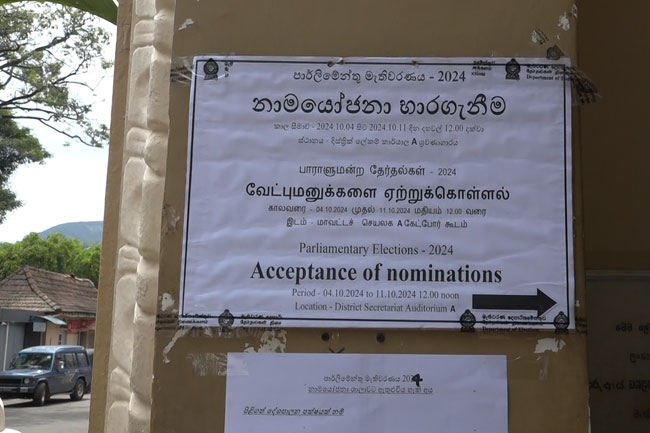
Photo credits: Ada Derana website
Issue: On October 11 the acceptance of nominations for the 2024 General Election (GE) concluded, with 690 nominations accepted from political parties and independent groups across the island.[1][2][3][4]
Several prominent politicians — including but not limited to — former presidents Ranil Wickremesinghe, Mahinda Rajapaksa and Maithripala Sirisena, along with former MPs Patali Champika Ranawaka, Wimal Weerawansa, Shehan Semasinghe, Lakshman Kiriella, Ali Sabry, Bandula Gunawardena and C. V. Wigneswaran have decided not to contest in the upcoming GE.[5][6][7][8]
Analysis
Last week’s coverage in the Sinhala print media and TV news bulletins continued to show overwhelming support for President Anura Kumara Dissanayaka and the NPP government, a sentiment mirrored in social media commentary as analysed using the monitoring tool Junkipedia.[1]
This week’s TMA will focus on two contrasting sentiments associated with the government led by Dissanayaka following the presidential election, and briefly explore the minimal criticism of the NPP in the lead-up to the general election.
1. A sense of excitement over the open confrontation of corruption (positive sentiment)
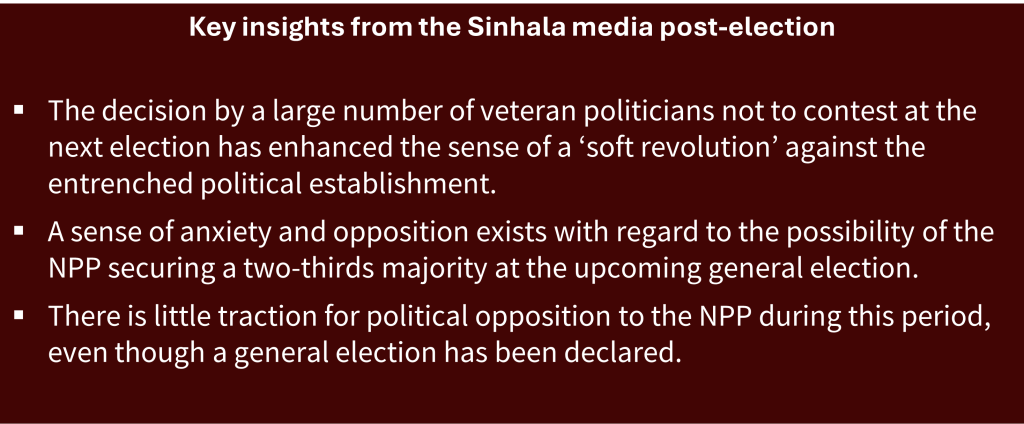
In the immediate aftermath of the presidential election, the Sinhala media portrayed Dissanayaka’s electoral victory at the Presidential Election (PE) as the ushering in of a ‘soft revolution’.[2]This ‘revolution’ was characterised in the previous issue of TMA as the culmination of (a) the rise of the political left, driven by growing demands for economic and social reforms focused on equality and justice; (b) a class shift that displaced the traditional political élite; and (c) an open confrontation of corruption, reflecting the anger against the political élite.[3]
The media coverage of the previous week focused on the class shift aspect of the ‘soft revolution’, with Dissanayaka, the symbol of that shift, being treated as a celebrity.[4] This past week the media focused on the aspect of confronting the corrupt establishment, seeing the withdrawal from electoral contests by current members of parliament as part of that confrontation.
The social engagement and excitement arise not just from the arrests, prosecutions or recovery of stolen assets, but from the perception that the established (corrupt) political figures who operated with confidence are now fleeing the political stage.
2. A sense of anxiety over a two-thirds majority (negative sentiment)
Despite the sense of excitement over the confrontation of corruption, last week’s Sinhala media coverage also reflected a sense of anxiety and opposition to the NPP possibly securing a two-thirds majority. This anxiety and opposition might be explained along two lines.
One, from Sri Lanka’s political history, where past presidents such as J. R. Jayewardene (1978), Mahinda Rajapaksa (2010) and Gotabaya Rajapaksa (2020) gained two-thirds majorities, and abused that power to favour vested interests, undermine the judiciary, suppress the media and squash political dissent.
Media outlets such as the privately-owned Anidda newspaper emphasised the importance of preventing such a super-majority, portraying it as crucial for safeguarding democracy. This narrative reflects a collective memory of the harmful consequences associated with instances of past super-majorities in parliament. These concerns persist in the current political context.
Two, it stems from suspicion towards the NPP’s political direction. The anticipation of left-leaning policies by the NPP have raised concerns, particularly among the political right who fear the government may push reforms towards a class-based conflict.
Therefore, while the NPP government’s anti-corruption stance is widely supported, the unease surrounding it gaining a two-thirds majority in parliament reflects broader public concerns about safeguarding democracy from the risks of a concentration of political power.
Minimal criticism of the NPP
Aside from the post-election sentiments, criticism of the NPP government has been notably muted since the election outcome. This can be attributed to three key aspects.
First, the post-election ‘honeymoon period’[5] has provided a buffer where the public and media typically grant space for the new administration to deliver on its promises.
Second, the NPP’s policy actions have been limited in the absence of a functioning parliament. This leaves critics with little to evaluate, with no significant decisions or policies to scrutinise.
Third, the NPP appears to have removed any opportunity or ‘oxygen’ for criticism on policy areas where the NPP was subjected to criticism prior to the election (e.g. handling the IMF programme and managing international relations). This cautious approach by the NPP on policies that could be subject to pushback has effectively cut off opportunities for criticism,
These aspects contributed to a largely unchallenged public narrative of the NPP’s action.
[1] The TMA team monitored Facebook, TikTok and YouTube profiles, pages and channels using Junkipedia for the keywords elections, Easter, nominations and economy. The monitoring period was October 7 to 11.
[2] See TMA Vol.14, #38.
[3] Ibid.
[4] See TMA Vol.14, #39.
[5] See TMA Vol.05, #32 and Vol.05, #33.