
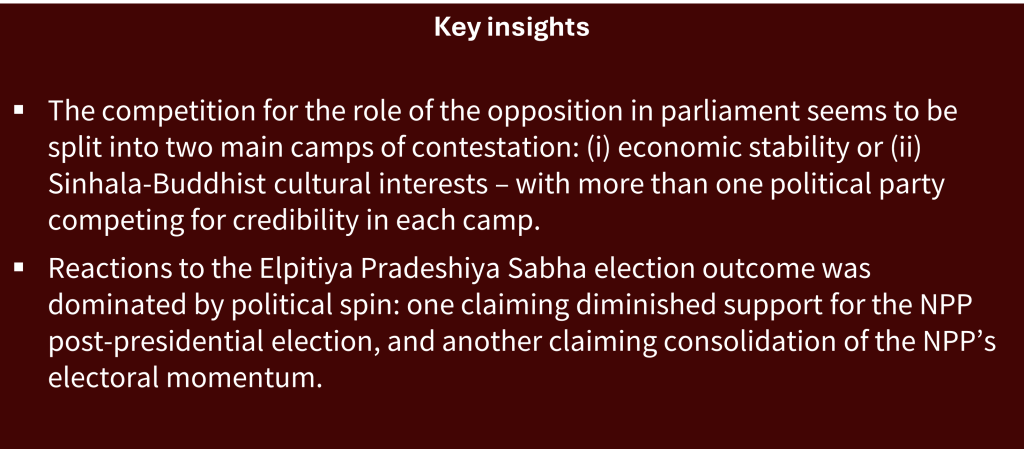
Issue: On October 26, 2024, the National People’s Power (NPP) won the Elpitiya Pradeshiya Sabha election, obtaining 15 out of 30 seats with 17,295 votes.[1][2][3]
The General Election (GE) is scheduled to be held on November 14, 2024.[4][5]
Analysis
Last week’s Sinhala media coverage of the Elpitiya Pradeshiya Sabha election and the upcoming GE featured both support for and...
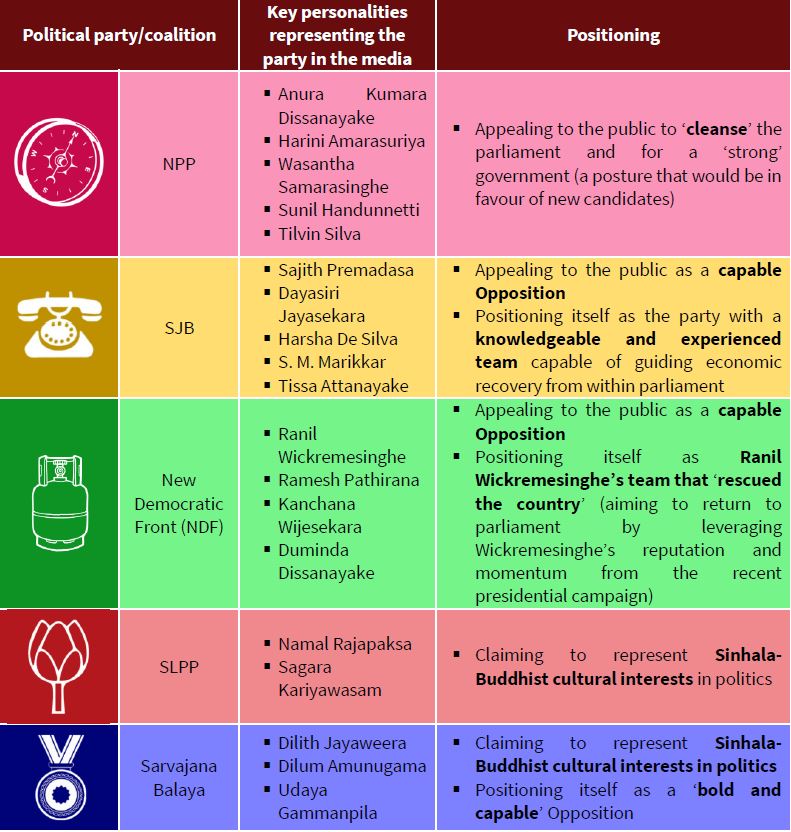
This week’s TMA will unpack the electoral positioning of each party as political competition heightens ahead of the upcoming GE. These positions will be briefly described below.
Table 1: Positioning of political parties/coalitions
Contested Oppositional space
The competition for the role of the opposition in parliament seems to be split into two main camps, each driven by rivalries centred on either (i) economic stability or (ii) Sinhala-Buddhist cultural interests.
On one hand, both the SJB and NDF appeal to voters on economic management and stability. The SJB positions itself as the experienced team necessary to steer economic recovery, while the NDF leverages Ranil Wickremesinghe’s legacy of stability and continuity, appealing to the reputation of Wickremesinghe.
On the other hand, the SLPP and Sarvajana Balaya each claim to represent Sinhala-Buddhist cultural interests. The SLPP appeals to its long-established Sinhala-Buddhist voter base, drawing on its historic role in defending these values.
Overall, the positioning of these political parties reveals a highly contested Opposition space, with rivalries that could split voter support and shape the outcome of the GE.
The next section unpacks in more detail the position of each party.
Unpacking the positions of five parties
(1) The NPP: For ‘cleansing’ parliament and ‘strong’ government
Building on promises made during the Presidential Election (PE), the NPP reaffirmed its stance to tackle corruption by focusing on ‘cleansing’ parliament.[2] The NPP positioned itself as a party committed to fostering a new political culture led by fresh faces within its ranks.[3]Moreover, the NPP advocates for a majority to establish a ‘strong’ government capable of implementing meaningful reforms.
However, it stops short of explicitly seeking a two-thirds majority – possibly due to criticism associated with such a concentration of power, as experienced in the recent political history under former Presidents Gotabaya Rajapaksa (2020), Mahinda Rajapaksa (2010) and J. R. Jayewardene (1978) and the SLPP government’s tenure, as analysed in a recent issue of TMA.[4]
(2) The SJB: Capable Opposition, with a competent team
The SJB positions itself as the most qualified choice for the Opposition, emphasising its ‘experienced and efficient team’ well-equipped to manage and guide the country toward economic recovery. By highlighting its strengths, the SJB leverages existing criticism of the NPP particularly regarding its perceived inexperience and inefficiency in handling complex economic and governance challenges.
This positioning aligns with the SJB’s approach during the PE, which underscored the competence of the SJB team.[5]
(3) The NDF: Capable Opposition, with Wickremesinghe’s team that ‘rescued the country’
Politicians under the NDF present themselves as Wickremesinghe’s team that ‘rescued the country’ and has positively contributed to the current state of the economy. Thus, they frame their return to parliament by capitalising on Wickremesinghe’s reputation and momentum from the recent presidential campaign.
This positioning, previously advanced by the UNP, relies on the currently established perception of Wickremesinghe – and by extension the party associated with him – as capable of safeguarding and stabilising Sri Lanka’s economy.[6]
(4) The SLPP: For Sinhala-Buddhist cultural interests
The SLPP continues to position itself as the party of broad-based representation, with a particular focus on Sinhala-Buddhist voters,[7] despite recent election-related setbacks. This positioning, particularly that of the Sinhala-Buddhists, makes the SLPP a strong contender and close rival to the Sarvajana Balaya.[8]
(5) The Sarvajana Balaya: Capable Opposition, for Sinhala-Buddhist cultural interests
The Sarvajana Balaya – echoing its stance during the PE – positions itself more explicitly as embodying a Sinhala nationalist position that focuses on Sinhala-Buddhist cultural and religious interests.[9] This enables it to attract voters who have become disenchanted with the SLFP and SLPP.
Additionally, the Sarvajana Balaya, as a relatively new force, aims to attract not only Sinhala-Buddhist voters but also those dissatisfied with traditional parties. Leveraging this dissatisfaction with the perceived complacency of established parties, the Sarvajana Balaya positions itself as a ‘bold’ alternative, appealing to voters seeking a more dynamic Opposition.
[1] The TMA team monitored Facebook profiles, YouTube channels and TikTok handles using Junkipedia for the keywords Elpitiya, elections, NPP, loans and promises. The monitoring period was October 28 to November 1.
[2] See TMA Vol.14, #33, 34 & 35.
[3] For more information, see: https://web.facebook.com/100089282387259/posts/535507196102022/.
[4] See TMA Vol.14, #40.
[5] See TMA Vol.14, #31; Vol.14, #33, 34 & 35; Vol.14, #36.
[6] See TMA Vol.14, #02 & 03; Vol.14, #31; Vol.14, #33, 34 & 35; Vol.14, #36.
[7] See TMA Vol.09, #37.
[8] See TMA Vol.09, #37.
[9] See TMA Vol.14, #31.