
Issue: On July 26, the Election Commission (EC) announced that the presidential election will be held on September 21, 2024.[1][2] On August 15, the EC accepted the nominations of 39 presidential candidates.[3][4]
Analysis
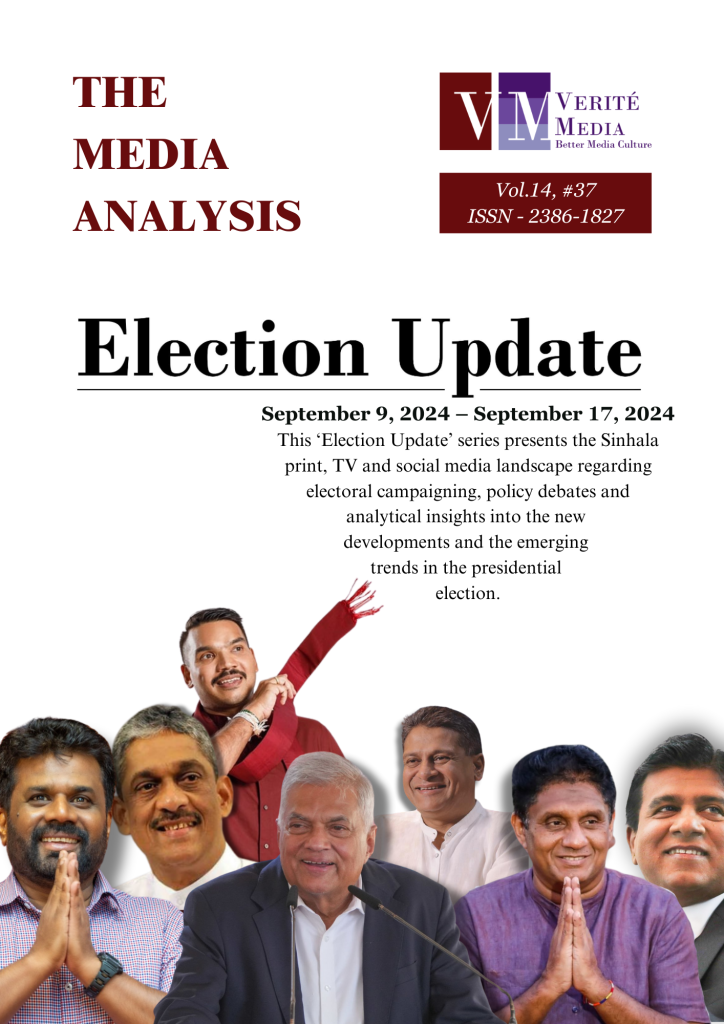
This week’s TMA is the final issue in the election update series focused on the upcoming presidential election (PE).
This week’s analysis (based on Sinhala media coverage across print, TV and social media) is divided into two parts. The first part unpacks the negative campaigning that is gaining momentum and shaping perceptions of the leading presidential candidates – Anura Kumara Dissanayaka, Sajith Premadasa and Ranil Wickremesinghe – in the final stages of the election campaign. The second part ranks the candidates based on Sinhala media coverage, positioning them on the axes of trust and value proposition.
Part I – Negative campaigning
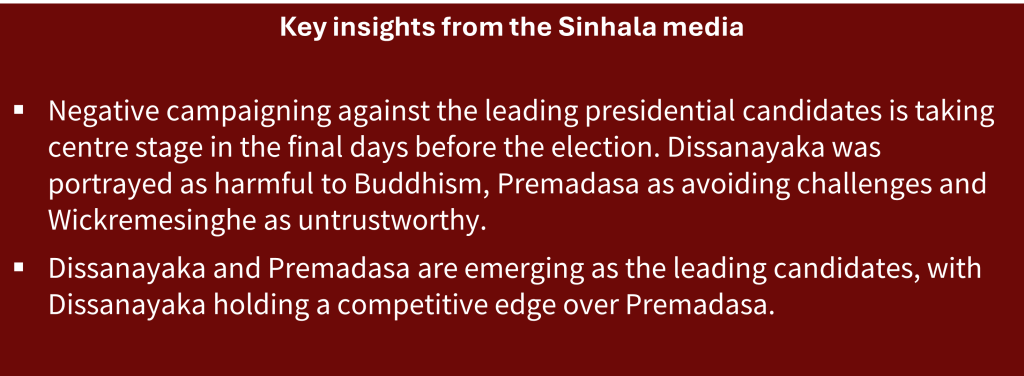
1. Anura Kumara Dissanayaka – Bad for Buddhism
Negative campaigning against Dissanayaka portrays his potential presidency as a threat to the prominence and protection of Buddhism in the country. Media outlets, including the state-owned Dinamina, criticised him and the NPP for undermining the significance of Buddhism. This criticism first emerged in early 2023 when the NPP was associated with ‘anti-Buddhist’ elements/figures such as Youtuber Sepal Amarasinghe who was arrested that year for allegedly ‘insulting/defaming’ the sacred tooth relic.
Last week, critics continued to highlight statements made by NPP affiliates, framing them as attacks on Sinhala-Buddhist cultural values. For instance, a video circulating on social media allegedly features Sunil Handunnetti, a former JVP MP and a prominent member of the NPP, stating that while worshipping statues is part of Sinhala culture, it is essentially a tribal practice with no real significance.[1] Similarly, reports claimed NPP Spokesperson Nalin Hewage ridiculed the Buddhist practice of worshipping the Bo tree, a sacred symbol in Buddhism.[2]
2. Sajith Premadasa – Shying away from challenges
Negative campaigning against Premadasa primarily came from President Wickremesinghe’s camp, including the president himself. Premadasa was portrayed as a politician who avoids challenges, with critics framing him as shying away from his responsibilities, particularly by refusing to take on the country’s leadership during the aragalaya period.[3] This criticism strongly resurfaced after Premadasa’s absence from two live TV programmes – ‘Satana’, scheduled to air on Sirasa TV, and ‘Derana 360’, scheduled to air on TV Derana.[4] Critics further claimed that if Premadasa had effectively fulfilled his role as leader of the opposition, Dissanayaka would not have risen to such prominence as a presidential candidate.
3. Ranil Wickremesinghe – Untrustworthy person
Negative campaigning against Wickremesinghe portrays him as untrustworthy, a perception built on claims that he has links to a violent past, the perception that he has authoritarian tendencies and allegations of him being associated with corruption. For instance, last week, the privately-owned Mawbima editorial referenced his alleged involvement with the UNP government in the 1981 burning of the Jaffna Library and the dismissal of 100,000 government workers during a strike.
Part II – Rankings of the main presidential candidates
The following section provides a brief analysis of how the Sinhala media ranks the main presidential candidates on a trust-value proposition graph.
Exhibit 1: Trust-Value Proposition graph
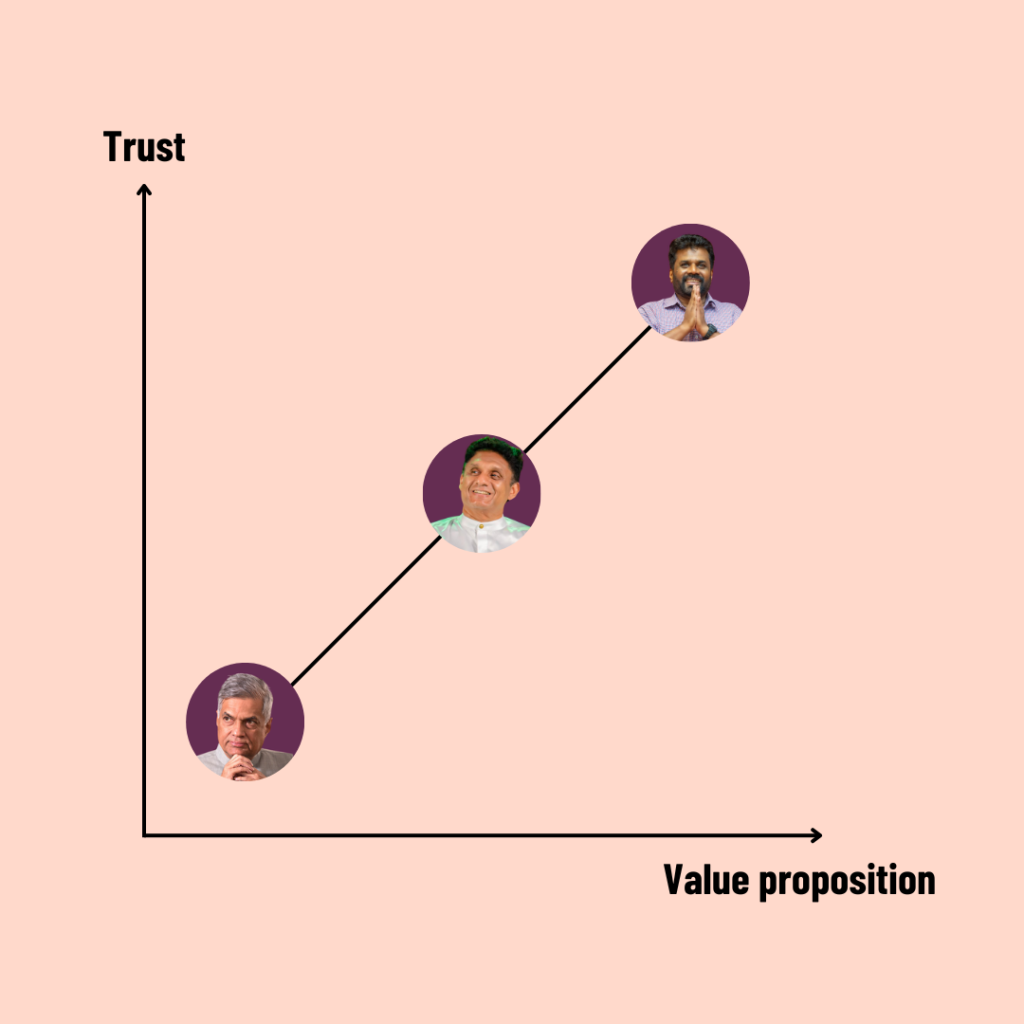
Dissanayaka – High on trust, high on value proposition
In the Sinhala media discourse surrounding the 2024 presidential election, Dissanayaka is portrayed as having both a high level of trust and a strong value proposition among the people. The discourse reflects a growing demand for change, with increasing calls to move away from corruption and élite capture, pushing for an overhaul of the country’s political culture.[5] In this context, his firm stance against corruption strengthens his value proposition, while Dissanayaka distancing himself from the traditional political elite garners high levels of trust.[6]
Wickremesinghe – Low on trust, low on value proposition
Wickremesinghe is seen as offering a weak value proposition due to his lack of emphasis on combatting corruption. In the Sinhala psyche, he is viewed as a symbol of the traditional political élite. Therefore, Wickremesinghe ranks the lowest among the three candidates (also see previous section on how Wickremesinghe is portrayed as untrustworthy).
Premadasa – Moderate trust, moderate value proposition
Premadasa is positioned at the midpoint between Wickremesinghe and Dissanayaka on the trust-value proposition graph, with moderate trust and value. He is perceived as being less committed to fighting corruption (due to the questionable history of some of his old and new team members[7]) and is also viewed as not far removed from the established political élite.
***
In conclusion, a closer reading of the Sinhala media reporting suggests that the public is increasingly aligning with Dissanayaka’s policies and value framework. He appeals to parts of the orphaned vote base of the Rajapaksas, disillusioned voters of the yahapaalanayagovernment – who sought to eliminate corruption, nepotism and patronage – and to aragalaya supporters, who demanded “system” change and fought against corruption in Sri Lanka’s political culture. An analysis of the Sinhala media suggests that Premadasa and Dissanayaka are emerging as front-runners among the presidential candidates, with Dissanayaka holding a competitive advantage over Premadasa.
[1] For more information, please read https://www.dailynews.lk/2024/09/17/featured/631371/buddhist-obsession-of-the-red-power/
[2] For more information, please read https://www.dailynews.lk/2024/09/17/featured/631371/buddhist-obsession-of-the-red-power/
[3] For more information, please see https://vt.tiktok.com/ZS2QFssQc/ and https://www.instagram.com/p/C_2UcEQugnI/
[4] For more information, please see https://www.adaderana.lk/news/102068/response-to-sjbs-allegations-over-sajiths-participation-in-derana-360-program and http://www.lankaenews.com/news/3821/en/Sajiths-Fear-of-Debates-and-the-Hiru-Malakuna-Show
[5] See TMA Vol.14, #33, 34 & 35.
[6] See TMA Vol.14, #33, 34 & 35.
[7] See TMA Vol.14, #33, 34 & 35.