
October 14 – October 20, 2024 | Vol.14, #41 | ISSN – 2386-1827
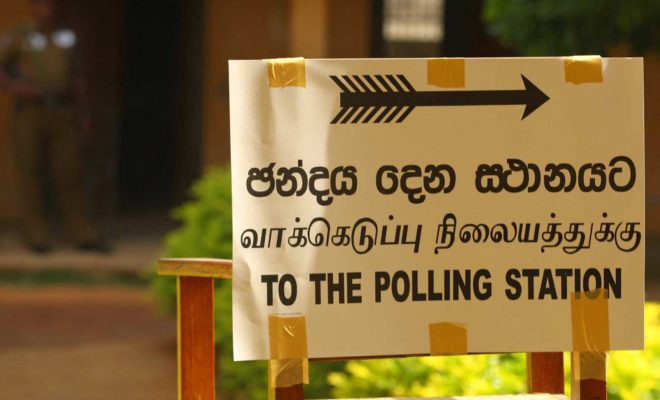
Photo credits: Groundviews
Issue: On October 11, 2024, the acceptance of nominations for the 2024 General Election (GE) concluded, with 690 nominations being accepted from political parties and independent groups across the country.[1][2][3][4]
The GE is scheduled to be held on November 14, 2024.[5][6]
Analysis
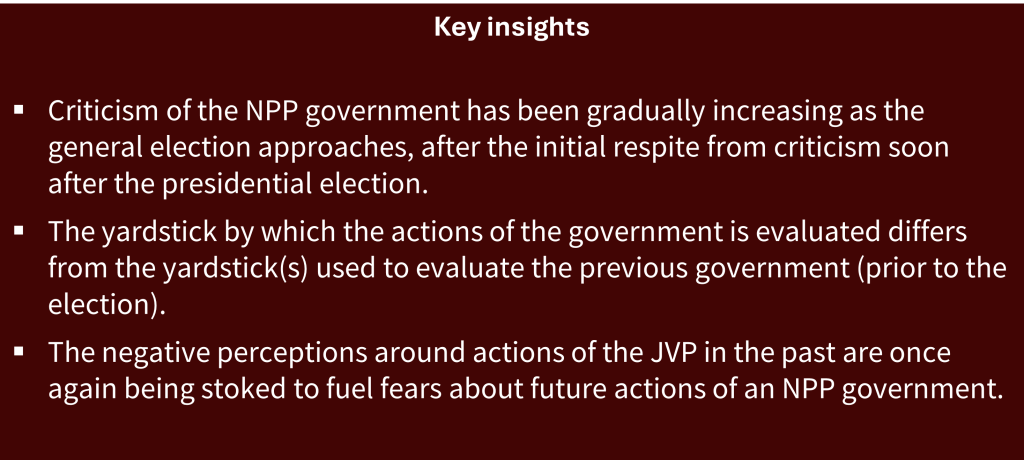
Last week’s issue of TMA analysed the limited criticisms directed at President Anura Kumara Dissanayaka and the NPP government.[1] The analysis set out three key aspects of such criticism, namely, the: (1) typical ‘honeymoon period’ following an election victory; (2) lack of new initiatives to scrutinise, given the dissolution of parliament; and (3) cautious approach, in executive actions, towards changing the status quo of existing policies.[2]
The present analysis notes a gradual increase in the criticism directed at President Dissanayaka and the NPP government – ahead of the upcoming General Election (GE) – in the Sinhala press reporting and TV coverage. This change was also evident in social media commentary, as analysed using the monitoring tool Junkipedia.[3]
This analysis will unpack the limited yet expanding criticism of the new president and the government through three frames: (i) the clash of contexts; (ii) the change in the yardstick; and (iii) fuelling fears about future actions of an NPP government.
Frame I: Clash of contexts: Media caught in the pre-GE and post-PE crosscurrents
The Sinhala media’s engagement with regard to the upcoming general election remains notably subdued, with little excitement or enthusiasm, despite the election being imminent. This media engagement contrasts with previous election cycles, when media outlets typically displayed a much higher intensity of reportage focused on elections.
The difference in media engagement may be attributed to the clash between the pre-GE and post-PE contexts. The tendency to favour positive coverage of a new government during the typical ‘honeymoon period’ following the PE appears to be clashing with the tendency to have heightened criticism of a government prior to an election. At present the media seems to be caught between the crosscurrents of these conflicting contexts that are concurrent.
Frame II: Change in the yardstick: Comparison between past and present governments
The expanding criticism of the NPP government reflects a change in the yardstick being used to evaluate government policies. Many lines of criticism of the NPP government are focussing on issues that were very much present during the government immediately preceding the present one, but without being subject to open criticism.
For instance, the privately-owned Mawbima highlighted that the NPP will be fielding father-son duos and spouses as candidates for the GE. However, family relationships in political parties are, and have been, commonplace and not been the main focus of criticism in the recent past. The previous government, led by former President Wickremesinghe, was primarily evaluated on its economic performance and the maintenance of the status quo, while significant prevalence of friend and family favouritism (nepotism) was generally overlooked.
This change in the yardstick (or what is salient) in terms of critical scrutiny is a result of the aspirations and expectations created by the NPP in the presidential election campaign. Dissanayaka’s election promises, especially those aimed at combatting and denouncing nepotism and corruption, have now emerged as the yardstick by which the NPP government is assessed by both its supporters and dissenters[4] (see this week’s memes for similar social media responses).[5]
This has happened in the past as well. In 2015, the yahapaalanaya government (2015 – 2019) – which won on a campaign of bringing about good governance, particularly in combatting corruption – was scrutinised much more on that yardstick of reducing and punishing corruption than was the government it replaced.[6]
Frame III: Fuelling fears: Building up billas
There was a pattern last week, of critical voices invoking implicit doubts and fears in the public psyche about the JVP and projecting them onto the NPP, as the party that has been formed around (and is still being led by) the JVP.
This strand of criticism, often with exaggerated or baseless claims, raised the spectre of many a billa (a Sinhala term that combines the meaning of a bogeyman and a fearsome outcome) in describing the potential future under an NPP/JVP political leadership.
The practice of projecting the trajectory of the political other as a billa is not uncommon in election campaigns. In the past, TMA has highlighted several instances, including with regard to the Millennium Challenge Corporation (MCC) Agreement and the development of the Hambantota Port, where the spectre of a fearsome outcome (billa) was created to sway public opinion away from a political party.[7]
The projections of billas to describe a future NPP government drew on implicit fears of communist-style governments assumed to over-ride private property and undermine democratic freedoms.[8] As unpacked in a previous issue of TMA, the past violence of the JVP-led insurrections of 1971 and 1987 – 1989 was also invoked in this billa creation practice of political criticism – to raise the spectre of Sri Lanka being overtaken by government managed mob rule instead of rule-based law and order.[9]
This strand of political critique was focused on the NPP, casting doubt over the stability and trajectory of the country if it came under a highly dominant JVP-led NPP government.
[1] See TMA Vol.14, #40.
[2] Ibid.
[3] The TMA team monitored Facebook profiles and pages using Junkipedia for the keywords election, Samagi Jana, Jathika Jana, loans and Easter Sunday. The monitoring period was October 14 to 18.
[4] For more information, see: https://www.npp.lk/en/policies/npppolicystatement.
[5] The Mawbima political column pointed out that the NPP’s Secretary Nihal Abeysinghe was contesting from Kalutara, while his son Chathuranga Abeysinghe was contesting from Colombo. Furthermore, the column noted that the spouse of national list candidate Bimal Rathnayake, Samanmalee Gunasinghe, was contesting from Colombo.
[6] See TMA Vol.05, #35; Vol.06, #10; Vol.08, #02.
[7] See TMA Vol.09, #25 & 26; Vol.08, #26; Vol.08, #28 & 29.
[8] Ibid.
[9] See TMA Vol.14, #38.