
September 23 – September 29, 2024 | Vol.14, #38 | ISSN – 2386-1827
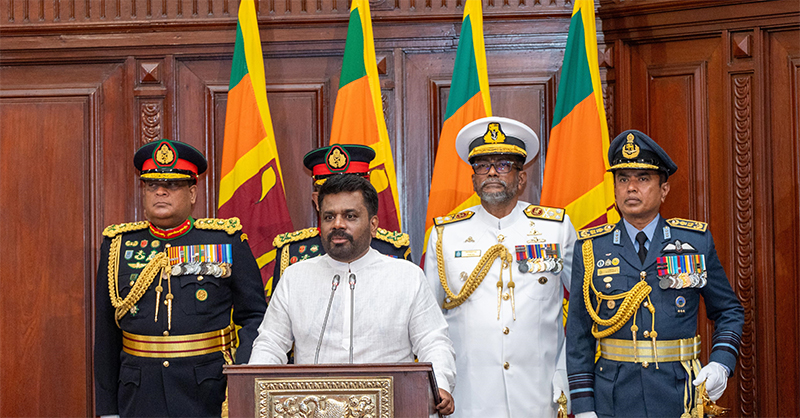
Photo credits: Lanka Truth
Event: On September 22, the Election Commission (EC) formally announced NPP Leader Anura Kumara Dissanayaka as the winner of the 2024 Presidential Election (PE).[1][2][3][4] Subsequently, on September 23, Dissanayaka was sworn into office as the ninth executive president of Sri Lanka.[5][6]
Analysis
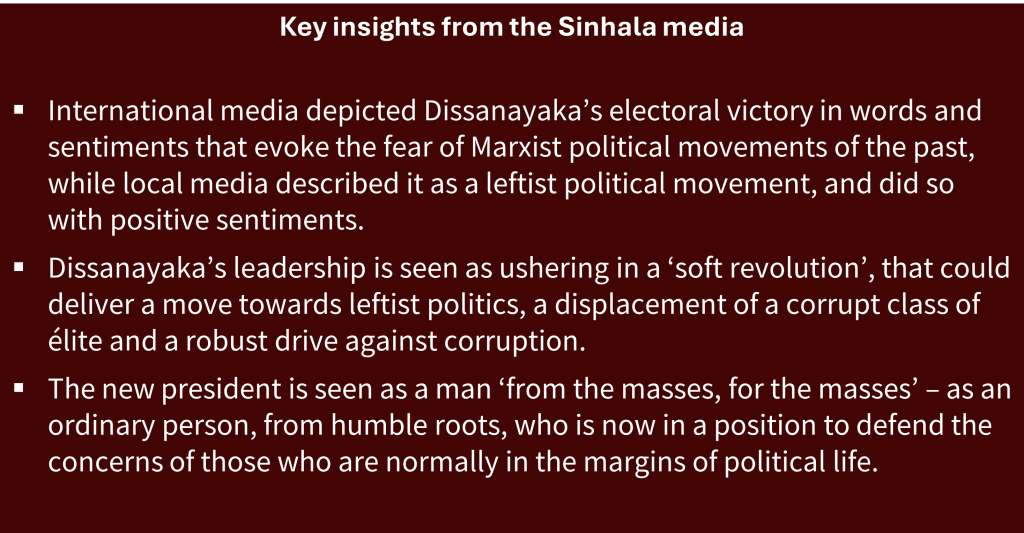
Sinhala media reporting, including print, TV and social media, predominately praised Dissanayaka’s win at the 2024 PE – framing it as a pivotal moment in Sri Lankan politics.
This week’s analysis highlights three key aspects of the media discourse surrounding Dissanayaka: (1) contrasting portrayals of the new president in the local and international media, (2) the sociological positioning of President Dissanayaka and (3) dimensions of a ‘soft revolution’, as seen through the media.
(1) Contrasting portrayals of the new president in the local and international media
International and local media portrayals of Dissanayaka contrasted on two key fronts: (a) the terminology used to describe Dissanayaka and (b) the connotations of ‘the left’ in international and local media.
(a) Terminology used to describe Dissanayaka: Marxist vs leftist
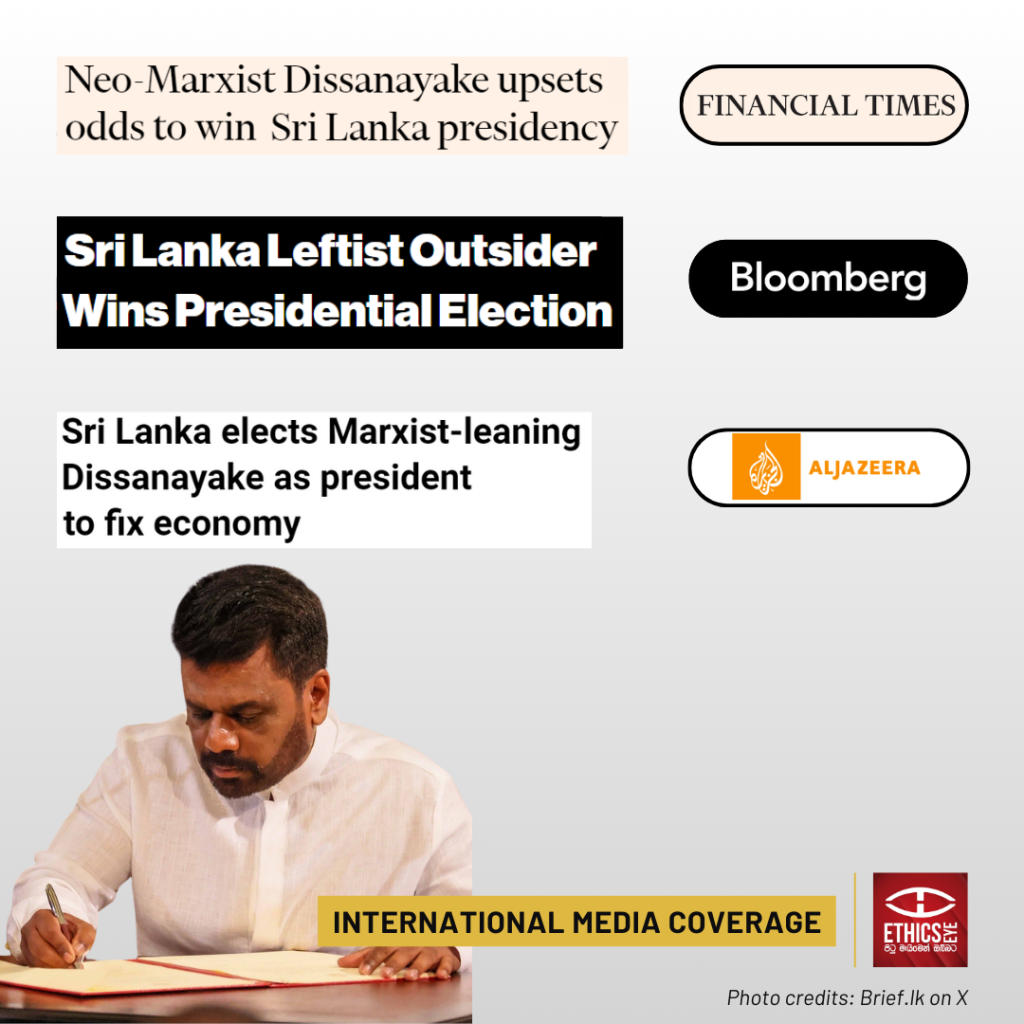
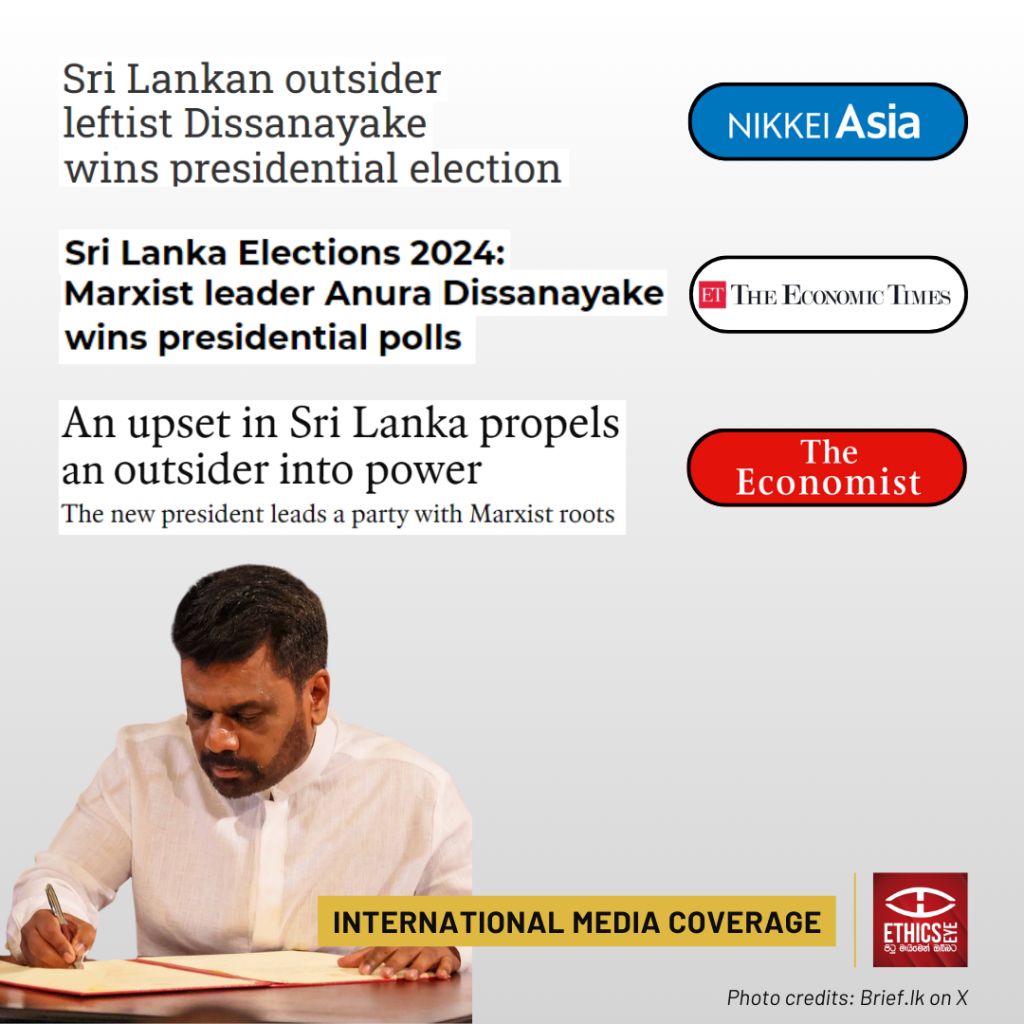
International media headlines frequently employed terms such as ‘Marxist’ to characterise Dissanayaka and the NPP’s election victory.[1] Alongside that, many outlets flagged the revolutionary/violent history of the JVP and its connection to the NPP.[2] By contrast, local media primarily used the term ‘left-leaning’, ‘socialist’, or ‘left leader’ and avoided describing him as a ‘Marxist’.
(b) The negative and positive connotations of ‘the left’ in international and local media
The international media’s use of ‘left’ carries negative connotations. Aligning
Dissanayaka with global leftist movements – often perceived as ‘radical’ – international media outlets tended to present Sri Lanka as going through a radical political shift, potentially evoking concern or scepticism among their audiences.
Conversely, Sinhala media employed the term ‘left-leaning/leftist’ and ‘socialist’ (and also ‘red star’) in a more positive light to emphasise Dissanayaka’s stance against the élite capture and corruption. The term ‘left-leaning’ in local media connotes his commitment to social justice and equality, and resonates with a public disillusioned and angry with what is seen as a corrupt establishment.
Thus, the contrast in the coverage of Dissanayaka between international and local media reflects different sensibilities: the former frames his victory negatively as a significant ideological shift with potentially radical implications, while the latter highlights positively Dissanayaka’s deep connection with the people and focuses on the potential for addressing societal inequalities and injustice.
(2) Sociological positioning of President Dissanayaka: ‘From the masses, for the masses’
The Sinhala media highlighted Dissanayaka’s ‘humble roots’, portraying him as an ordinary person who went through hardships in life common to the lower socio-economic classes (‘the masses’), as opposed to those from a privileged socio-economic status.[3]This depiction of Dissanayaka as a man emerging ‘from the masses’, together with his leftist political views and simple lifestyle have also positioned him as being ‘for the masses’. This is a sharp contrast with past presidents – who are seen to have been from relatively élite or politically connected families, with a relationship to the masses akin to a benevolent landlord.
This shift in the way Dissanayaka has been positioned symbolises him as dislodging not just his well-established political opponents but also an established socio-economic class that has monopolised political leadership. It has the effect of conferring greater dignity and the potential for upward mobility for a large social group that has otherwise seen itself as being in the margins.[4]
For instance, Sunday editions of privately-owned newspapers such as Divaina, Lankadeepa and Sathi Aga Aruna, along with the state-owned Silumina, featured articles highlighting his journey from a schoolboy in rural Thambuttegama, where he sold toffees in the market to support his family, to be elected to the presidency.[5] People were also asked in the political campaigns to identify him as ‘brother’ Anura (or affectionately referred to as Anura aiya – trans. Anura elder brother), rather than as ‘honourable’ or ‘respected’ which are references often used for political leaders.
This way of presenting himself reinforced the narrative of a leader who has risen ‘from the masses’ and, by remaining connected to his humble roots, can now also be ‘for the masses’.
(3) Dissanayaka as ushering in a ‘soft revolution’
Sinhala media discourse framed Dissanayaka’s electoral victory as if it were ushering in a ‘soft revolution’. Some forms of such narratives were also seen in the immediate post-election period around yahapaalanaya (2015) and Gotabaya (2019).[6] There are three distinctive features in the narrative surrounding the Dissanayaka ‘soft revolution’.
- The ascendancy of the political ‘left’: Dissanayaka’s victory is seen as a powerful leftward shift in Sri Lankan political leadership. Since 1977, all governments have either fully embraced or leaned towards centre-right capitalist values. In contrast, Dissanayaka’s leadership represents a movement grounded in strong socialist values. Sinhala media highlighted that this political shift aligns with public frustration over corruption and elitism, reflecting widespread dissatisfaction with the status quo. It reflects the growing societal demand for economic and social reforms rooted in equality and justice, as expressed within centre-left political views.
- Sense of a class revolution: Media narratives surrounding Dissanayaka’s victory conveyed a sense of a class uprising and resistance against entrenched political élites – where economic and class élites and traditional political families have been decisively dislodged by a movement grounded in working-class support. For example, Mawbima editorial framed his victory as a triumph for the masses and as a defeat of the dominance of the élite political establishment.
- Open confrontation of corruption: Dissanayaka’s victory was portrayed as a crucial point in the masses’ ongoing movement against the corruption of political and economic elites.[7] The political campaign of the Dissanayaka-led NPP was uniquely marked by the promise of confronting the scourge of corruption in the country and restoring economic outcomes which are more just and beneficial for most people.
[1] For more information, see: https://www.instagram.com/p/DASaqDcBf52/ and https://www.instagram.com/p/DAQnPm5Im7J/.
[2] [2] See TMA Vol.13, #07.
[3] See TMA Vol.14, #33, 34 & 35, #36, and #37.
[4] See TMA Vol.14, #02 & 03.
[5] For more information, see: https://asia.nikkei.com/Politics/Dissanayake-s-journey-from-toffee-seller-to-Sri-Lankan-president and https://www.aljazeera.com/features/2024/9/30/real-winners-of-sri-lankas-election-a-people-emboldened-to-force-change.
[6] See TMA Vol.05, #03 and Vol.09, #44.
[7] See TMA Vol.14, #02 & 03 and Vol.13, #05.