
Ethics Eye
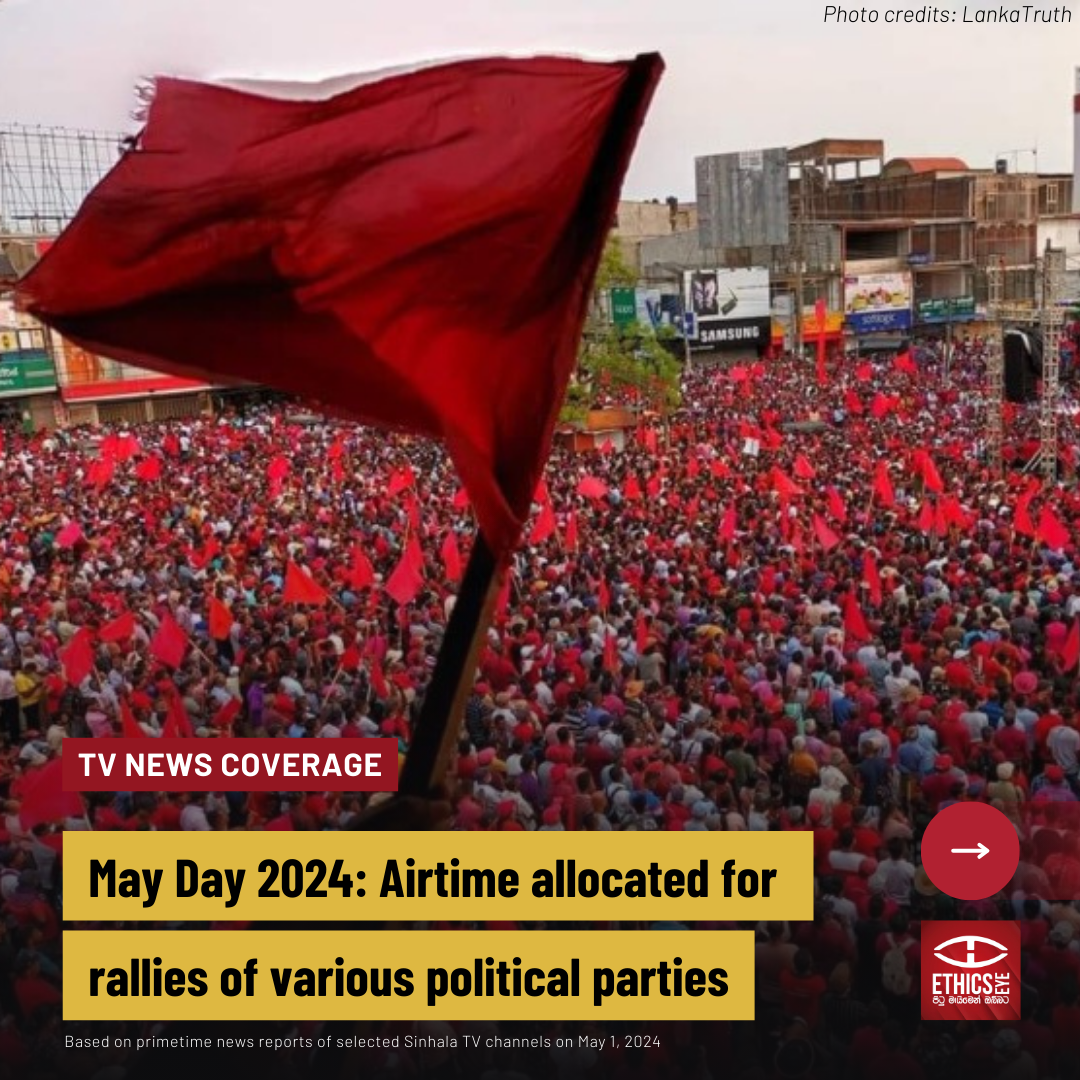
Around 40 May Day/Labour Day rallies were organised by various political parties across the island on May 1, 2024.
For more information, click here
This week in The Media Analysis...
1. Mayday May Day for labour and government parties
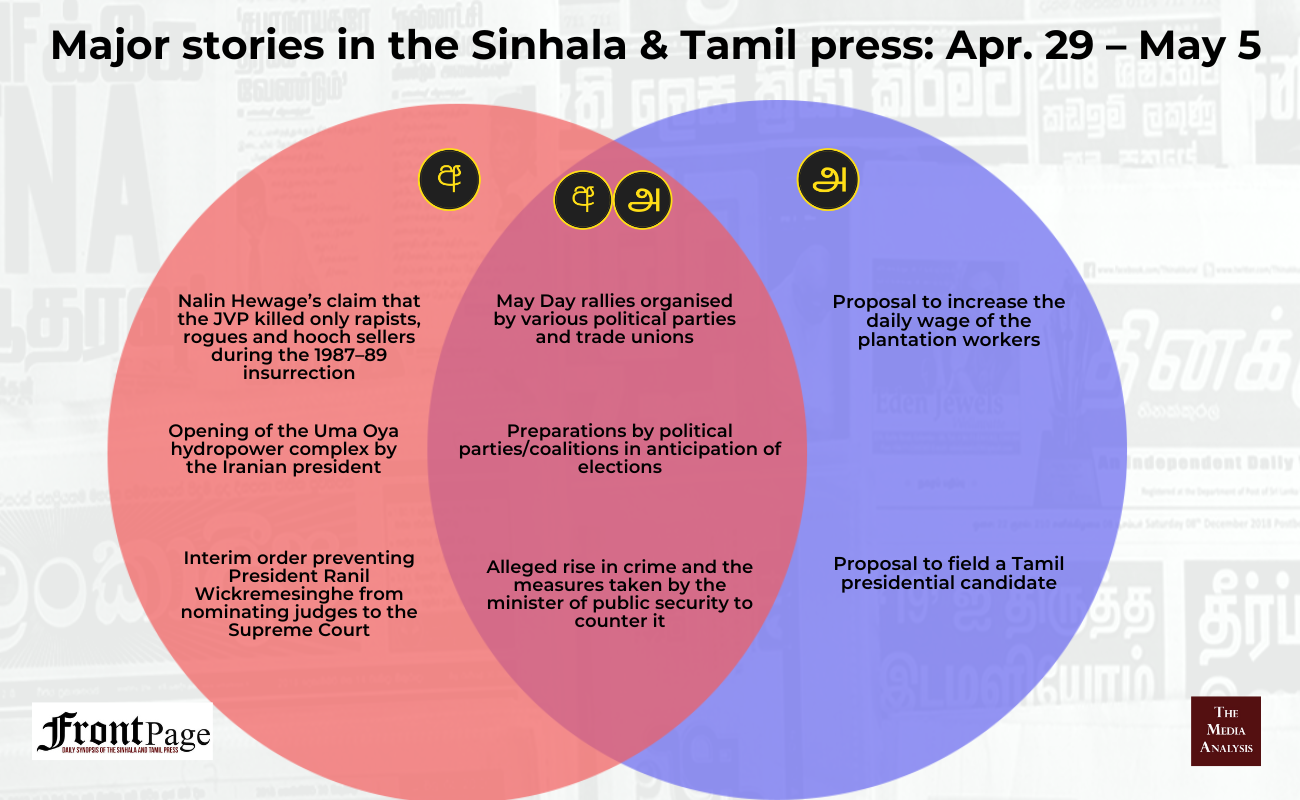
02. The Language Divide
03. The TV coverage of the issues
04. This week’s cartoons
05. This week’s memes
06. Other topics covered in reportage
Past issues can be viewed here
Disclaimer: This week’s TMA is focusing on the May Day/Labour Day rallies.
01. Mayday May Day for labour and government parties
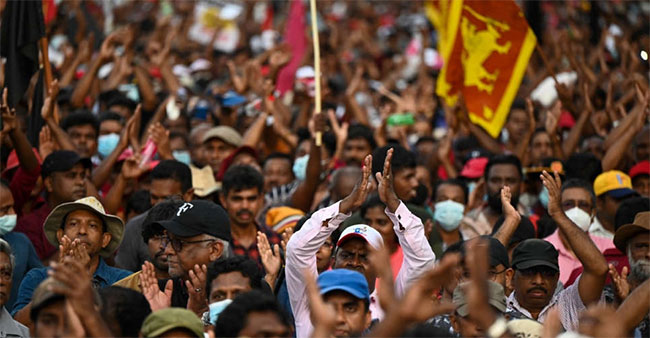
Photo credits: Ada Derana
Analysis
Last week’s Sinhala press reporting, TV coverage and social media posts overwhelmingly featured the May Day rallies organised by various political parties. Among the social media posts monitored this week for TMA using specific key search terms, the majority supported the May Day rallies organised by the NPP and the SJB.[1] In contrast to the rallies by political parties, rallies organised by trade unions not affiliated with any political party received only marginal coverage in the Sinhala print media and TV channels.
This week’s TMA will unpack the significance of this year’s May Day celebrations along two salient framingsdistilled from the Sinhala media discourse.
First framing: Exhibiting political strength
In Sri Lanka, May Day rallies mainly serve as a platform for political parties to exhibit their political strength, boost party morale and mobilise their popular support bases, including among trade unions.[2] Often, the Sinhala media perceives the turnout at rallies, especially in election years, as an indicator of the party’s popularity.
In last week’s Sinhala media coverage, the May Day rallies of the NPP and the SJB stood out from the other political parties in their display of numerical strength. Between the two political parties, the NPP distinguished itself not only by having a larger turnout but also by the quality of content.
Larger turnout: The Sinhala media portrayed the NPP as having attracted the largest crowds for all four of its May Day rallies held in Colombo, Anuradhapura, Matara and Jaffna than any other political party. The media commentary explicitly cited the NPP as the clear winner in terms of having the largest crowds at its May Day rally.[3]
Quality of content: The NPP rallies and speeches, as covered in the media, also distinguished themselves from others by the appearance of greater discipline and decency in the way the crowds and speakers conducted themselves. Unlike the speeches made by most other political parties covered in the media, the speeches made by the NPP – as featured in the media – were devoid of obscene innuendo about political opponents. The NPP rallies as shown in the media also eschewed any form of entertainment such as the musical shows following the rallies[4] or singing and dancing during the rallies; however, these were typical features at other rallies shown on TV. Therefore, a closer analysis of the May Day rallies and speeches of the NPP showed a better sense of decency and discipline, setting it apart from the rest of the rallies.
In addition to the NPP and SJB, the UNP and SLPP were also discussed in the media in relation to May Day.
UNP: The Sinhala media positioned the UNP as slowly regaining its political strength. As observed in past issues of TMA, the UNP and President Ranil Wickremesinghe continued to – albeit marginally – be credited with attempting to rebuild Sri Lanka’s deteriorating economy.[5] However, a closer analysis of the media discourse on the UNP reveals that it is anticipated to be a strong party only if it is supported by at least a faction of the SLPP or the SJB.
SLPP: Continuing past media trends, the Sinhala media positioned the SLPP as a weak political party.[6] For instance, the privately-owned newspaper Anidda observed the transformation the SLPP has undergone from being a party receiving a two-thirds majority in parliament in 2020 to being a party that has diminished in its size and support by 2024. However, it seems to be positioned somewhat better, compared to where it was during the period of the aragalaya (wave of democratic protests in 2022)[7] when the SLPP faced vocal and outright public rejection.
Second framing: Excluding the worker
As observed in past issues of TMA, the Sinhala press continued to lament the ‘over-politicisation’ of May Day rallies, where workers’ issues are seen to be upstaged by party politics.[8] Press editorials appearing in state-owned Dinamina and privately-owned Aruna, Divaina, Mawbima and Lankadeepa framed May Day as being politicised to the extent that there is no space for the representation of the rights and aspirations of the workers. The ‘over-politicisation’ of May Day rallies appears to be largely tied to the close ties between trade unions and political parties in Sri Lanka.[9]
The print media discourse on the over-politicisation of May Day also revealed a sense of nostalgia for the once-idolised symbolic figure of “the worker” in Sri Lanka. Historically, Sri Lanka’s labour movements have been strongly influenced and shaped by concepts from the political left. Consequently, “the worker” (kamkaruwa in Sinhala) tended to be portrayed as a victimised but heroic figure in search of social justice.[10] However, this idealised image of “the worker” does not seem to resonate with the collective imagination in Sri Lanka in the present day, and has become a diminishing feature in the mood of the May Day rallies. It is for this lost imagery of “the worker” that a sense of nostalgia appeared in print media commentary.
Outside the above two media framings, there was a notable shift in the messaging of political parties in preparation for elections. In the past – especially in the run up to the 2019 Presidential Election and the 2020 Parliamentary Election – the political messaging at rallies including May Day rallies has appeared to be shaped by issues affecting the Sinhala-Buddhist constituency.[11] In these rallies, the political parties seem to have shifted their attention to focus much more on issues faced by the non-Sinhala-Buddhist voters. All three key political parties staged rallies in locations with significant non-Sinhala-Buddhist voters. For instance, the UNP along with the Ceylon Workers’ Congress held a rally in Kotagala, and pledged to increase the wage of the plantation workers.[12] Similarly, the SJB along with the Tamil Progressive Alliance (TPA) organised a rally in Nuwara Eliya.[13] Meanwhile, the NPP held a May Day rally in Jaffna, in addition to other rallies it held in areas such as Matara and Anuradhapura.
Overall, the 2024 May Day rallies appeared to serve as a platform for political parties to convey their key messaging ahead of an anticipated election. The UNP presented itself as the party capable of bringing economic stability,[14] while President Ranil Wickremesinghe positioned himself as the leader who took on the challenge of rescuing Sri Lanka. The SJB portrayed itself as capable of ushering in a ‘system-change’, promising to combat corruption and improve governance.[15] Opposition Leader Sajith Premadasa positioned the SJB as highly effective despite lacking state power, and as taking a more acceptable ‘middle path’ among the political divides of the country. Meanwhile, the NPP positioned itself as a people’s movement advocating for a democracy that represents the masses[16] and opposes the élite capture of the state.
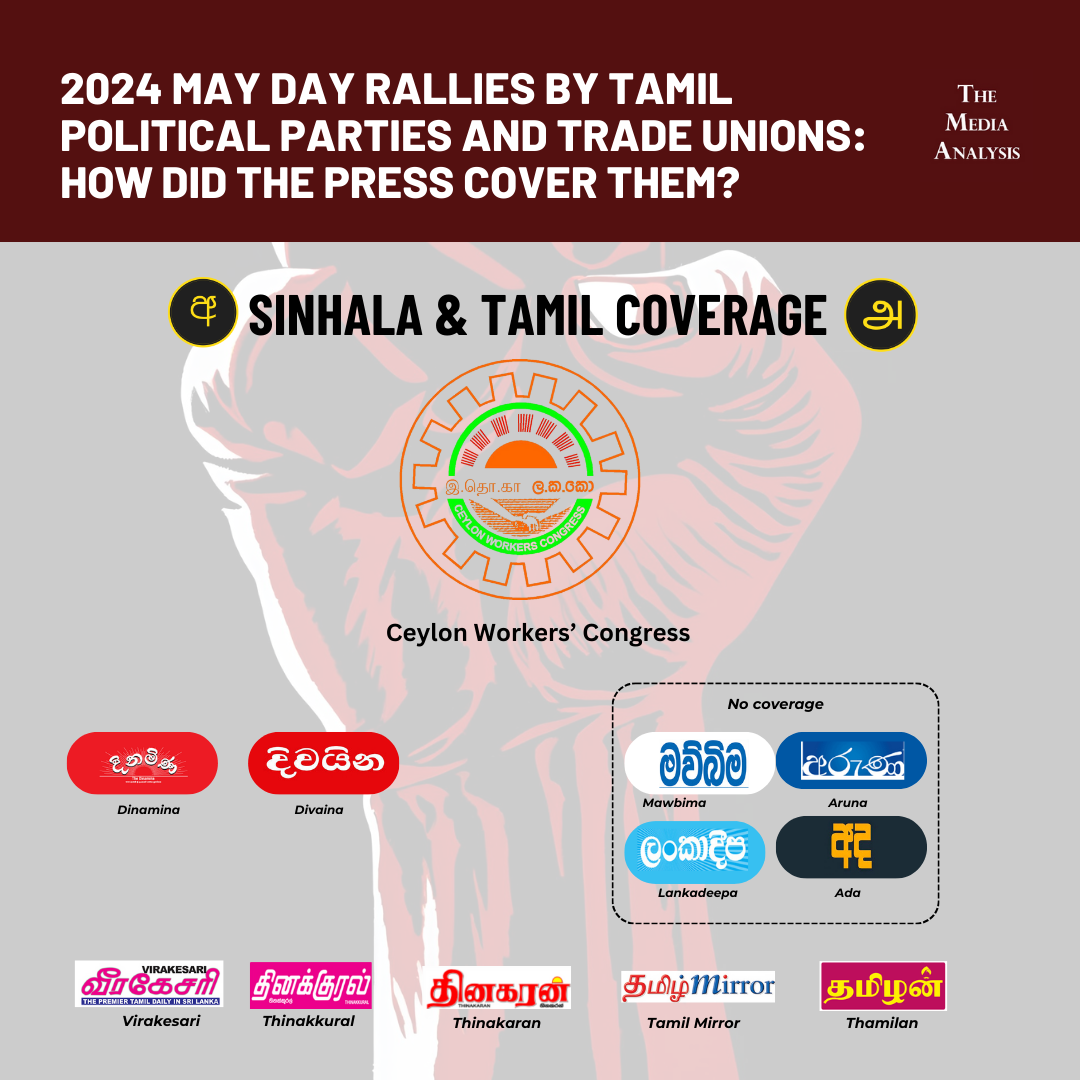
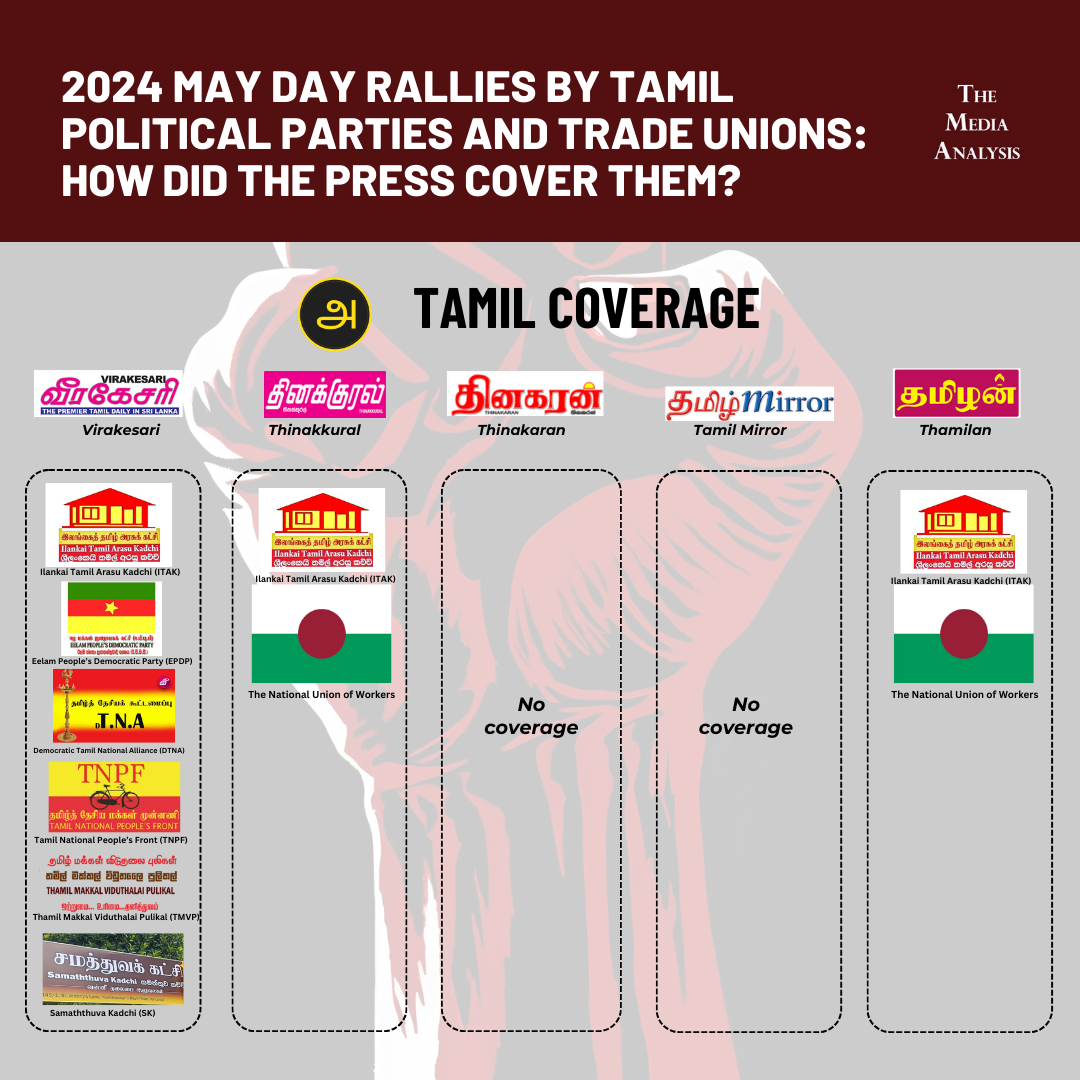
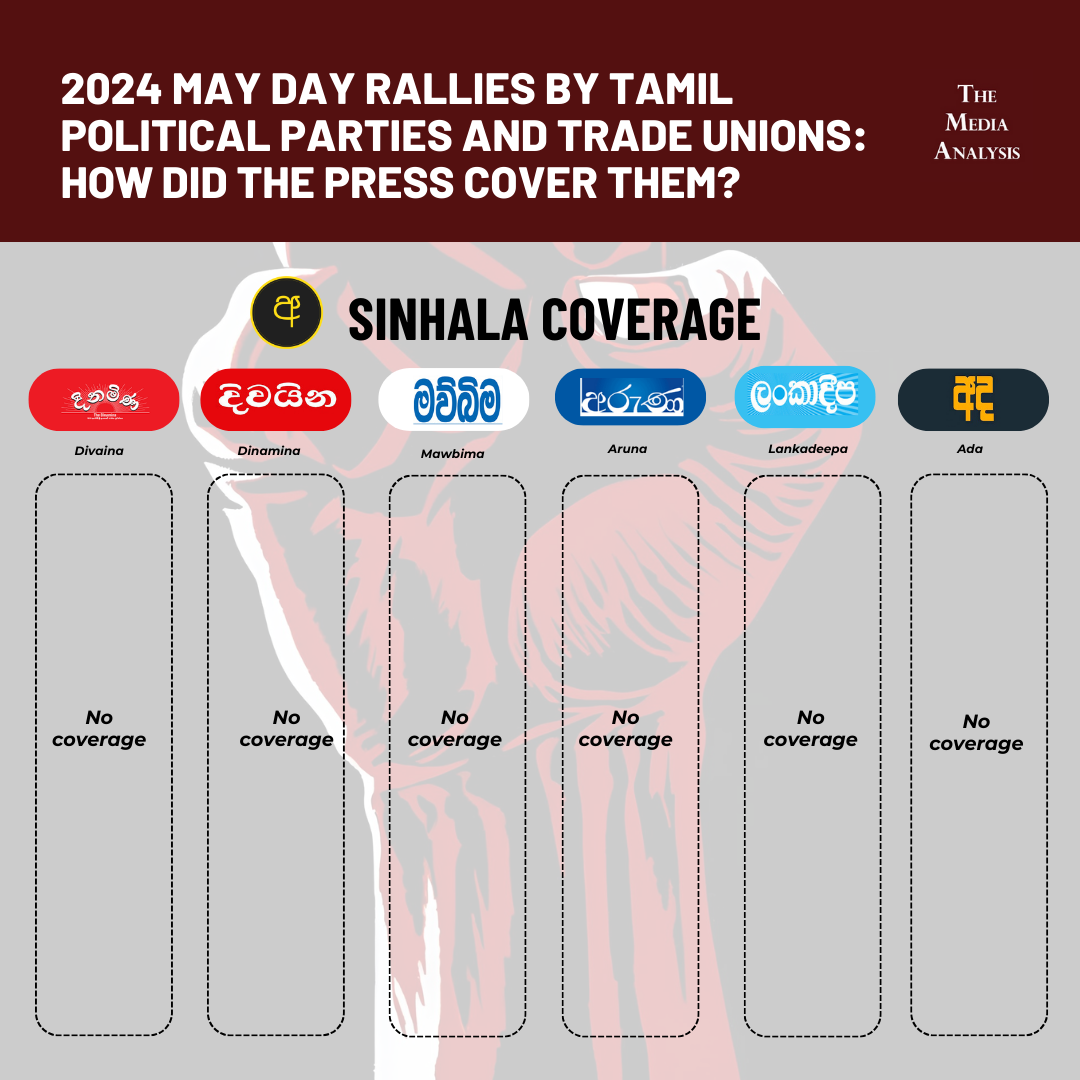
02. The Language Divide
Signposts the differences and nuances in reporting between Sinhala and Tamil language newspapers
|
|
|
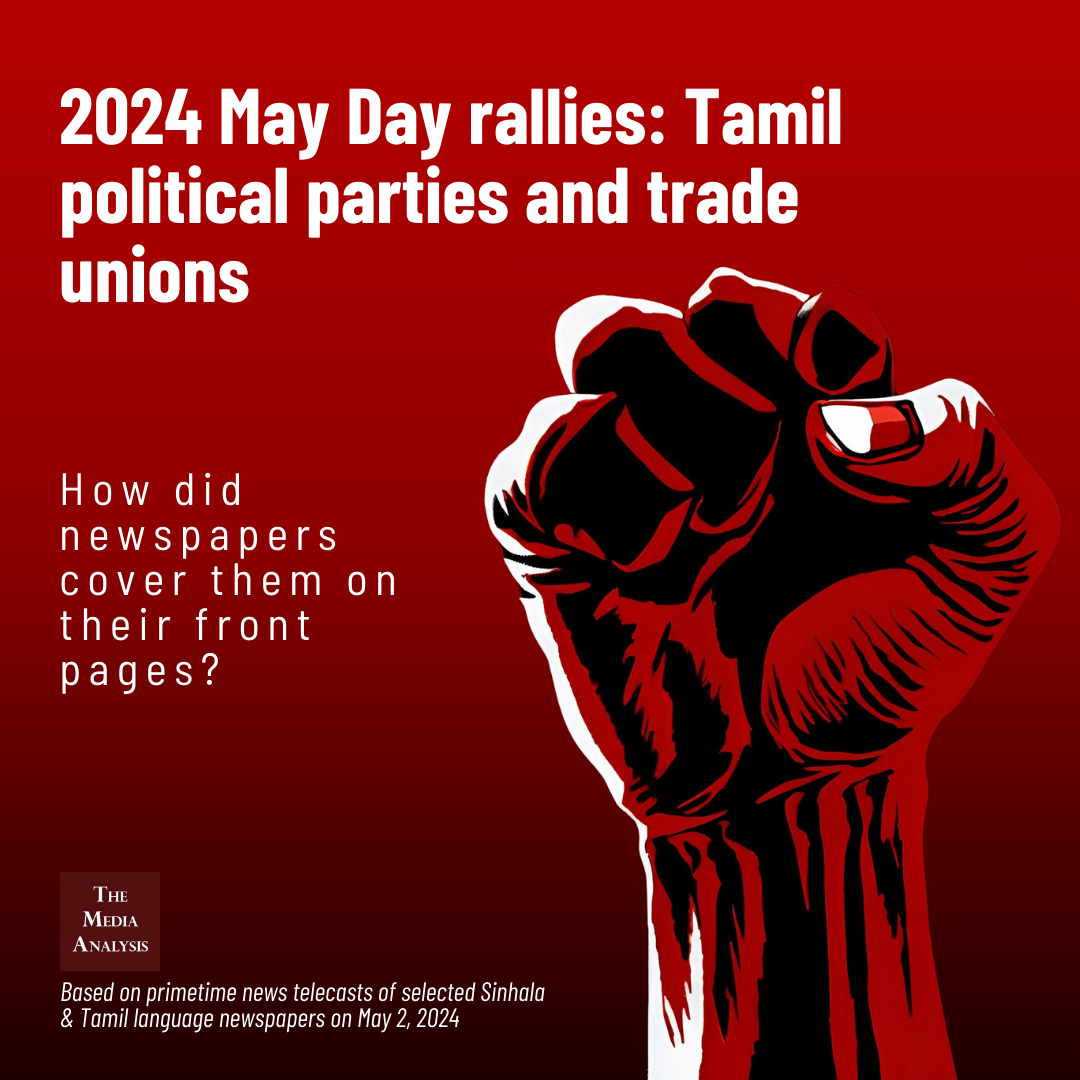
03. The TV coverage of the issue
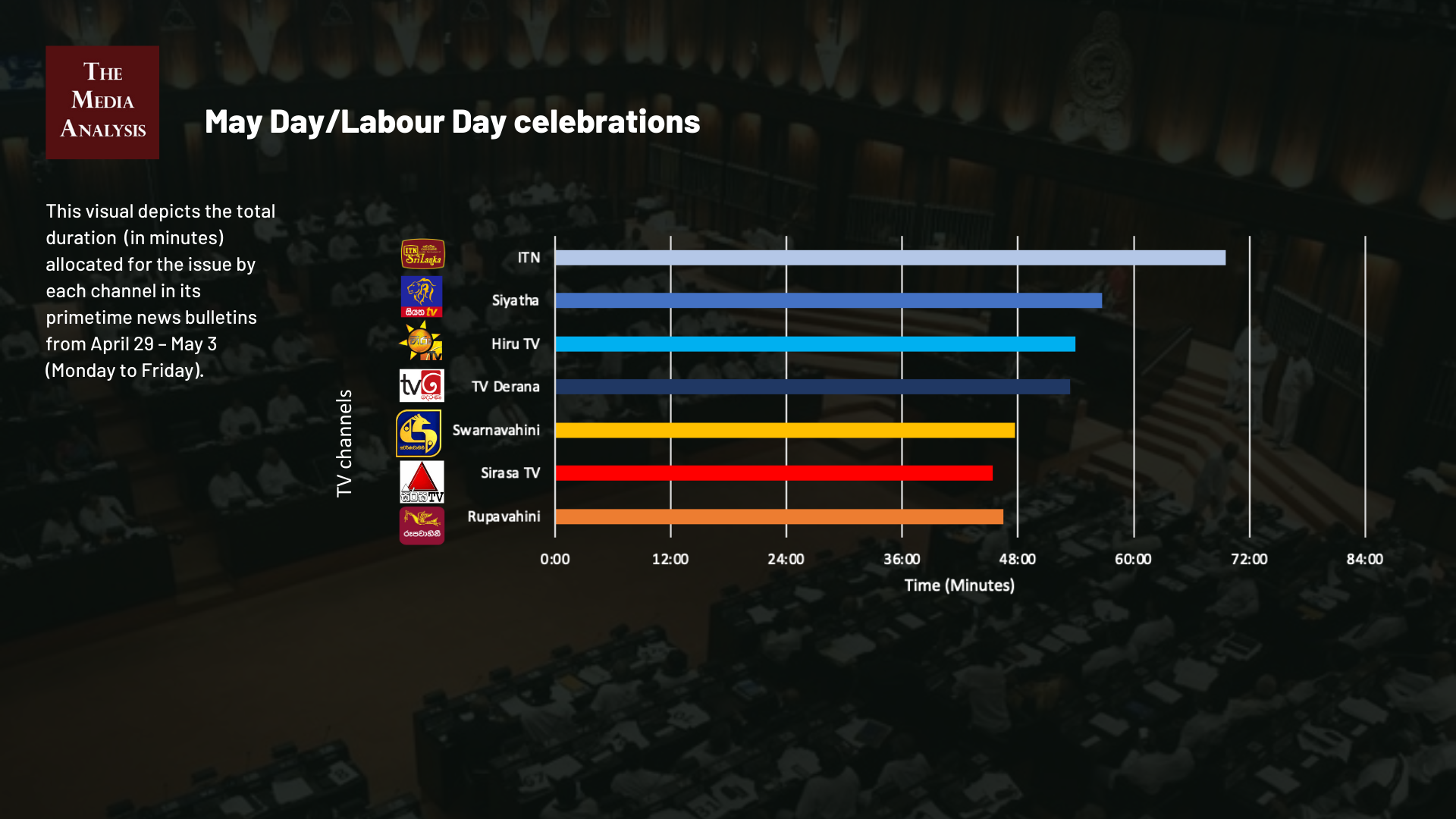
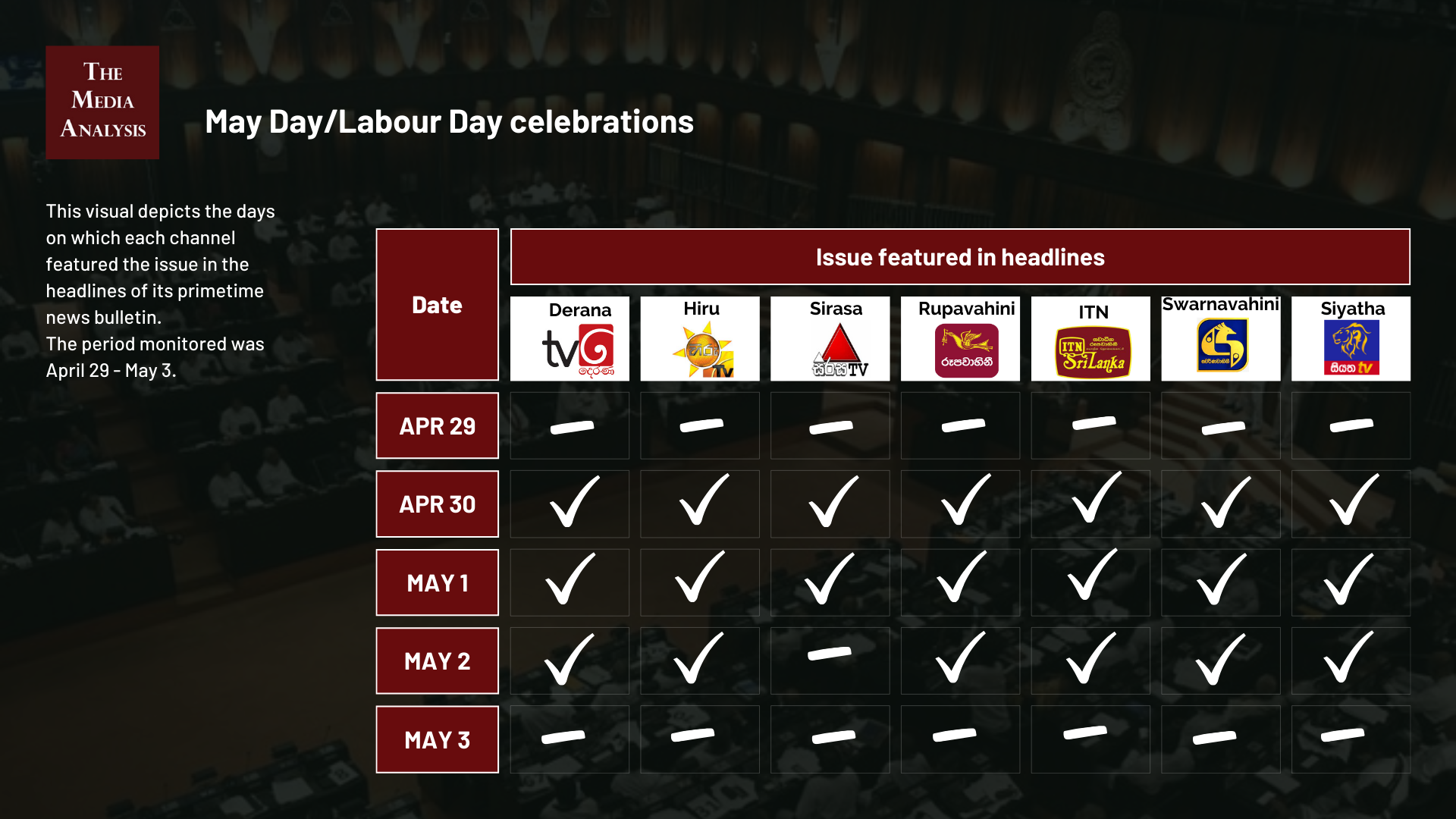
The data on television coverage is based on the monitoring of the primetime news telecasts of selected Sinhala language TV channels uploaded to YouTube.
04. This week’s cartoons
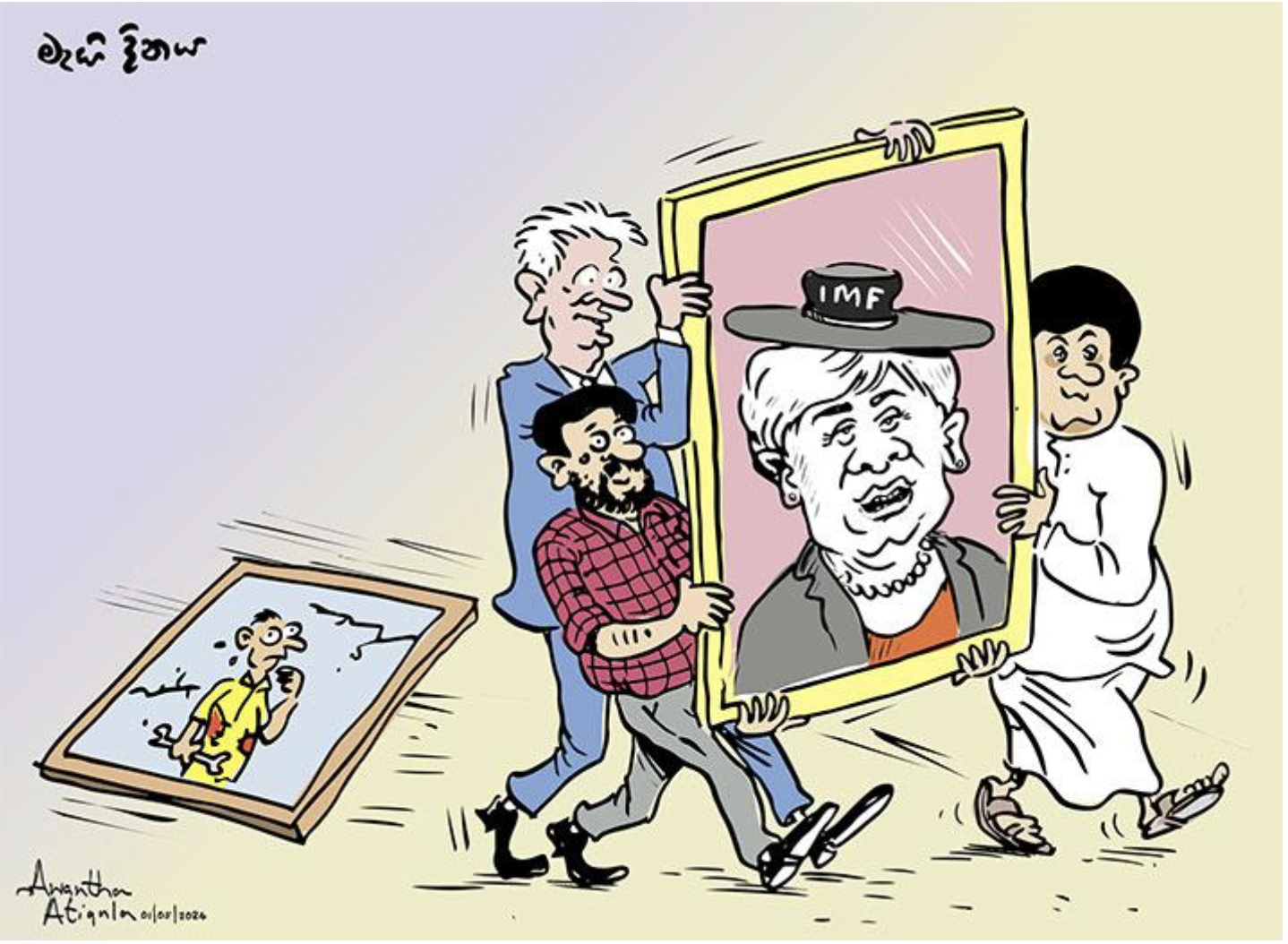
Courtesy of Ada, May 1, 2024
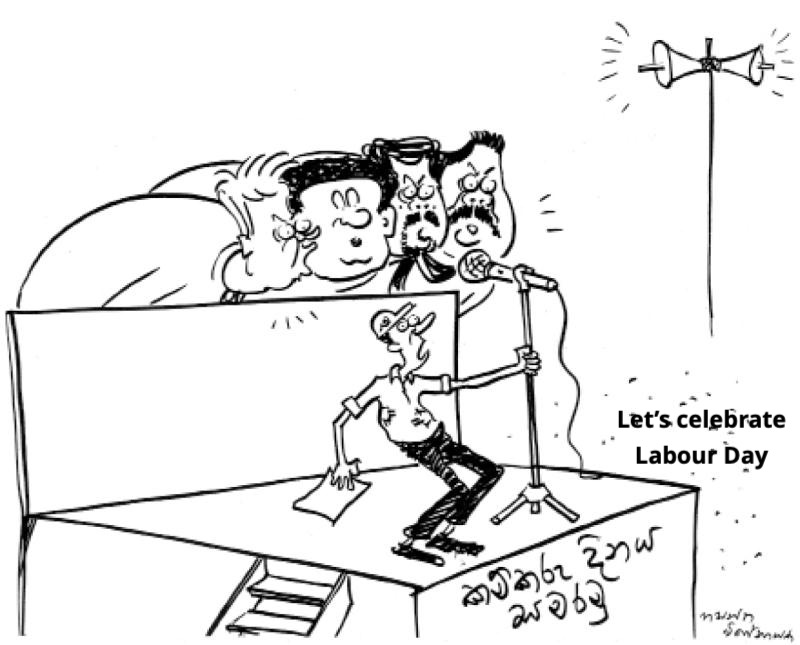
Courtesy of Aruna, May 1, 2024
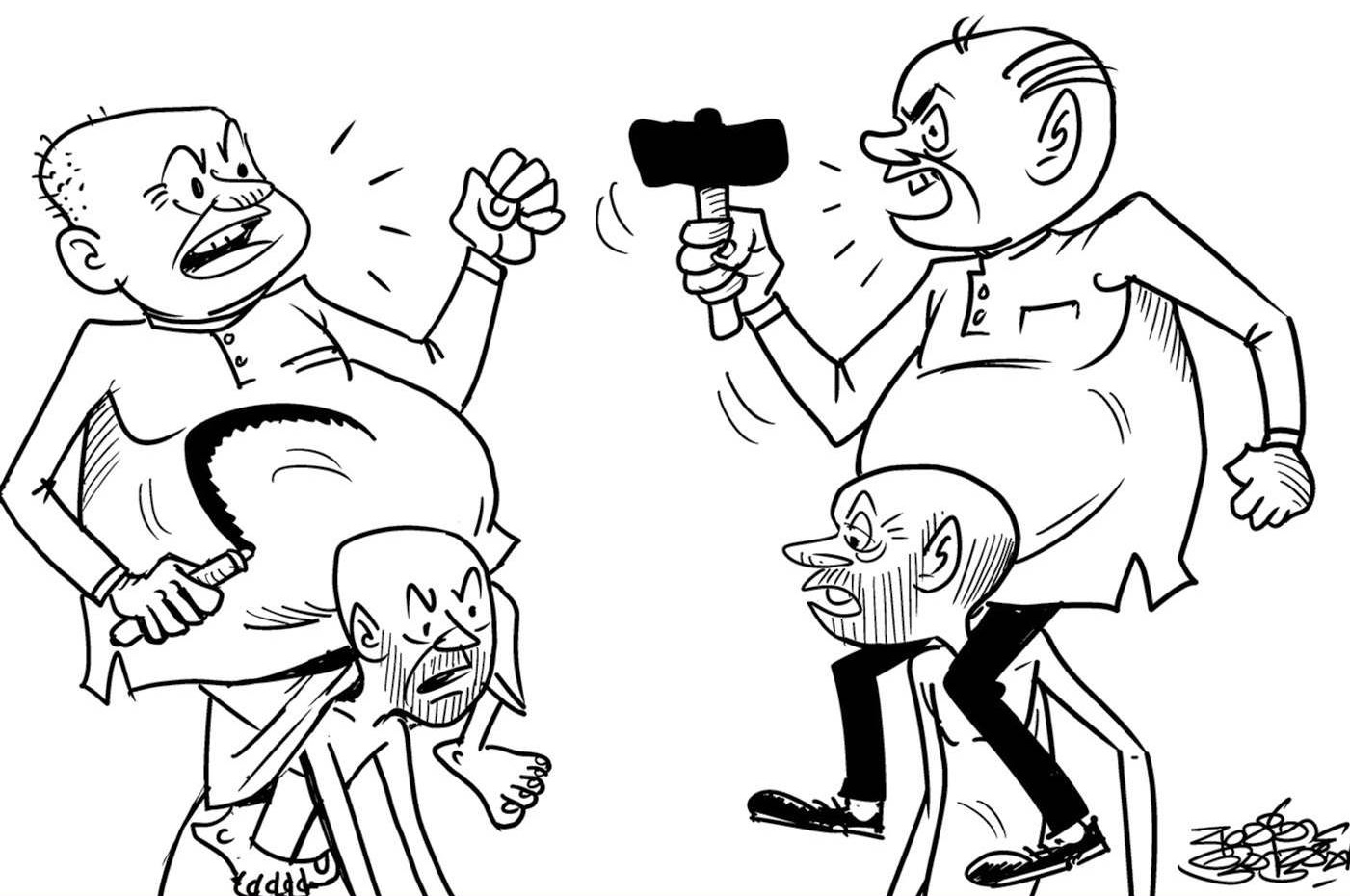
Courtesy of Dinamina, May 1, 2024
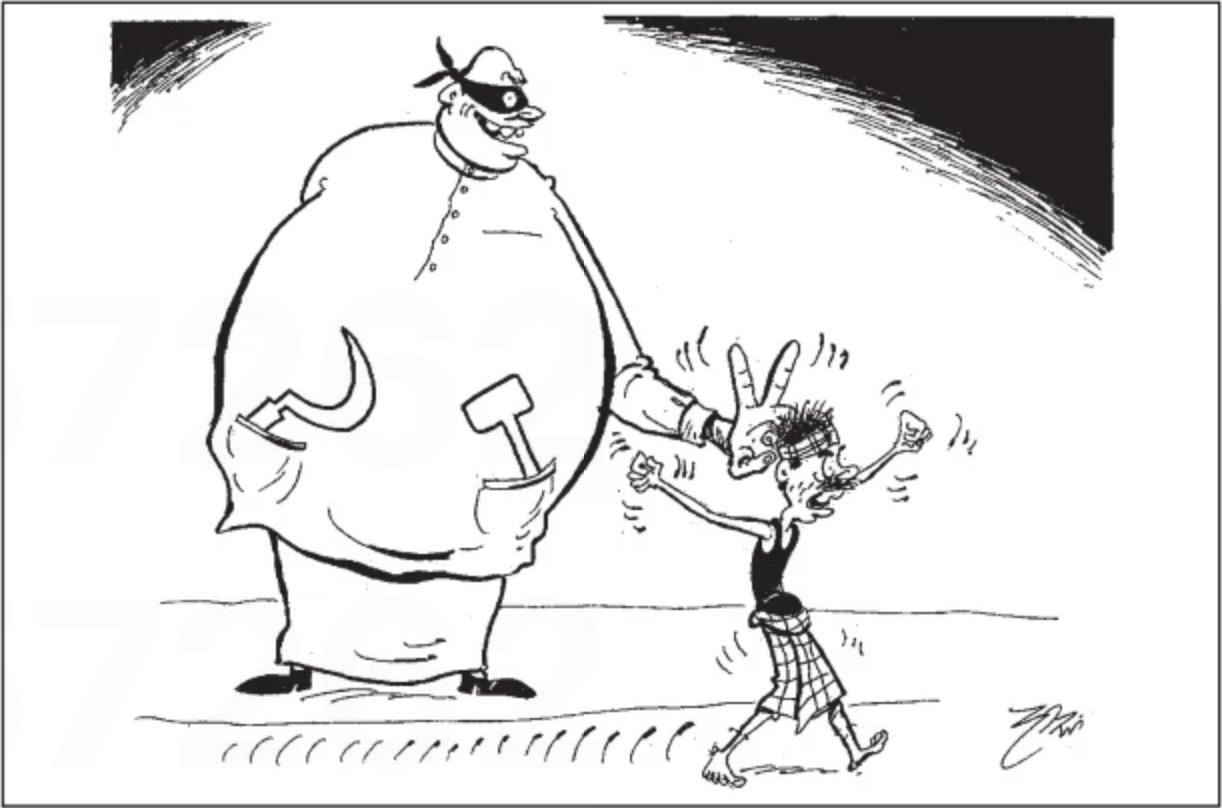
Courtesy of Lankadeepa, May 1, 2024
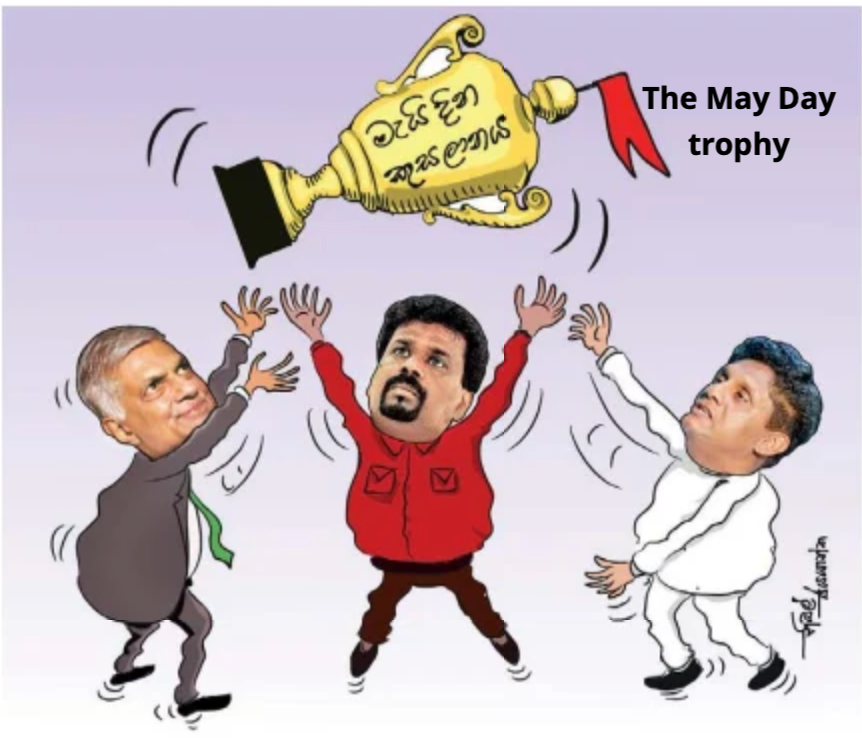
Courtesy of Sunday Lankadeepa, May 5, 2024
05. This week’s memes
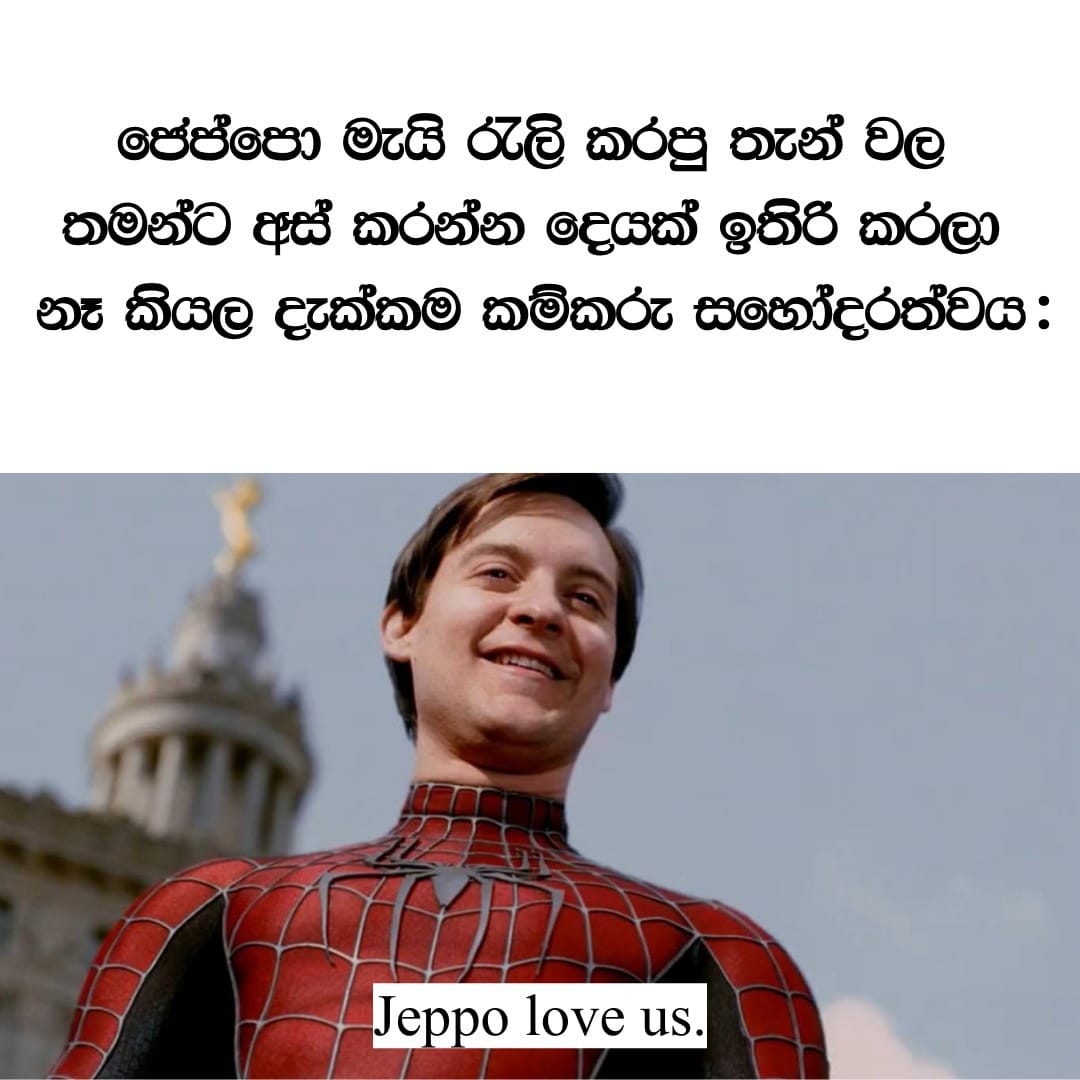
When the brotherhood of labourers sees that the jeppo (JVP) has left them nothing to clean up in the places where it held its May Day rallies:
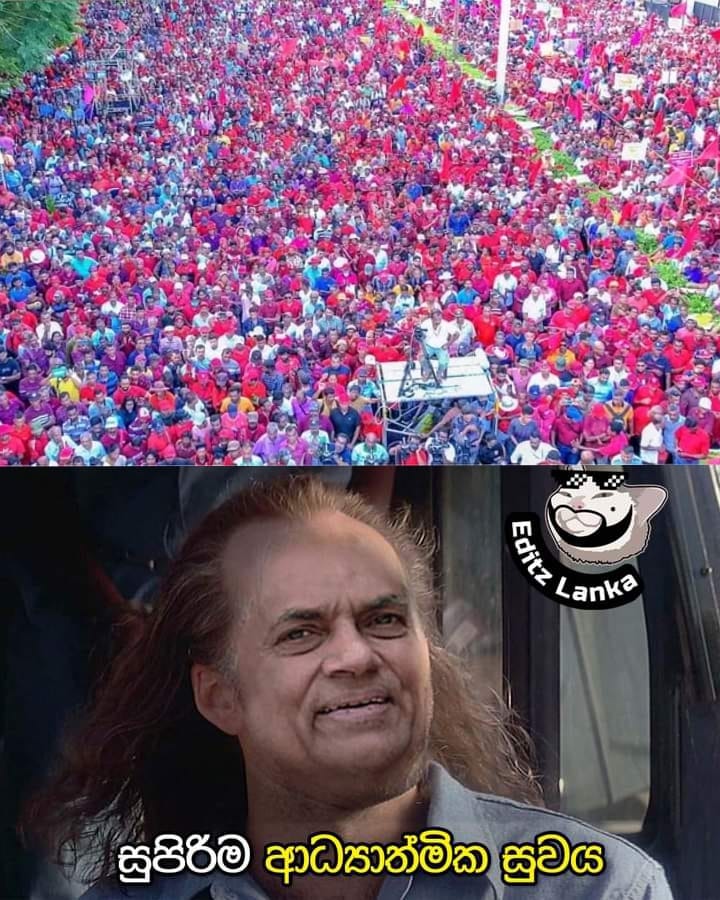
The most supreme spiritual bliss
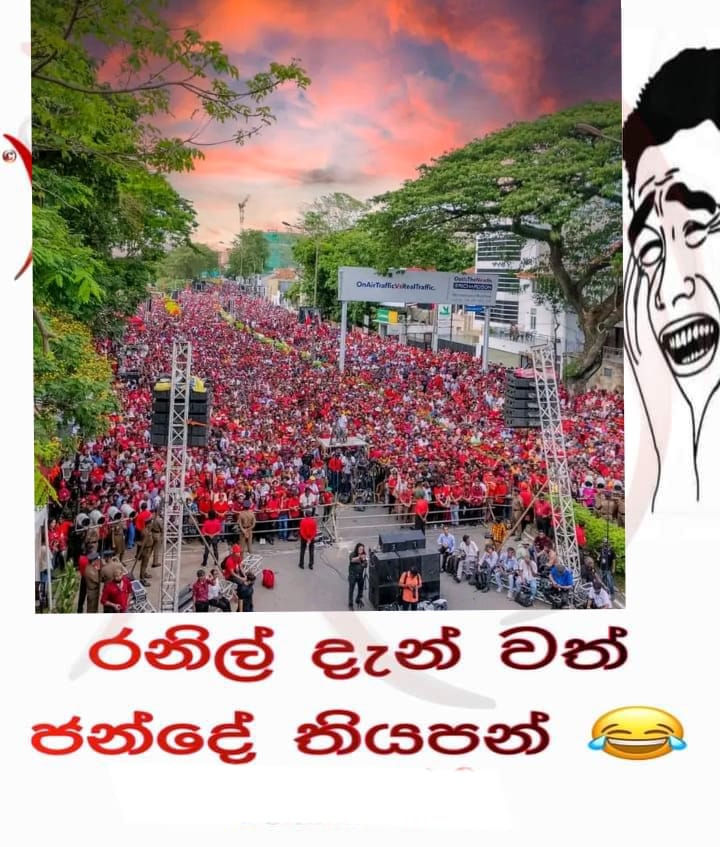
Ranil, at least now hold the election
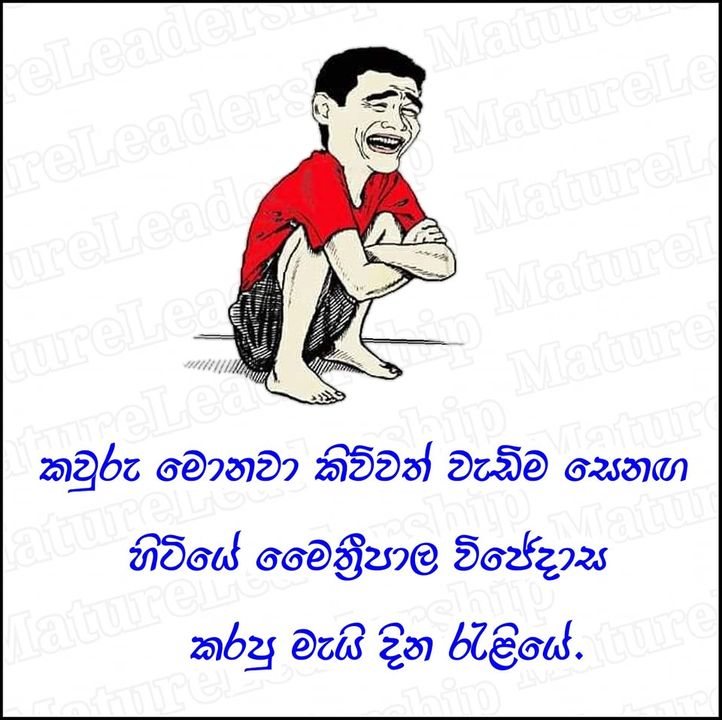
No matter what anyone says it was Maithripala Wijeyadasa’s May Day rally that had the biggest crowd
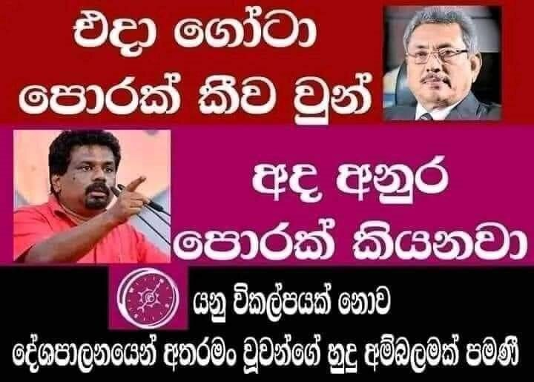
Those who said that Gota (Gotabaya Rajapaksa) was a great man at that time are today saying that Anura (Anura Kumara Dissanayaka) is a great man. The ‘compass’ (the NPP) is not an alternative force. It is just a shelter for those who have lost their way in politics
06. Other topics covered in reportage
- The government’s proposal to increase the wage of the plantation workers
- Criticisms of a foreign company issuing visas at the airport
- Provision of liquor licenses to opposition MPs
- Reduction in the price of LP gas
- Securing the third tranche of the IMF Extended Fund Facility (EFF)
To view this week’s news summaries, please click here