
July 8 – July 28, 2024 | Vol.14, #28, 29 & 30
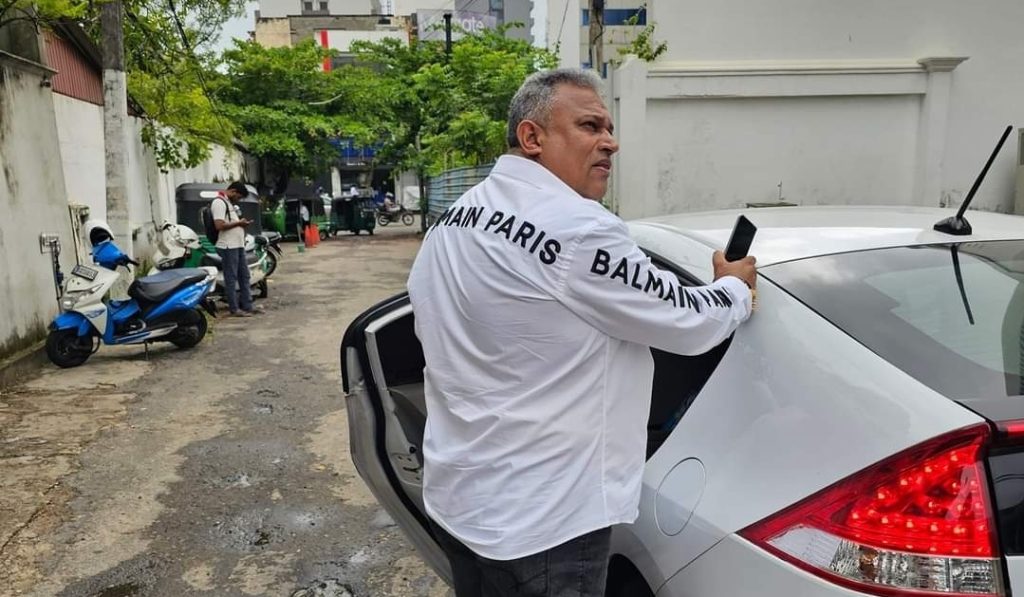
Photo credits: NewsWire
Highlights: Certain segments of social media expressed sympathy for Club Wasantha’s death, despite his connections to the criminal world.
The killing of Club Wasantha resurfaces concerns entrenched within the Sinhala psyche conerning (1) drugs, (2) police conduct and (3) public safety.
Issue: On July 26, the Election Commission of Sri Lanka issued the gazette notification announcing that the 2024 Presidential Election will be held on September 21.[1][2]The commission further declared that nominations will be accepted on August 15.[3][4]
Some key incidents that were covered in the media over the past three weeks are as follows:
On July 8, businessperson Surendra Wasantha Perera alias Club Wasantha was killed in a shooting incident in Oruwila, Athurugiriya.[5][6] Following the incident, the Sri Lanka Police released a video of the police interrogation of the tattoo studio owner allegedly aiding the murder of Perera.[7][8][9]
Analysis
The killing of Surendra Wasantha Perera received widespread coverage across various Sinhala newspapers, TV channels and social media commentary. Club Wasantha, who had been allegedly associated with underworld figures, was killed in the broader context of the government’s anti-drug operation named ‘Yukthiya’ (trans. justice).[1]
This week’s analysis comprises of two brief sections: an analysis of social media users’ reactions to his death (findings from CrowdTangle, the social media monitoring tool used in TMA) and three entrenched concerns within the Sinhala psyche that resurfaced following Wasantha’s killing. These concerns are in relation to (1) drug-related issues, (2) police conduct and (3) public safety, which also play a critical role in electoral campaigns.
Part I – Surendra Wasantha Perera through a social media lens
Perera, also known as Club Wasantha for his ownership of several nightclubs, was a prominent businessperson with a significant social media presence. In the past, the Sinhala media has often justified killings of individuals linked to criminal activity. For instance, the killing of Makandure Madush, a known drug kingpin, was justified as a necessary action to stop his unlawful activities.[2]
Despite Perera’s alleged connections to the criminal world, he received a significant amount of sympathy from a segment of social media users. His consistent social media activity when he was alive garnered him followers who kept up with his daily life. He was depicted as a family-oriented individual[3] known for his generosity, demonstrated through various donations to temples and other social causes.[4]
Part II – Three entrenched concerns
The three entrenched concerns related to (1) drugs-related issues (2) police conduct and (3) public safety following Wasantha’s killing are briefly unpacked below.
1. Concern over drugs
In the Sinhala mainstream media, individuals involved with the underworld and criminal activities are frequently depicted as a form of ‘evil’ that needs to be ‘done away with’.[5] In the past, especially during the administration of former President Mahinda Rajapaksa, this antipathy towards these individuals afforded exceptional acceptance to justify extrajudicial killings of suspected underworld figures, which were popularly viewed as a ‘necessary evil’.[6]
During the peak of the COVID-19 pandemic, former President Gotabaya Rajapaksa acted with what can be termed as “COVID-19 license” – suspending democratic processes – to ‘combat the pandemic’.[7] Thus, there have been several instances in Sri Lanka’s political history when there has been public acceptance when governments have worked outside of a democratic framework to respond to an emergency/crisis situation.
In this context, the anti-drug operation of the incumbent government, ‘Yukthiya’, appears to receive similar exceptional acceptance and legitimacy from the public to combat the ‘war’ against drugs.[8] For example, according to a syndicated survey conducted by Verité Research in February 2024, about two-thirds of the respondents expressed positive views about the ‘Yukthiya’ operation as being successful in combating drugs, even when half of them did not think it was being conducted in a reasonable/fair manner.
2. Concern over police conduct
There was much criticism – that highlighted an underlying mistrust in the public psyche – of the police’s ability to apply and enforce the law equally and follow due process.
A section of the press and social media criticised the police for failing to protect the rights of a murder suspect. Media outlets, including the privately-owned Aruna and Aniddanewspapers, and MP Anura Kumara Dissanayaka condemned the police for turning the investigation into Perera’s assassination into a “media spectacle” by releasing a video of the suspect’s confession to the public.[9]
3. Concern over public safety
Media voices, including MP Sajith Premadasa and privately-owned newspapers Aniddaand Lankadeepa, criticised the government and police for their inability to safeguard the public. Critics argued that despite the government’s claims of success in efforts to curb organised crime gangs and assurances that security measures are adequate, assassinations like that of Wasantha, in a ‘Chicago-style shooting’, continue to take place.
Overall, despite the above criticism, the ability of the political leadership to act on huge public concerns is an important aspect of public acceptance of government. In this regard, the incumbent government and the president appear to have gained some legitimacy from the ‘Yukthiya’ operation.
[1] See TMA Vol.14, #15.
[2] See TMA Vol.10, #43.
[3] For more information, please see https://www.tiktok.com/@_wasantha_official_/video/7393961300532940039; https://web.facebook.com/reel/830462525701012 and https://web.facebook.com/reel/1027127605473873.
[4] For more information, please see https://www.facebook.com/100068708289212/posts/785635550403381 and https://ceylondailynews.lk/home/2024/07/09/club-wasantha-dead/.
[5] See TMA Vol.02, #41; Vol.07, #09; Vol.08, #32.
[6] See TMA Vol.07, #09.
[7] See TMA Vol.13, #08, 09 & 10.
[8] See TMA Vol.09, #07 & 08; Vol.14, #15.
[9] For more information, please see https://www.facebook.com/ethicseye/posts/pfbid0dfHSVQzA6DXjnQ8K9TPN3iLkWnoMEXkqLofs1NRXzbqwAtED9hRXn5DQF4NdVus6l?rdid=F9TgNHERzkkYkWuf.