
August 5, 2024 — August 11, 2024
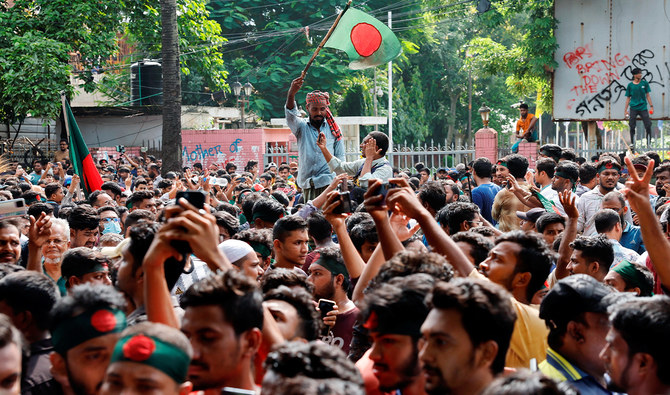
Photo credits: Reuters via Arab News
Event: In early July in Bangladesh, protests began as peaceful demands from university students to abolish quotas in civil service jobs.[1][2]
On July 21, following the Bangladesh Supreme Court’s judgement to remove most of the quota system, the protests paused for a brief period.[3][4] However, demonstrators returned with demands, including a public apology from Prime Minister Hasina for the violence and the restoration of internet connections.[5][6][7]
On August 6, Prime Minister of Bangladesh Sheikh Hasina resigned as the prime minister.[8][9] Following the prime minister’s resignation, the President of Bangladesh Mohommed Shahabuddin dissolved parliament.
On August 8, Nobel Peace laureate Muhammed Yunus was sworn in as the head of the interim government.[10][11]
Analysis
Last week, the protests in Bangladesh and subsequent resignation of its Prime Minister Sheikh Hasina were widely discussed in the Sinhala print media, TV coverage and social media posts (based on data collected through CrowdTangle, a social media monitoring tool).[1] The Sinhala media’s reading of the protests in Bangladesh were shaped by Sri Lanka’s own experience of island-wide protests known as the aragalaya (struggle) in 2022.
This week’s analysis will be presented in two parts. The first part will unpack two distinct lenses that shaped public perception of the protests in Bangladesh. The second part provides a reassessment of President Wickremesinghe’s role during the aragalaya, in light of media reporting on the protests in Bangladesh.
Part I: Sri Lanka’s experience with the aragalaya
The Sinhala media portrayed the aragalaya, and especially its aftermath, through two divisive lenses: (1) as a victory for democracy and (2) as a challenge to an elected government by groups with foreign financial support. These same lenses were adopted by the Sinhala media in its coverage and evaluation of the recent protests in Bangladesh.
First, the aragalaya has been viewed through a lens of a victory for democracy. The aragalaya has been praised for its ability to unite people from diverse social, ethnic and religious backgrounds and successfully ousting an administration due to widespread public discontent over economic and governance mismanagement.[2] Adopting this lens, the print media, including privately-owned Divaina, along with social media users (based on data collected through CrowdTangle) portrayed the events that unfolded in Bangladesh as a victory for democracy. They highlighted the large turnout of individuals and the Bangladeshi people’s success in removing state leaders with ‘authoritarian tendencies’.
Second, certain segments of the public and media have viewed the aragalaya through a lens of suspicion, believing it to have been influenced by foreign powers. For instance, former President Gotabaya Rajapaksa, in his book, claimed that the conspiracy to oust him was orchestrated by Western powers and the LTTE diaspora.[3] This narrative of a ‘West-led conspiracy’ aligns with the longstanding apprehension and antipathy within segments of the Sinhala psyche towards Western interference in domestic politics.[4] Adopting this lens, media voices, including privately owned Aruna, attributed the downfall of the Bangladeshi prime minister’s government to its weakened ties with mainly the United States.
Part II: The role of Wickremesinghe during the aragalaya
The protests in Bangladesh prompted a reassessment of Wickremesinghe’s role during the aragalaya. His actions were evaluated from two contrasting perspectives.
First, subsequent to Wickremesinghe taking office as president, he was stridently criticised for attempts at suppressing political dissent through actions such as attacks on aragalaya protesters and journalists, the imposition of a state of emergency and the deployment of the military to maintain public order.[5] However, in light of the violent and volatile events in Bangladesh, voices such as Minister Pavithra Wanniarachchi[6] and Minister Prasanna Ranatunga and various social media users (please see this week’s memes) amplified their praise of Wickremesinghe for establishing security and stability following the aragalaya protests. They contended that without Wickremesinghe’s intervention Sri Lanka might have faced a similarly violent and volatile outcome as in Bangladesh.[7]
Second, media voices, particularly on social media, who viewed the events in Bangladesh as a success, argued that the appointment of Wickremesinghe failed to meet the demands of the aragalaya. They contended that instead of addressing these demands, Wickremesinghe stifled the momentum for political change, exacerbated divisions and ultimately contributed to the fragmentation of the aragalaya.
Overall, Sinhala media coverage of the events in Bangladesh was evaluated through the same contrasting lenses used to interpret Sri Lanka’s aragalaya: as a victory for democracy and as being influenced by foreign powers. These events also prompted a re-evaluation of Wickremesinghe’s role during the aragalaya, with some praising him for restoring security and stability post-aragalaya, and others criticising him for deepening divisions and contributing to the movement’s fragmentation.
[1] In accordance with TMA’s methodology to monitor social media, the TMA team filtered the five posts with the highest interactions on Facebook in Sinhala for the term aragalaya and the names Bangladesh and Hasina, using CrowdTangle. The time period monitored was August 5 to 10.
[2] See TMA Vol.12, #28. For more information, please read https://www.cpalanka.org/wp-content/uploads/2023/12/A-Brief-Analysis-of-the-Aragalaya_Final-Report_FINAL_N3.pdf and https://www.lstlanka.org/wp-content/uploads/2023/08/Aragalaya-LST-review-eng.pdf.
[3] See TMA Vol.09, #42, Vol.09, #45, Vol.10, #27, Vol.13, #22 and Vol.14, #11.
[4] See TMA Vol.09, #42, Vol.09, #45, Vol.10, #27, Vol.13, #22 and Vol.14, #11.
[5] See TMA Vol.12, #28.
[6] For more information, please see https://www.dailynews.lk/2024/08/10/admin-catagories/breaking-news/605674/bangladesh-desperately-seeking-a-leader-like-president-ranil-minister-pavithra/.
[7] For more information, please see https://www.dailynews.lk/2024/08/10/admin-catagories/breaking-news/605674/bangladesh-desperately-seeking-a-leader-like-president-ranil-minister-pavithra/.