
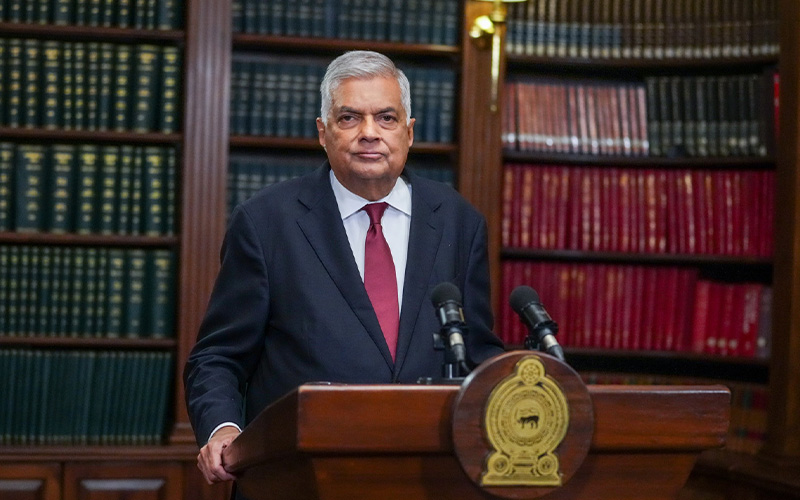
Event: On June 26, while delivering a special address to the nation, President Ranil Wickremesinghe announced that Sri Lanka has concluded debt restructuring negotiations with the Paris Club and the EXIM Bank of China.[1][2][3][4] The president stated that Sri Lanka was allowed to postpone all bilateral loan repayments to foreign countries until 2028.[5][6] Additionally, Sri Lanka will have until 2043 to repay these bilateral loans on concessional terms.[7][8]
Analysis
Over the past week, the Sinhala print reportage, TV coverage and social media commentary were predominantly critical of the president and his special address to the nation. TMA used the CrowdTangle tool to analyse social media posts. The majority of the posts ridiculed the president and the poster campaign, aranchiya subayi (trans. news is good), launched just before his special address (see this week’s memes published in this issue of TMA).[1]
Doubts over the president’s framing of ‘debt restructuring as a success’ to aid economic recovery dominated the Sinhala media discourse. Nevertheless, there were marginal voices, consisting primarily of the state-owned media and the UNP, that supported Wickremesinghe’s framing of debt restructuring as a success. This week’s TMA briefly analyses the dynamics within the critical and supportive voices.
1. Doubting the president’s framing of debt restructuring as a success
The Sinhala media cast doubts over the president’s framing of debt restructuring as a success. It did so on two grounds: (i) the trustworthiness of the president and (ii) the substance of the president’s address.
(i) Doubting the trustworthiness of the president
First, the Sinhala media cast doubts over whether the president can be trusted on his representation – that Sri Lanka has ‘successfully’ emerged from bankruptcy. A spectrum of voices, including academics, media commentators, the SJB and the NPP, argued that such an evaluation can be credibly made only by independent international institutions. Doubts were also cast on the president’s standing and authority to represent Sri Lanka’s short- and long-term interests, casting him as a leader without a public mandate. Wickremesinghe and his government have faced continuous and consistent criticism for the lack of a public mandate, as analysed in past issues of TMA.[2] The editorials in privately-owned newspapers such as Mawbima and Anidda, as well as memes circulated in social media, interpreted the ‘good news’ as part of Wickremesinghe’s election campaign strategy.
Second, speculations over the intention of the president in portraying debt restructuring as a success also cast doubts on the president’s integrity.
(ii) Doubting the substance of the president’s address
The Sinhala media’s doubts over the core substance of the president’s address were based on two grounds: (a) ill-conceived method and (b) incompleteness of the method.
First, critical voices such as MP Charitha Herath questioned whether postponement in debt repayment alone can be considered a success, without further measures towards a haircut. Such critical commentary viewed the president’s method of debt restructuring to be ill-conceived, as it will provide only temporary relief as opposed to a more lasting solution.
Second, critical voices such as economists featured in the media raised concerns over the incompleteness of debt restructuring. These critics noted that Sri Lanka’s recent agreement was limited to bilateral debts – and that it was premature to celebrate.[3]
2. Asserting Wickremesinghe’s success in debt restructuring
Views supportive of the president’s claims of successful debt restructuring in the Sinhala media were based on two grounds: (i) asserting confidence in the president’s ability and (ii) asserting confidence in the president as a person.
(i) Asserting confidence in the president’s ability
Supporters of the president attributed his ‘success’ in debt restructuring to the progress he has made in implementing the actions committed to within the IMF programme. For instance, the state-owned Dinamina newspaper argued that positive progress on the IMF commitments bolstered international confidence in Wickremesinghe, which enabled him to negotiate with bilateral lenders. These voices highlighted Wickremesinghe’s expertise and legacy in managing economic matters and foreign relations (a longstanding perception) as a key to his success in debt restructuring.[4]
(ii) Asserting confidence in the president
Building on the confidence in the president’s role in the progress of the IMF programme, government-aligned voices positioned Wickremesinghe as the person to provide leadership for the country. For instance, UNP Chairperson Wajira Abeywardena described Wickremesinghe’s leadership as the ‘only correct and proper direction’ available for the country at this time. This sentiment was further promoted through a poster campaign titled Me welave Ranil thamai (trans. it is Ranil at this time) launched immediately after the president’s address[5] both on offline and online. As noted in last week’s issue of TMA, supportive voices continue to portray Wickremesinghe as the ‘man of the hour’, deserving of support to lead the country towards progress.[6]
Overall, the Sinhala media coverage was overwhelmingly critical of the president’s address attempting to frame debt restructuring as a success. The criticism suggests that the president does not enjoy a high level of social confidence. The ‘good news’ framing that the president aimed to achieve through his special address to the nation did not gain traction.
[1] For more information, see https://asianmirror.lk/news/item/37557-poster-campaign-expect-good-news-signals-major-announcement-by-president-on-ending-sri-lanka-s-bankruptcy, https://counterpoint.lk/is-it-good-news-for-ranil/ and https://www.sundaytimes.lk/240630/columns/the-writing-on-the-wall-562680.html.
[2] See TMA Vol.13, #40 and Vol.14, #23.
[3] For more information, see https://www.treasury.gov.lk/api/file/1f884c2c-71db-4058-9b99-a9cb7f0690b7.
[4] See TMA Vol.11, #23, Vol.14, #02 & 03 and Vol.14, #25.
[5] For more information, see https://www.themorning.lk/articles/09MSHncoYzuM7eI3lOc4.
[6] See TMA Vol.14, #25.