
FactCheck.lk
On June 26, President Ranil Wickremesinghe made a television address to the nation after signing bilateral debt restructuring agreements. Are the claims made in his speech correct?
For more information, click here
FrontPage
President Ranil Wickremesinghe’s special address to the nation
How did the newspapers cover it on their front pages?
Click here to find out!
This week in The Media Analysis...
01. Doubt pervades president’s ‘good news’
02. Teachers’ protest: Print and social media diverge
03. The Language Divide
04. The TV coverage of the issues
05. This week’s cartoons
06. This week’s memes
07. Other topics covered in reportage
Past issues can be viewed here
Disclaimer: This week’s TMA is focusing on President Ranil Wickremesinghe’s special address to the nation on June 26 and on the non-academics’ strike.
01. Doubt pervades president’s ‘good news’
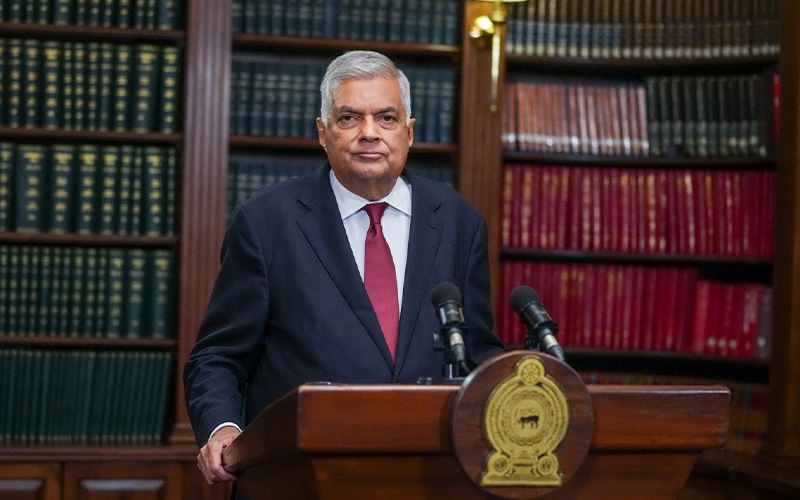
Photo credits: PMD
Analysis
Doubts over the president’s framing of ‘debt restructuring as a success’ to aid economic recovery dominated the Sinhala media discourse. Nevertheless, there were marginal voices, consisting primarily of the state-owned media and the UNP, that supported Wickremesinghe’s framing of debt restructuring as a success. This week’s TMA briefly analyses the dynamics within the critical and supportive voices.
1. Doubting the president’s framing of debt restructuring as a success
The Sinhala media cast doubts over the president’s framing of debt restructuring as a success. It did so on two grounds: (i) the trustworthiness of the president and (ii) the substance of the president’s address.
(i) Doubting the trustworthiness of the president
First, the Sinhala media cast doubts over whether the president can be trusted on his representation – that Sri Lanka has ‘successfully’ emerged from bankruptcy. A spectrum of voices, including academics, media commentators, the SJB and the NPP, argued that such an evaluation can be credibly made only by independent international institutions. Doubts were also cast on the president’s standing and authority to represent Sri Lanka’s short- and long-term interests, casting him as a leader without a public mandate. Wickremesinghe and his government have faced continuous and consistent criticism for the lack of a public mandate, as analysed in past issues of TMA.[2] The editorials in privately-owned newspapers such as Mawbima and Anidda, as well as memes circulated in social media, interpreted the ‘good news’ as part of Wickremesinghe’s election campaign strategy.
Second, speculations over the intention of the president in portraying debt restructuring as a success also cast doubts on the president’s integrity.
(ii) Doubting the substance of the president’s address
The Sinhala media’s doubts over the core substance of the president’s address were based on two grounds: (a) ill-conceived method and (b) incompleteness of the method.
First, critical voices such as MP Charitha Herath questioned whether postponement in debt repayment alone can be considered a success, without further measures towards a haircut. Such critical commentary viewed the president’s method of debt restructuring to be ill-conceived, as it will provide only temporary relief as opposed to a more lasting solution.
Second, critical voices such as economists featured in the media raised concerns over the incompleteness of debt restructuring. These critics noted that Sri Lanka’s recent agreement was limited to bilateral debts – and that it was premature to celebrate.[3]
2. Asserting Wickremesinghe’s success in debt restructuring
Views supportive of the president’s claims of successful debt restructuring in the Sinhala media were based on two grounds: (i) asserting confidence in the president’s ability and (ii) asserting confidence in the president as a person.
(i) Asserting confidence in the president’s ability
Supporters of the president attributed his ‘success’ in debt restructuring to the progress he has made in implementing the actions committed to within the IMF programme. For instance, the state-owned Dinamina newspaper argued that positive progress on the IMF commitments bolstered international confidence in Wickremesinghe, which enabled him to negotiate with bilateral lenders. These voices highlighted Wickremesinghe’s expertise and legacy in managing economic matters and foreign relations (a longstanding perception) as a key to his success in debt restructuring.[4]
(ii) Asserting confidence in the president
Building on the confidence in the president’s role in the progress of the IMF programme, government-aligned voices positioned Wickremesinghe as the person to provide leadership for the country. For instance, UNP Chairperson Wajira Abeywardena described Wickremesinghe’s leadership as the ‘only correct and proper direction’ available for the country at this time. This sentiment was further promoted through a poster campaign titled Me welave Ranil thamai (trans. it is Ranil at this time) launched immediately after the president’s address[5] both on offline and online. As noted in last week’s issue of TMA, supportive voices continue to portray Wickremesinghe as the ‘man of the hour’, deserving of support to lead the country towards progress.[6]
Overall, the Sinhala media coverage was overwhelmingly critical of the president’s address attempting to frame debt restructuring as a success. The criticism suggests that the president does not enjoy a high level of social confidence. The ‘good news’ framing that the president aimed to achieve through his special address to the nation did not gain traction.
02. Teachers’ protest: Print and social media diverge
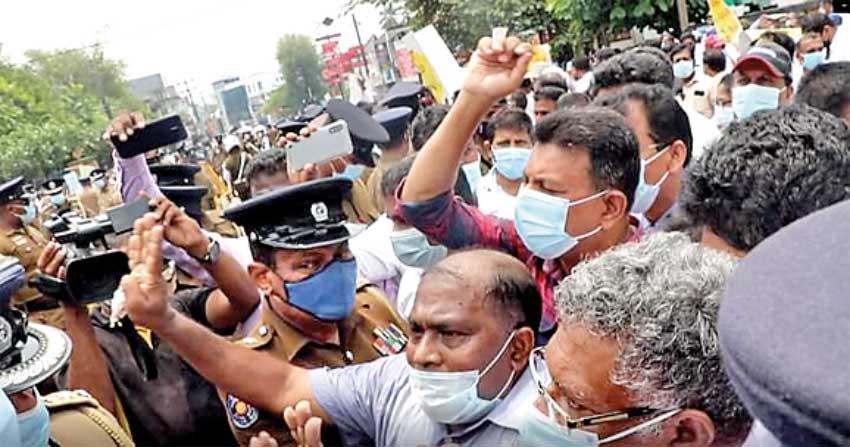
Event: On June 26, teachers and principals launched an island-wide trade union action by reporting sick and staging a protest near the Fort Railway Station over several demands, including solutions for salary disparities.[1][2] The police fired water cannons and tear gas to disperse the protest.[3][4]
On June 27, teachers and principals continued the island-wide strike as a response to police action against the protest the previous day.[5][6]
Over the past few days, the state print media has been overwhelmingly critical of the teachers’ and principals’ strike, condemning both the trade union action and the teachers involved.[1] By contrast, social media posts filtered through CrowdTangle have offered support for teachers (please refer to this week’s memes).[2]
Two diverging views emerged from the Sinhala media coverage of the strike: (1) an unsympathetic view and (2) a sympathetic view toward teachers and principals.
1. The unsympathetic view
The state print media adopted an unsympathetic lens to delegitimise the teachers’ and principals’ trade union action on two fronts.
First, the strikes were framed as inconveniencing the public, particularly schoolchildren. For instance, state media voices criticised the teachers and principals for ‘sacrificing the future of the children’ and ‘taking revenge on the children’ to advance their interests. Within the Sinhala psyche, public support for trade union action tends to plummet when the actions lead to widespread public inconvenience, casting them in a negative light.[3]
Second, the teachers and principals were framed as failing to uphold the ideals expected of the profession. Within the Sinhala psyche, teachers are revered as guru devivaru or deities of teaching, expected to prioritise children and their education.[4] Accordingly, state media voices criticised their trade union action, accusing them of having betrayed the dignity of the profession. This criticism extended to blaming the teachers for prioritising private tuition over proper school teaching, labelling them as guru horu (trans. thieving teachers). In this context, within the Sinhala media, it can be understood that teachers are expected to be self-sacrificing and maintain the dignity of their profession rather than compromising it.[5]
2. The sympathetic view
Social media commentary and editorials of several privately owned newspapers adopted a sympathetic lens in their support of the strike. This support was underpinned by two narratives of injustice.
First, these voices sympathised with the teachers and principals whose salaries were framed as insufficient to meet basic needs in post-economic crisis Sri Lanka. The pay scale for teachers was viewed as unfairly low, with social media users and some newspapers calling their salary demands ‘reasonable’ under the circumstances.
Second, they sympathised with the teachers and principals, whose union action was seen as being unjustly suppressed by the government. Editorials in privately-owned newspapers such as Divaina and Lankadeepa condemned the government’s harsh/excessive response, expressing indignation at the violence used against teachers, who, they argued, deserve respect. This line of criticism against aligns with past accusations of the government deploying a ‘toolkit for suppressing’ protests.[6]
In sum, the Sinhala media coverage diverged between the state print media which was unsympathetic, and social media posts (and some privately owned print media outlets) which showed sympathy towards the teachers and principals.
03. The Language Divide
Signposts the differences and nuances in reporting between Sinhala and Tamil language newspapers
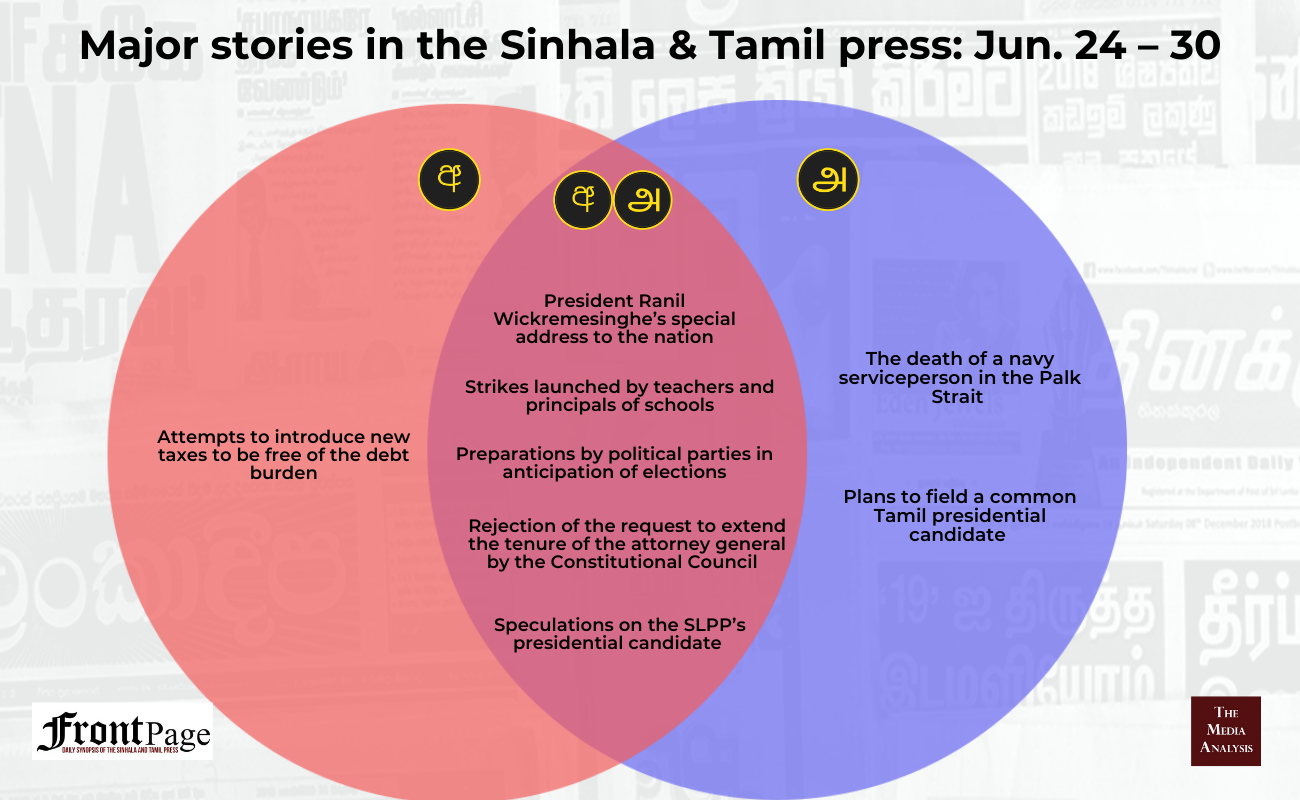
Last week’s Sinhala and Tamil press converged in relation to five main stories. The five stories were on: (i) President Ranil Wickremesinghe’s special address to the nation; (ii) the strikes launched by teachers and principals of schools; (iii) preparations by political parties in anticipation of elections; (iv) the rejection of the request to extend the tenure of the attorney general by the Constitutional Council; (v) speculations on the SLPP’s presidential candidate. The Sinhala press exclusively featured the attempts to introduce new taxes to be free of the debt burden. The Tamil press exclusively featured two main stories, and they were on the: (i) death of a navy serviceperson in the Palk Strait and (ii) plans to field a common Tamil presidential candidate.
Do you want to see the divided priorities on a daily basis? Check out FrontPage. It captures the day’s headlines and features succinct summaries of the political news reported in the most widely read Sinhala and Tamil newspapers.
04. The TV coverage of the issues
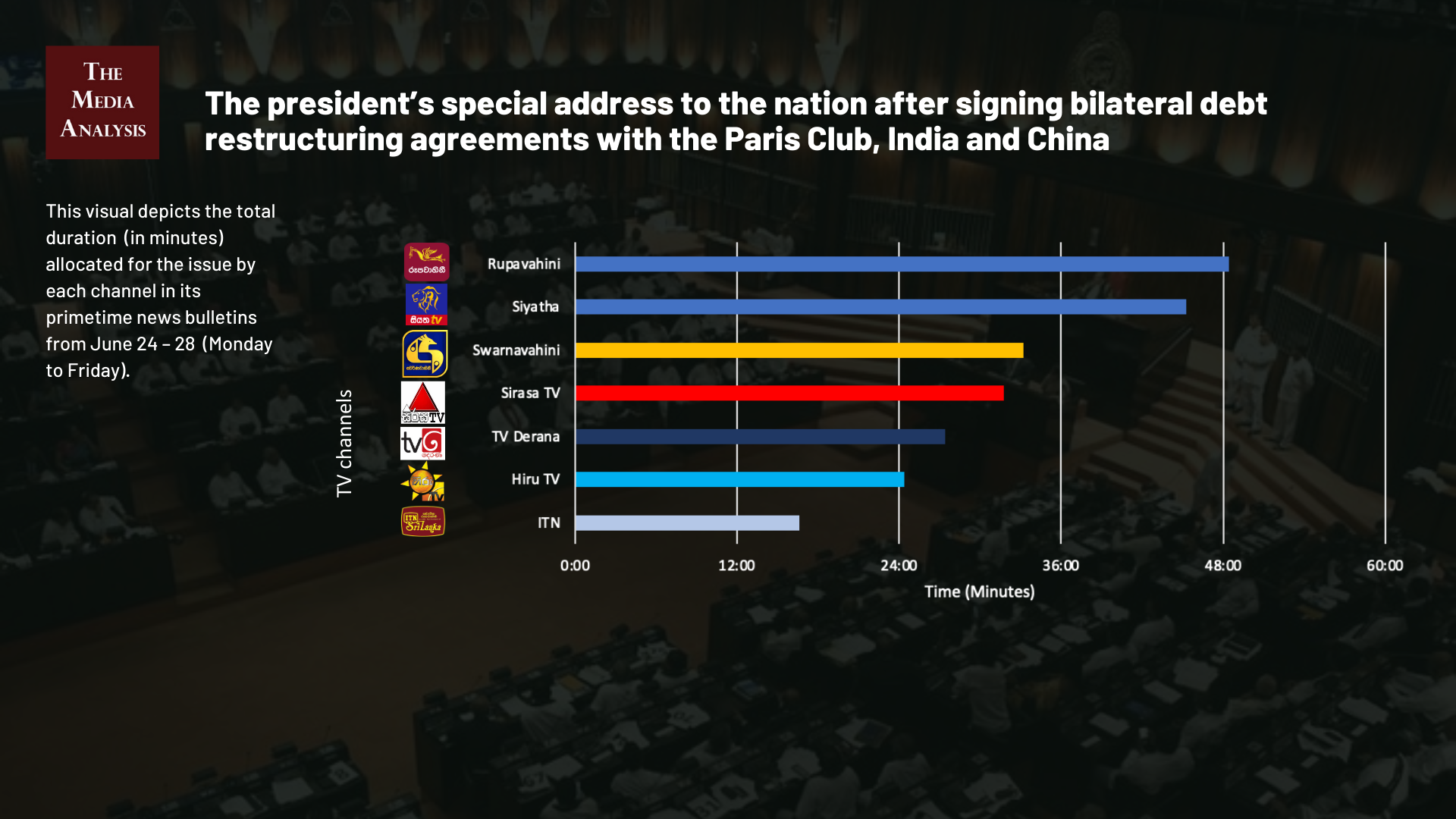
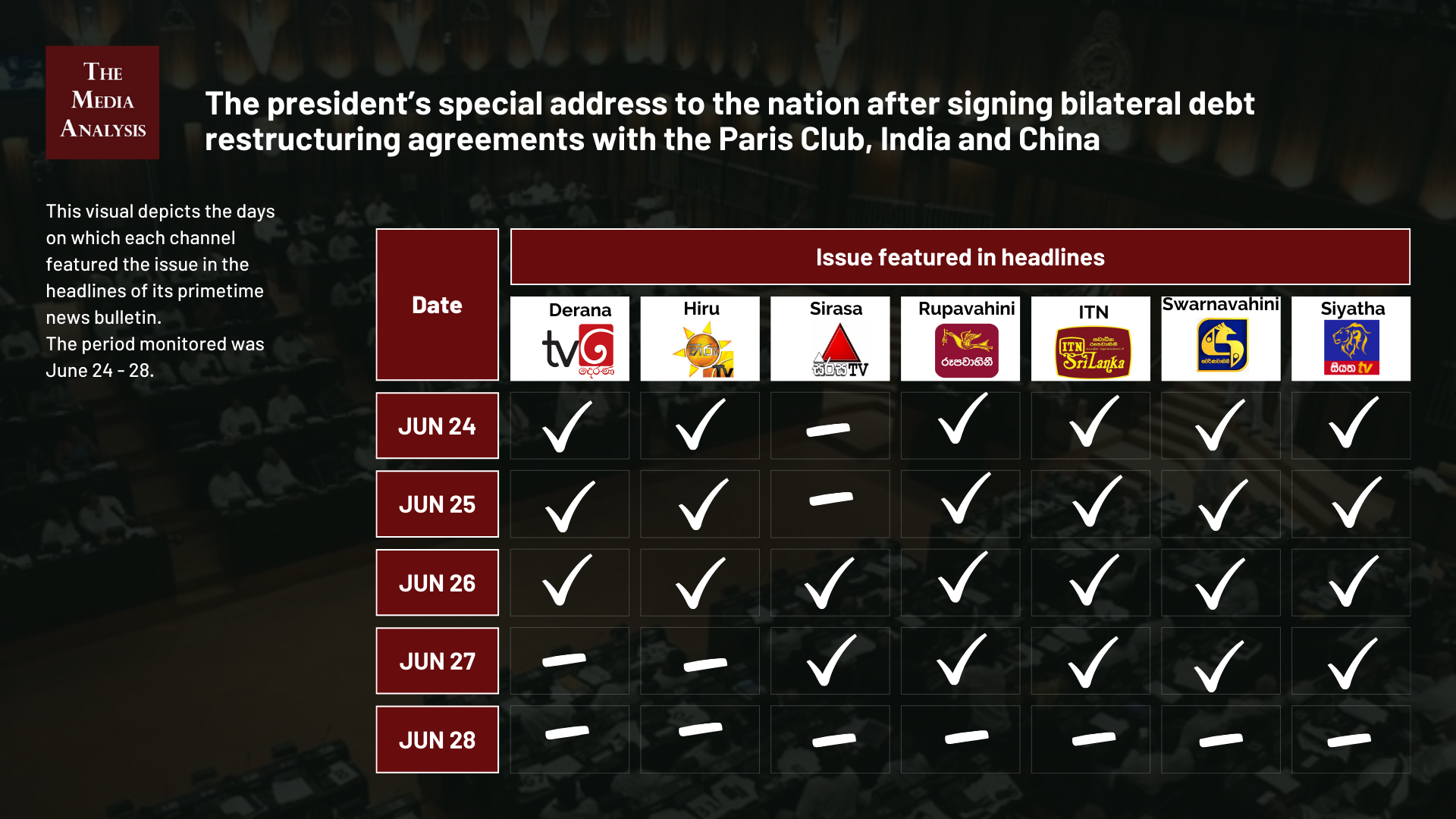
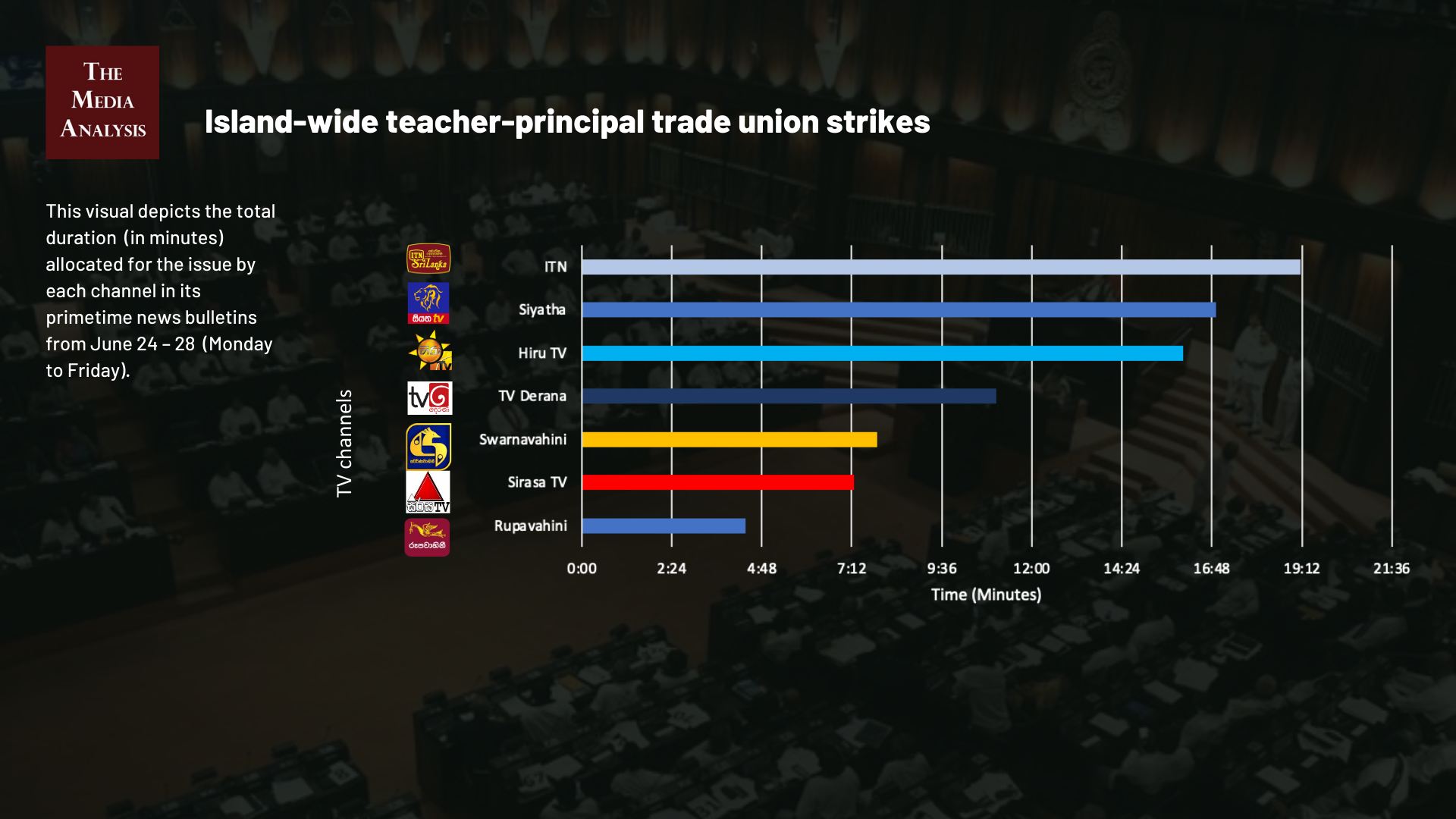
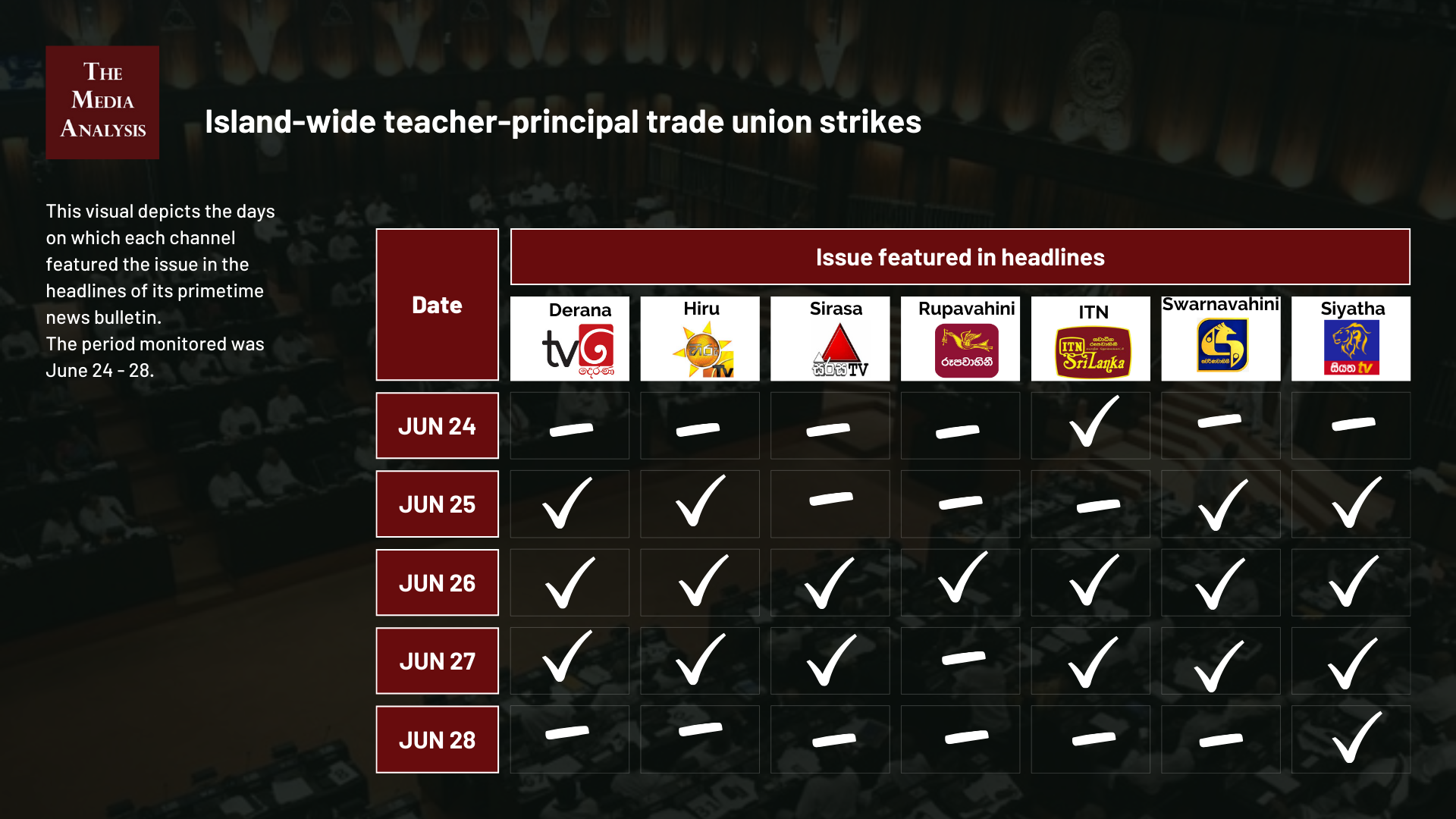
The data on television coverage is based on the monitoring of the primetime news telecasts of selected Sinhala language TV channels uploaded to YouTube.
05. This week’s cartoons
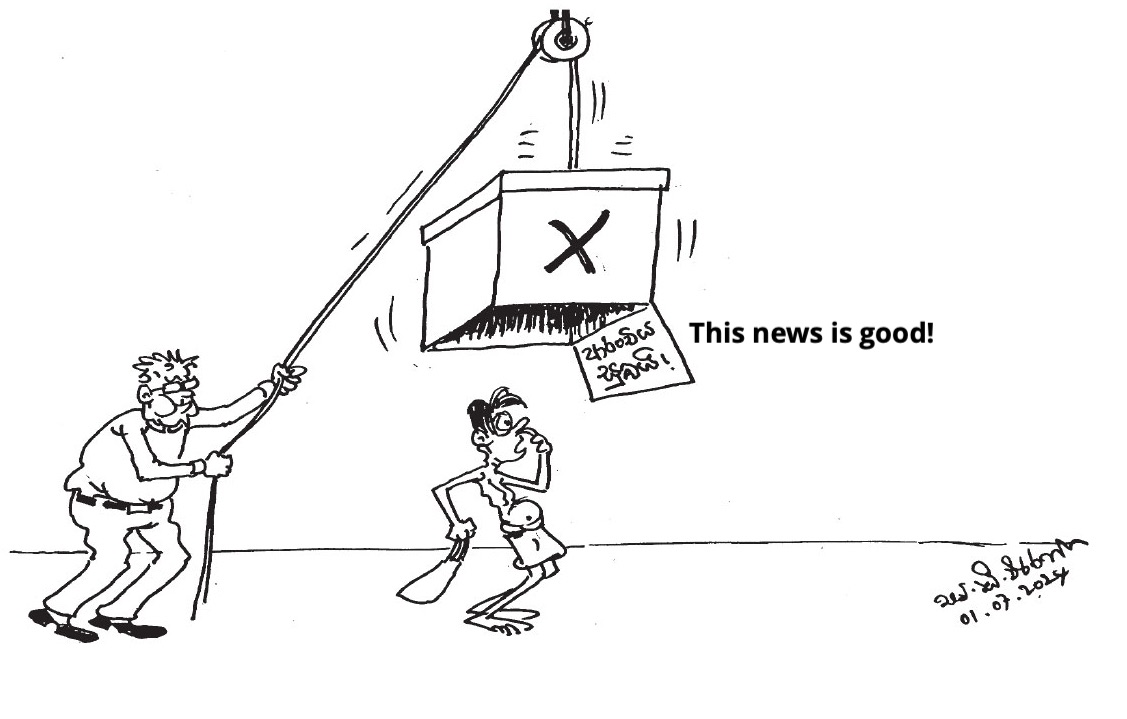
Courtesy of Mawbima, Jul.1, 2024
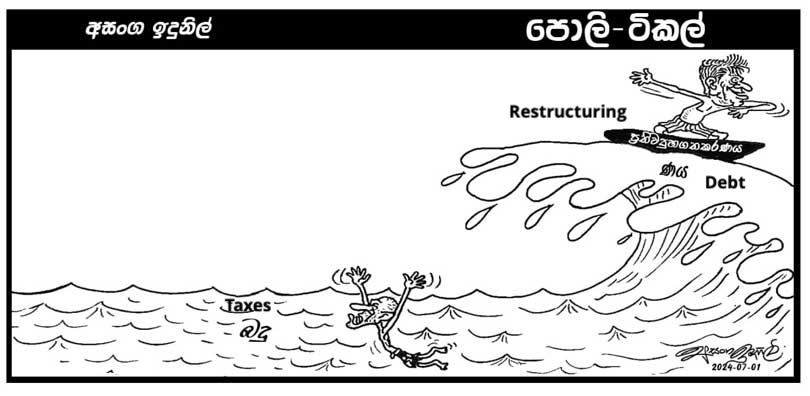
Courtesy of Lankadeepa, Jul.1, 2024
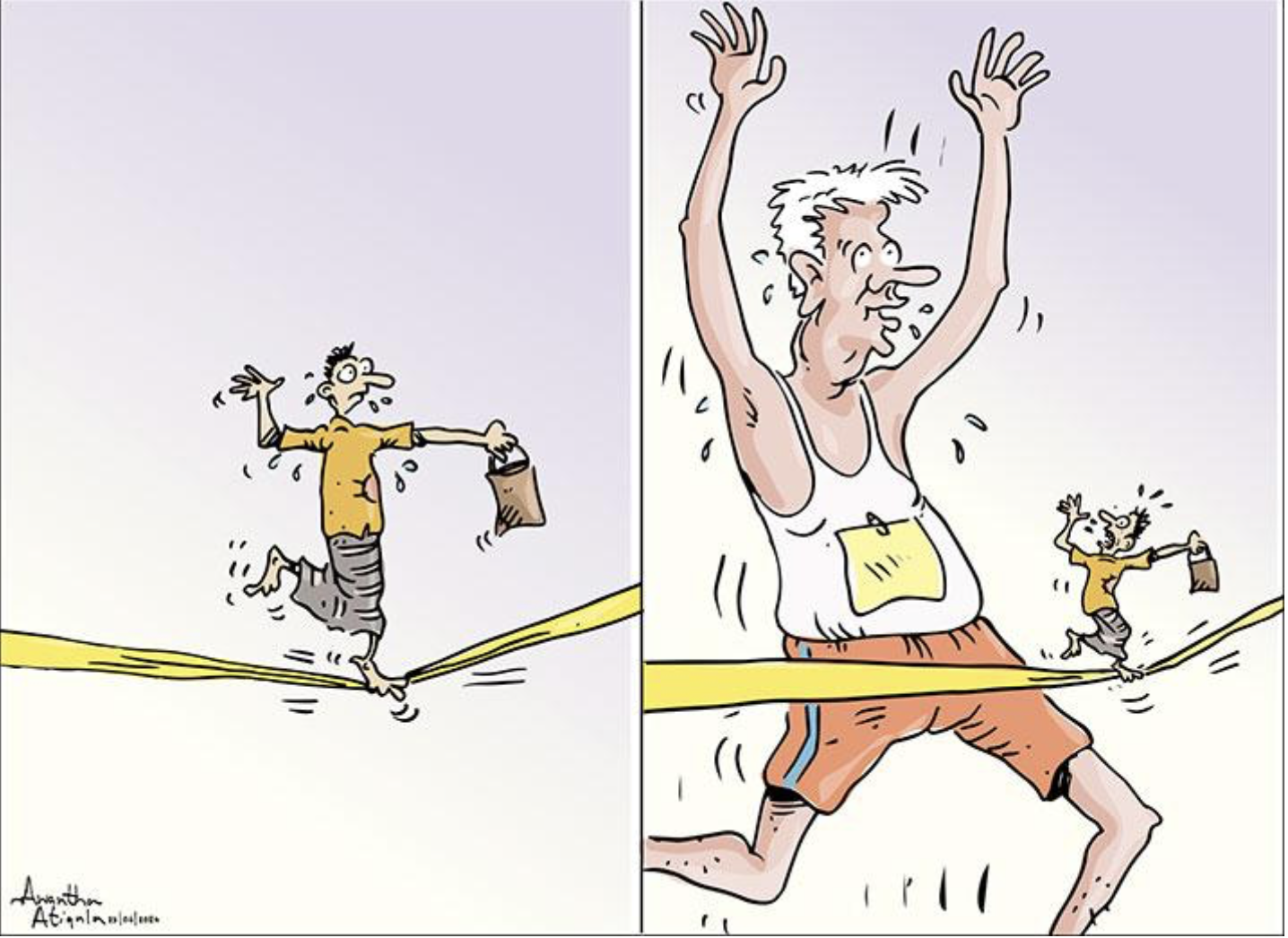
Courtesy of Ada, Jun.25, 2024
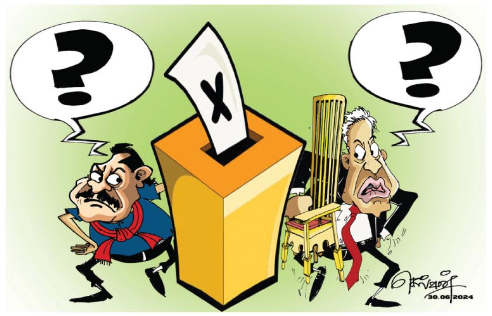
Courtesy of Virakesari, Jun.30, 2024
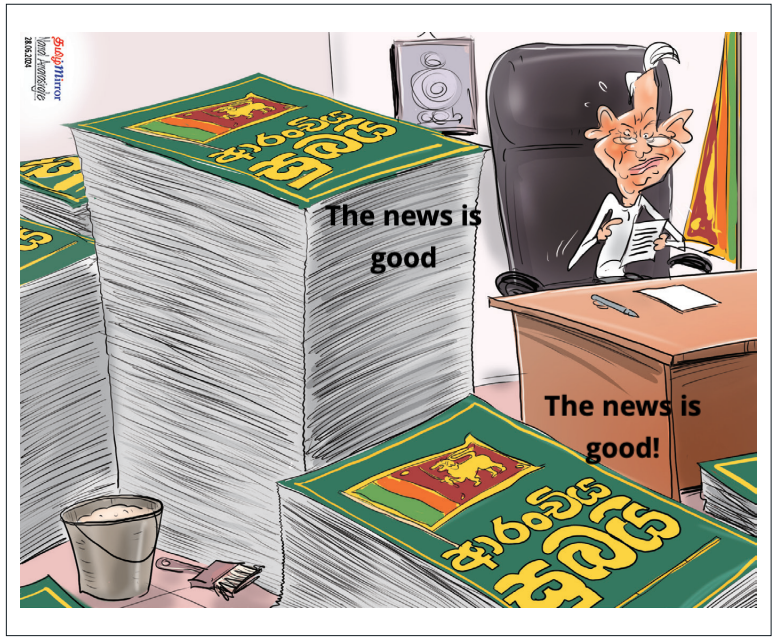
Courtesy of Tamil Mirror, Jun.28, 2024
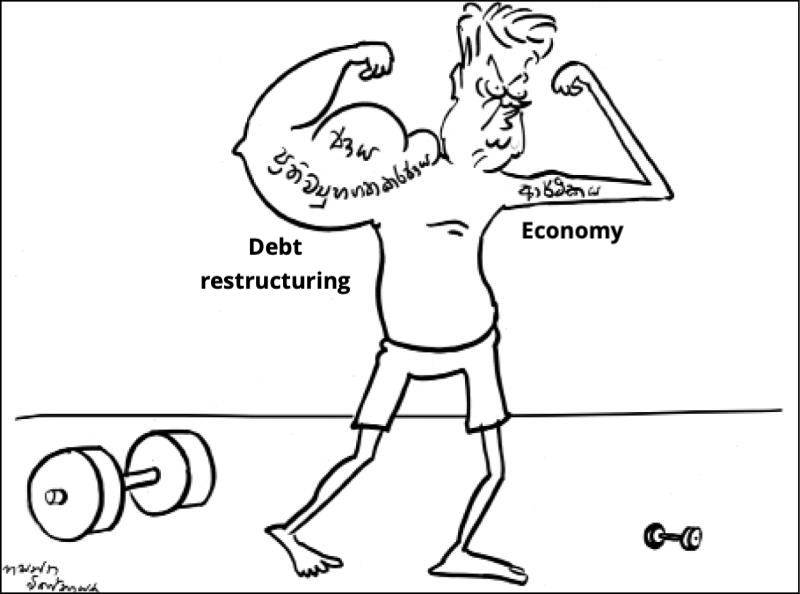
Courtesy of Aruna, Jun.30, 2024
05. This week’s memes
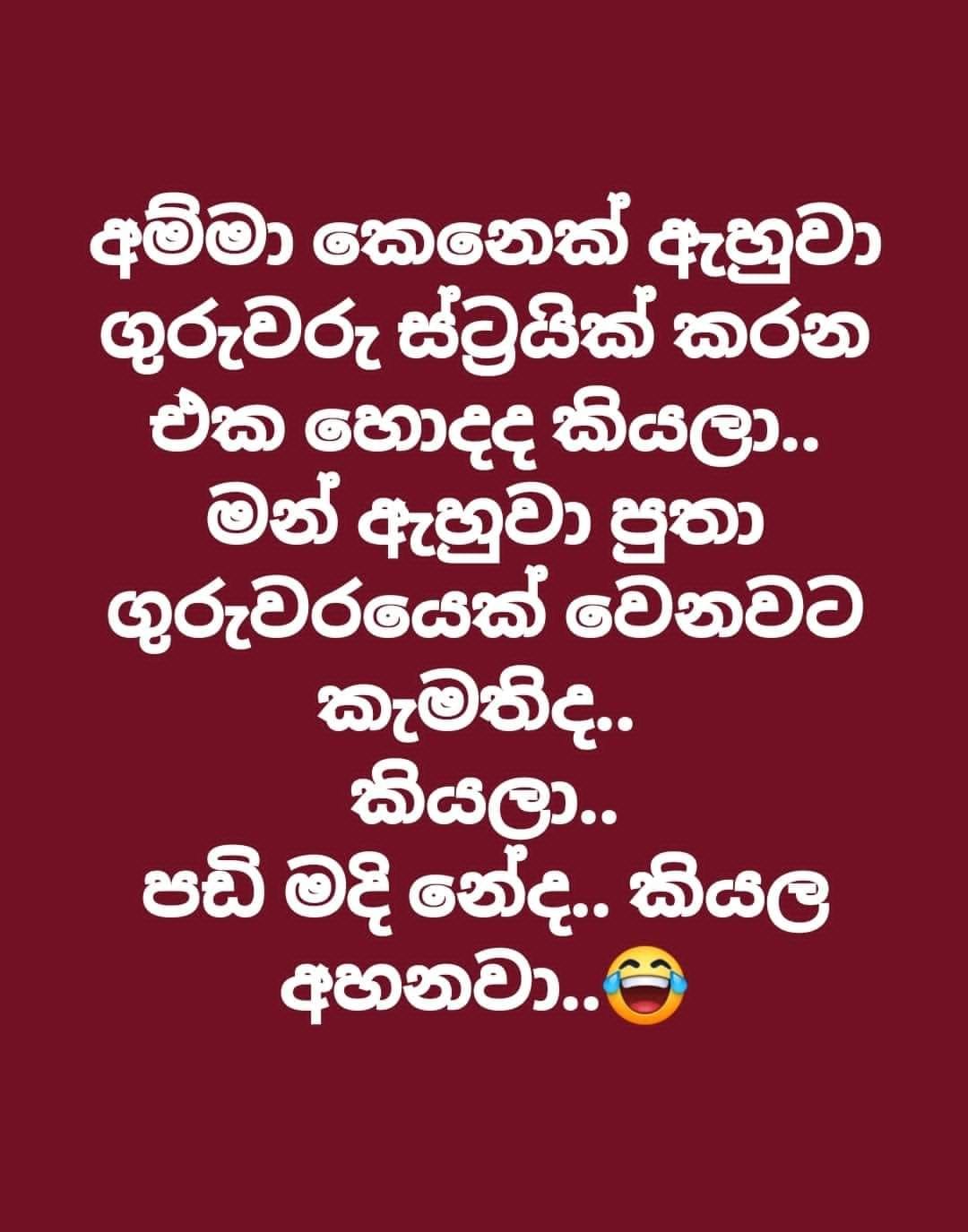
|
|
|
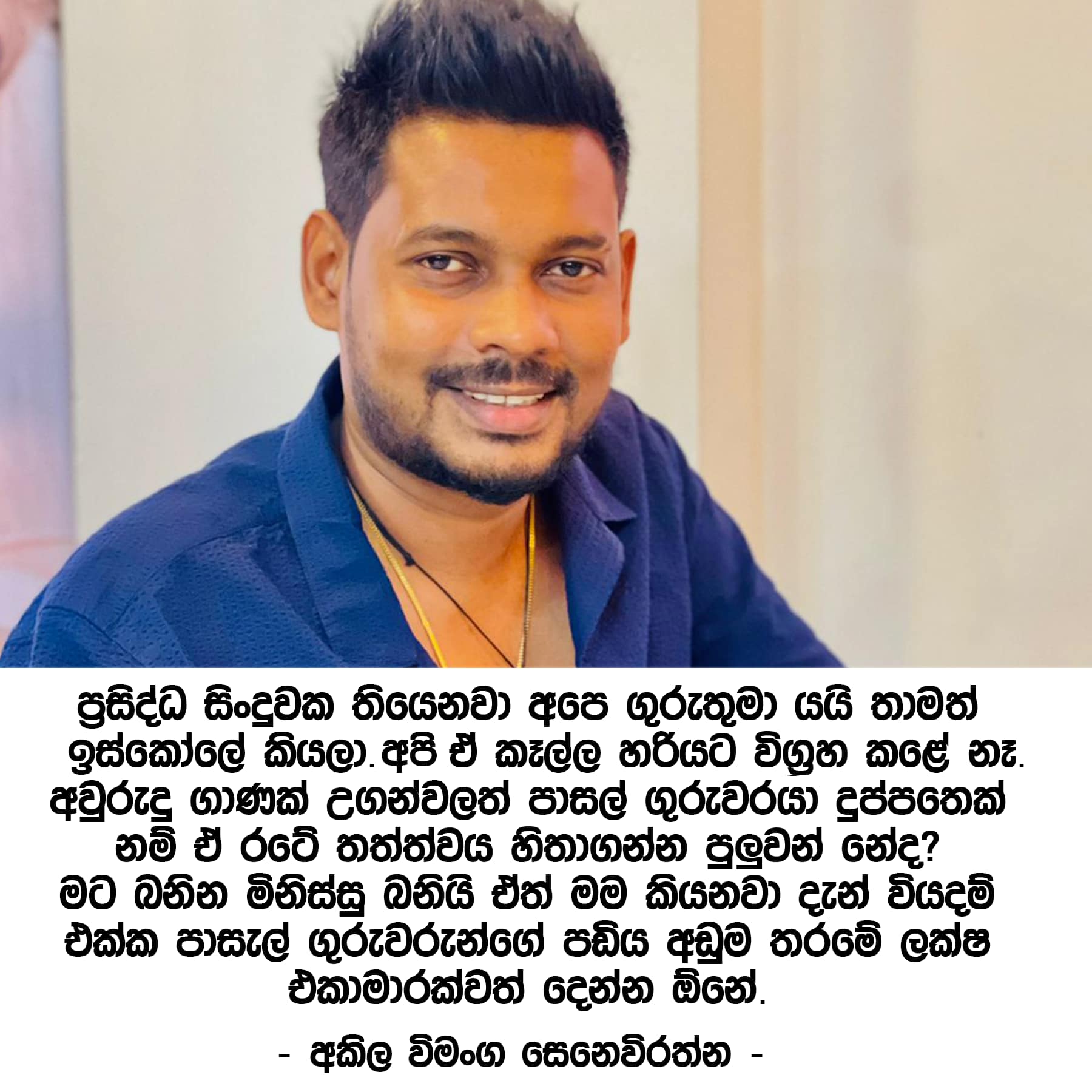
The lyrics of a popular song [titled Pana mada kadithi sung by veteran singer Sunil Edirisinghe] say, “Our teacher is still going to school.” We have not interpreted this song properly. If schoolteachers are poor even after teaching for years, doesn’t that in itself reveal the situation of that country? The ones who want to criticise me for this will do so, but I will say this: When considering the expenses at present, teachers should be given a salary of at least one-hundred-and-fifty thousand.
– Akila Vimanga Senviratne – (A popular A/L Sinhala teacher)
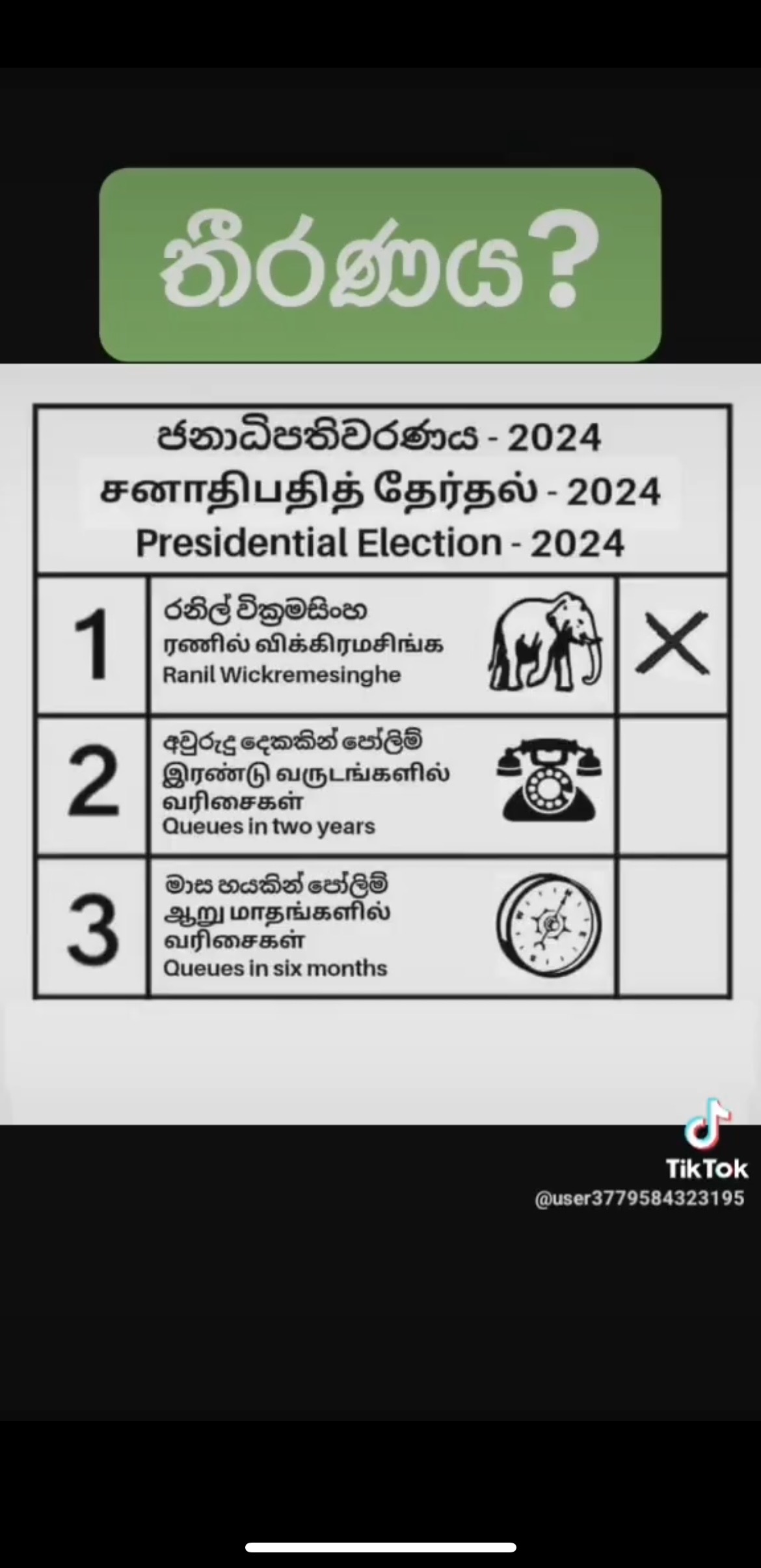
The decision?
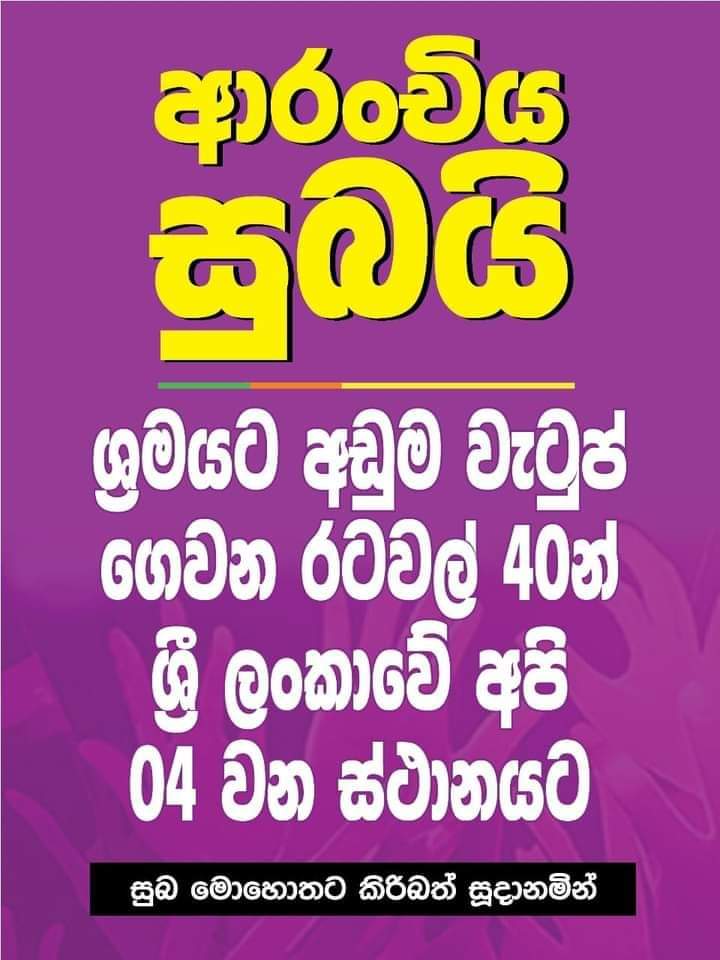
The news is good
Sri Lanka is the fourth out of 40 countries that pay the least wages for the amount of work put in
Kiribath (milk rice) is ready for the auspicious time (in Sri Lanka, kiribath is usually prepared and eaten to celebrate something such as the beginning of a new year)
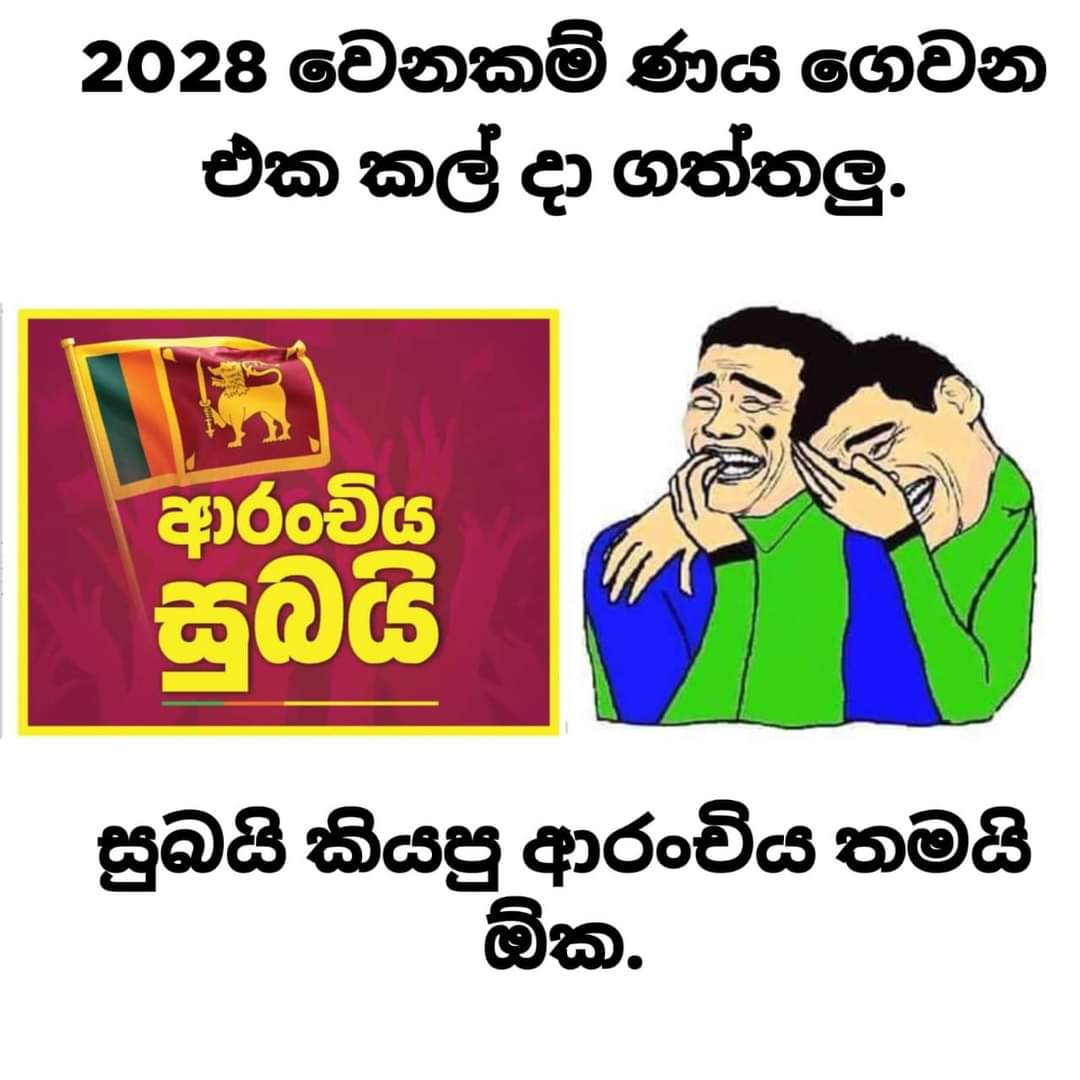
|
Apparently they have been able to get the debt repayments postponed until 2028.
The news is good This is the news that they said was good. |

The news is good!
But we are in debt to the world…
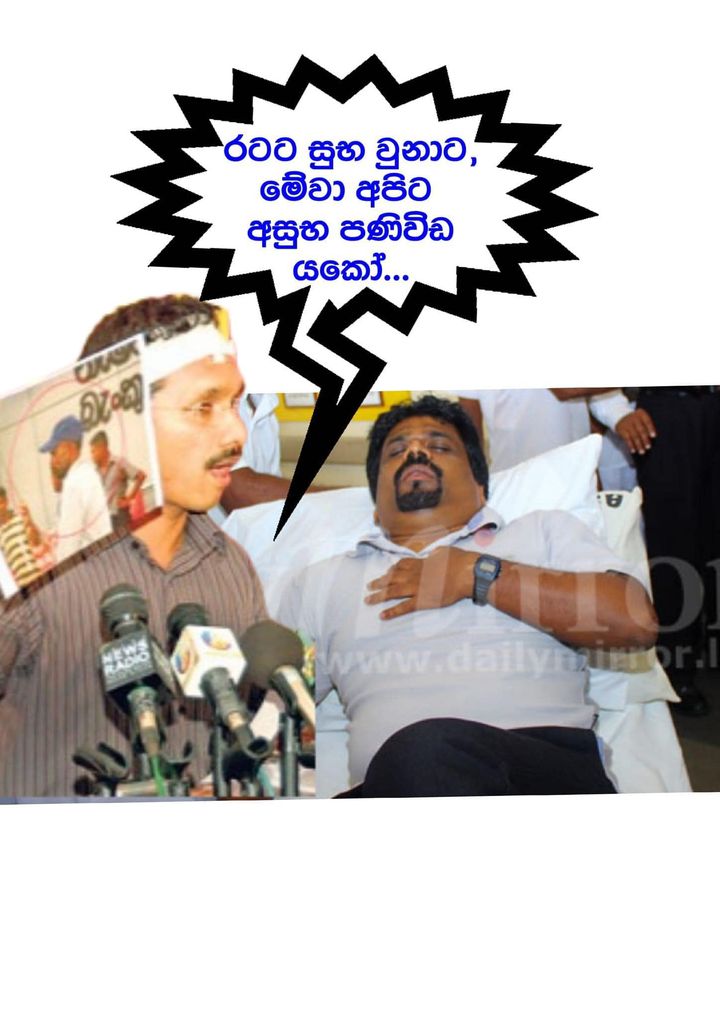
Even though this is good [news] for the country, this is bad news for us, you devil…
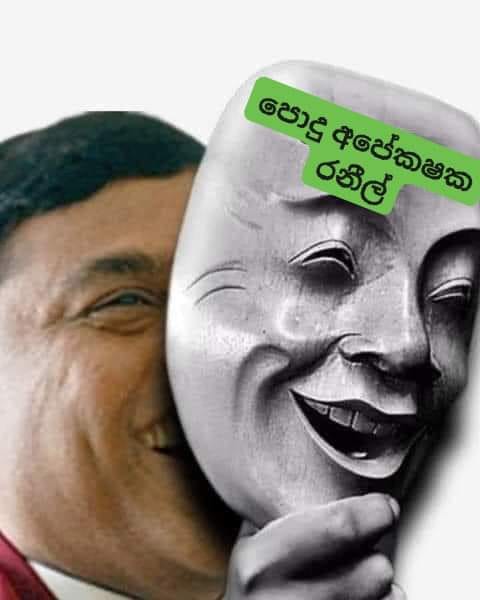
Common candidate Ranil
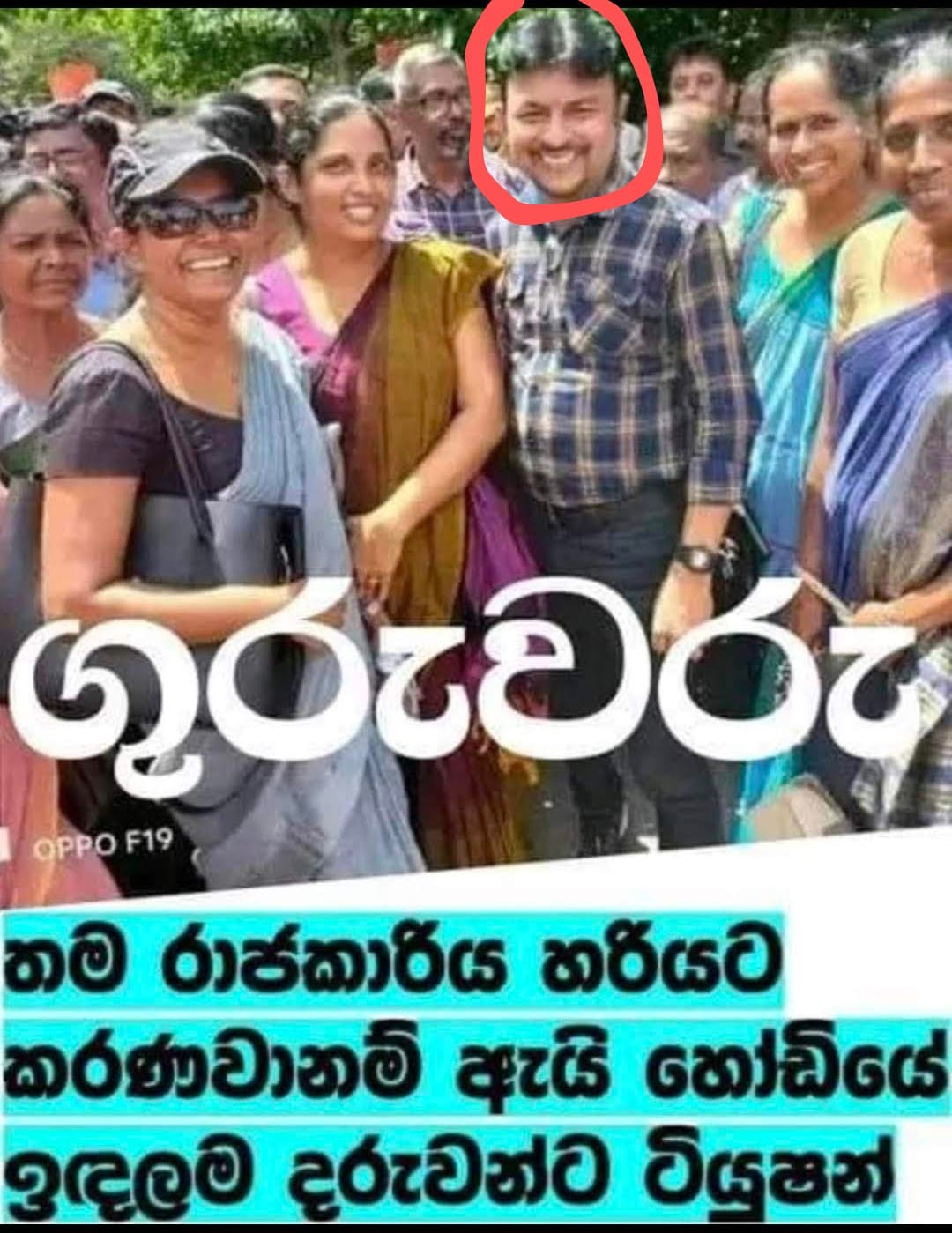
Teachers
If they are doing their job well, why are children going for tuition classes from Grade 1?
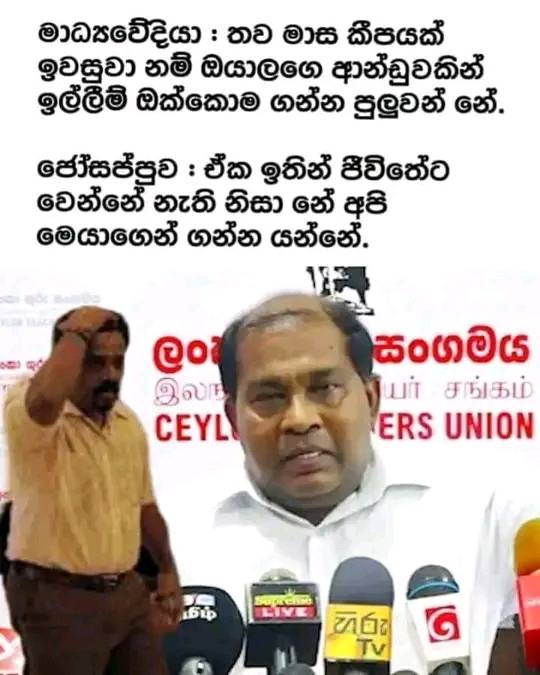
Journalist: If you all can be patient for a few more months, wouldn’t you be able to get your demands fulfilled through a government of your own?
Joseppuwa (the insulting form of the name Joseph in Sinhala, referring to Ceylon Teachers’ Union Secretary Joseph Stalin): It is because we know that will never happen that we are trying to get him to fulfil our demands.
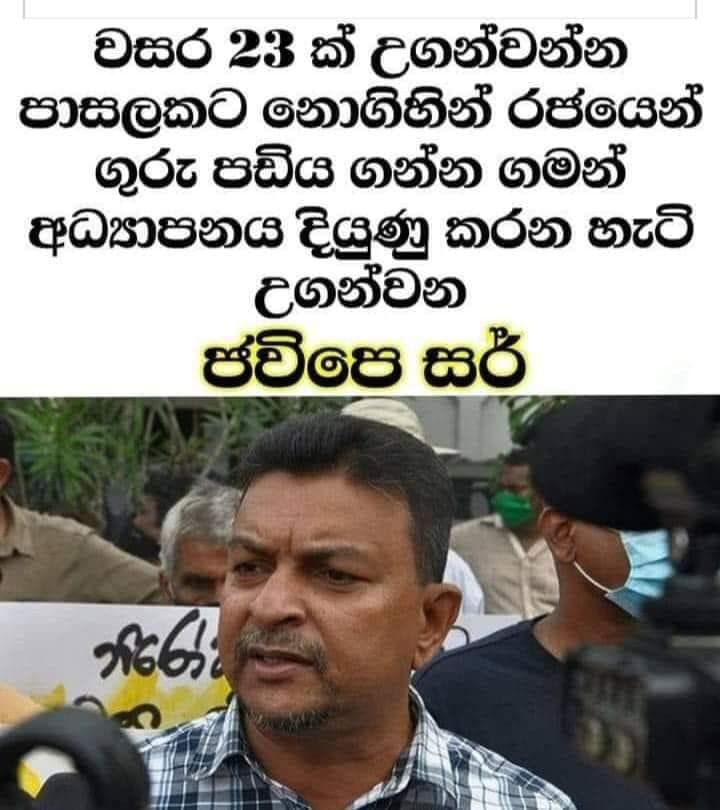
The JVP’s sir (teacher) who is teaching us how to improve education while receiving his teacher’s salary from the government, even though he has not set foot in a school for 23 years to teach (refers to General Secretary of the JVP-led Ceylon Teachers’ Service Union Mahinda Jayasinghe)
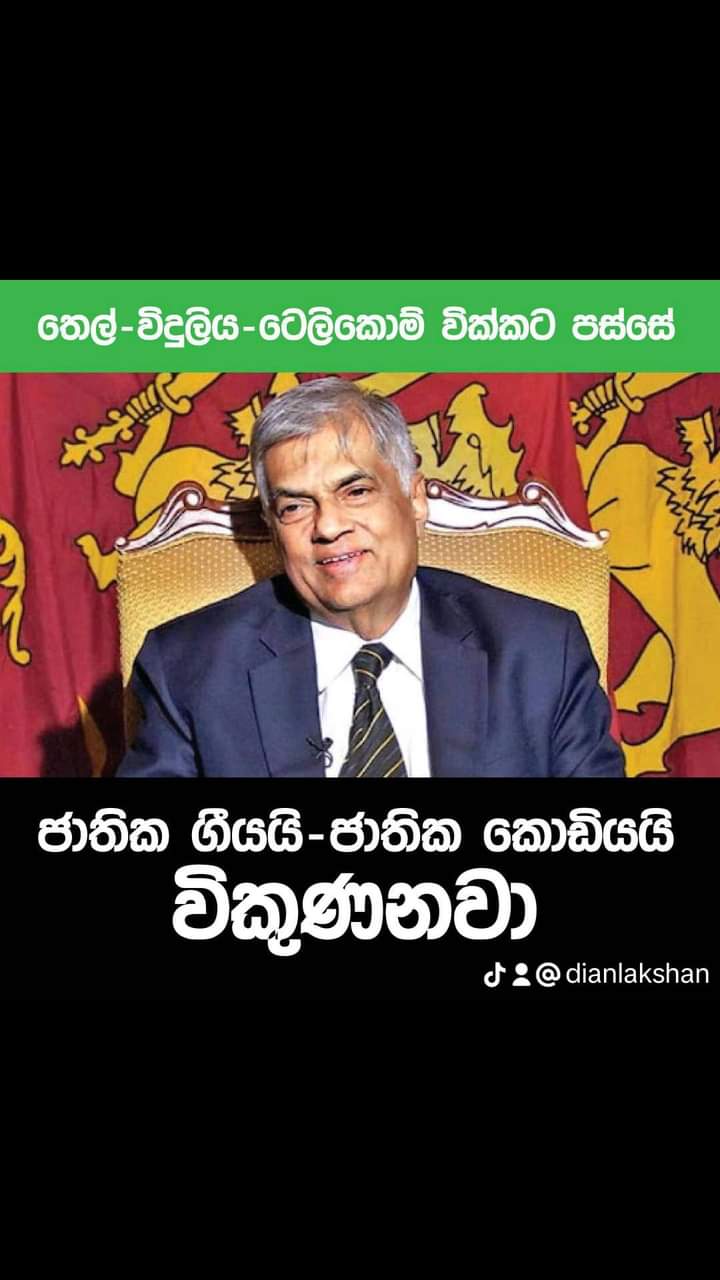
After selling fuel (Ceylon Petroleum Corporation)–electricity (Ceylon Electricity Board)–telecom (Sri Lanka Telecom),
I will sell the national anthem and the national flag
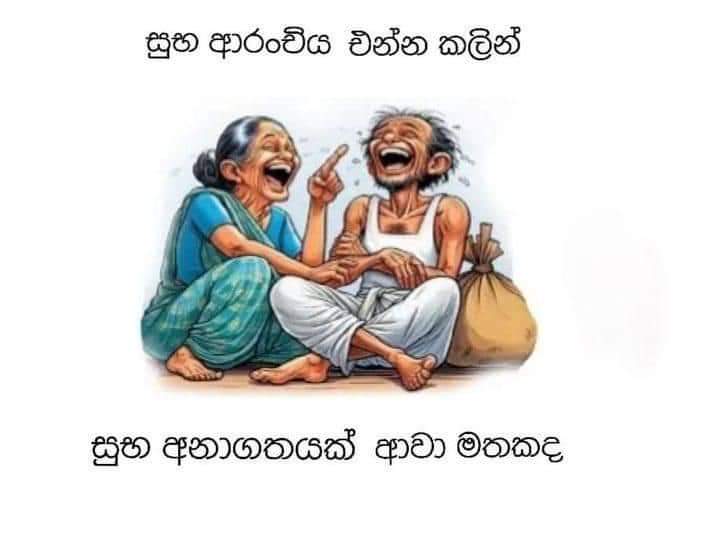
Do you remember how a “good future” (slogan of former President Mahinda Rajapaksa) arrived before the “good news” did?
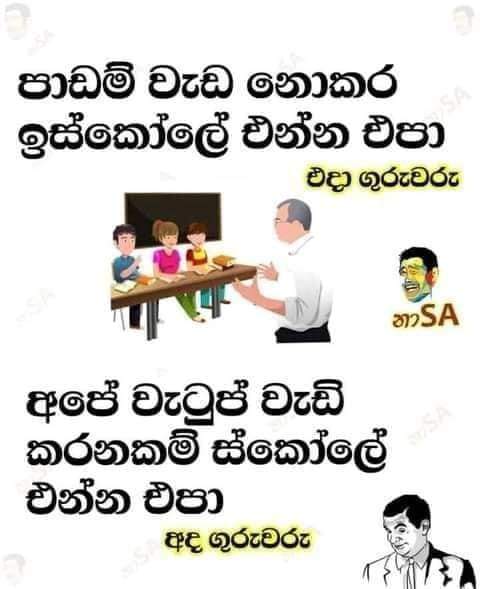
Don’t come to school without doing your schoolwork
Teachers then
Don’t come to school until they increase our salaries
Teachers today
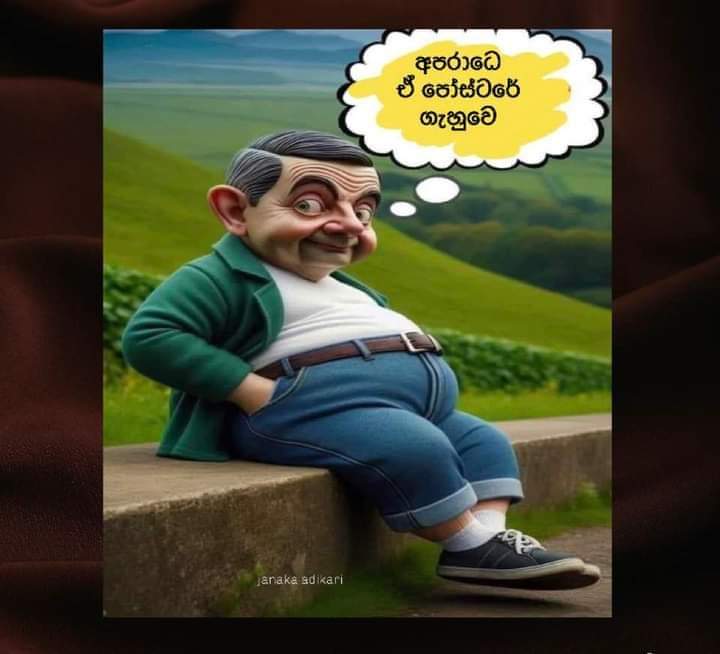
In vain [we] put up that poster
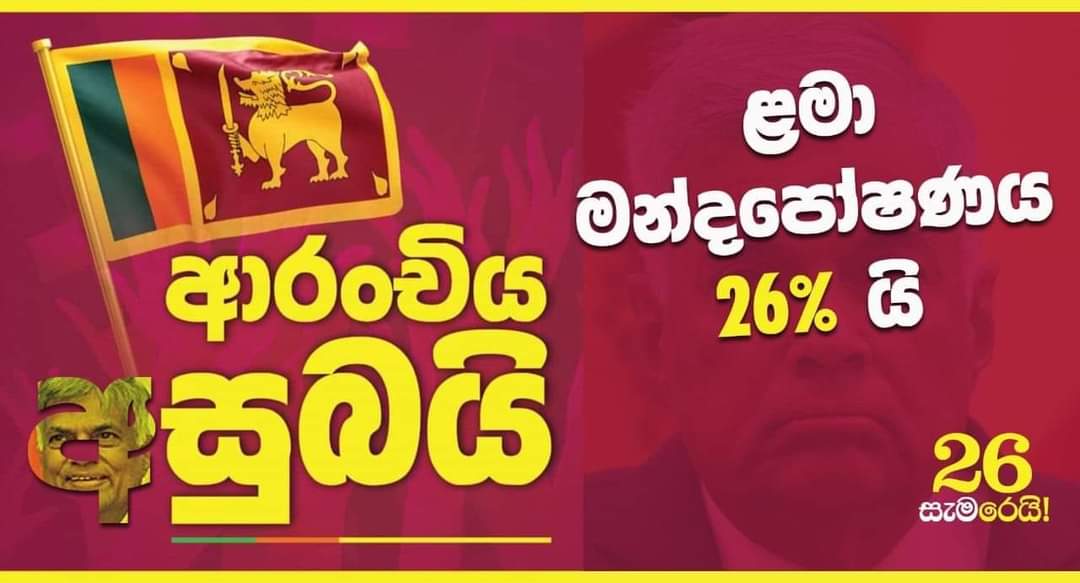
The news is (not) good
Child malnutrition is 26%
[It] will be celebrated on the 26th!
07. Other topics covered in reportage
- Arrest and imprisonment of former MP Hirunika Premachandra
- The reported use of parliamentary privileges to criticise the judiciary
- New bills proposed by the government
- Establishment of new political coalitions
- The reported increase in criminal activity
To view this week’s news summaries, please click here