
The Verité Media Analysis Market Fit Survey: Share your thoughts

We are currently conducting a short Market Fit Survey on The Verité Media Analysis. Please click here to fill out this survey which will only take three to four minutes of your time.
Same-sex relationships: Fodder for sensationalism and prejudice?

Yesterday (June 5), three Sinhala newspapers and one English newspaper reported an incident about two women involved in a same-sex relationship. For more information on how the incident was reported, click here
This week in The Media Analysis...
01. Electricity bill: Four currents spark distrust
02. The Language Divide
03. The TV coverage of the issue
04. This week’s cartoons
05. This week’s memes
06. Other topics covered in reportage
Past issues can be viewed here
Disclaimer: This week’s TMA is focusing solely on the numerous bills being presented by the government in parliament.
01. Electricity bill: Four currents spark distrust
Photo credits: The Island
Event: On April 25, the Sri Lanka Electricity Bill (SLEB) was presented in parliament by Minister of Power and Energy Kanchana Wijesekera.[1][2][3] The bill is to provide for the implementation of reforms to the energy sector in Sri Lanka.[4][5][6]
On June 4, Speaker Mahinda Yapa Abeywardana announced that the SLEB had been ruled inconsistent ‘as a whole’ with Article 12(1) of the Constitution by the Supreme Court.[7][8]
On June 6, the SLEB was passed with amendments by a majority of 44 (103 in favour and 59 against) votes, following the second reading of the bill in parliament.[9][10]
Analysis
Over the past week, the Sinhala media — which comprises print, TV coverage and social media — featured limited discussions on various government bills. These bills included the Sri Lanka Electricity Bill (SLEB), the Economic Transformation Bill, the Public Financial Management Bill and the Gender Equality Bill. Of these the SLEB received the most Sinhala media coverage.
Within the limited media coverage on the debate on the SLEB, TV coverage featured the issue more extensively than the print media. However, the social media commentary on the same was quite limited.[1]
The Sinhala media discourse on the SLEB was largely critical and distrusting of the SLEB. This week’s TMA will unpack the narrative of distrust surrounding the SLEB through two aspects: (1) the substance of the narrative of distrust and (2) the dynamics of the narrative of distrust.
1. Substance of the narrative of distrust
Four grounds form the narrative of distrust around the SLEB as discerned from last week’s Sinhala media discourse on the bill. These grounds also reflect the deepening public mistrust in the current government’s actions.[2]
a) Questioning the government on lacking a public mandate
Opponents of the bill, such as MP Charitha Herath, criticised the government for lacking the public mandate to pass laws related to major structural reforms in the energy sector (detailed in later sections of this analysis). President Ranil Wickremesinghe and his government have faced continuous and consistent criticism for this lack of public mandate, as highlighted in previous TMAs.[3] This perception, combined with the timing of these major structural changes taking place just before an anticipated election, fuelled the scepticism surrounding the government’s motives in passing the bill.
b) Questioning the ‘rushed’ passing of the bill
The SLEB faced criticism for being ‘hastily’ tabled and passed without allowing sufficient time for parliamentary debate or public consultation. For instance, the privately-owned Aruna newspaper questioned the government on the ‘rushed’ manner in which the bill was passed in parliament. Speaker Mahinda Yapa Abeywardana announced that the SLEB had been ruled inconsistent ‘as a whole’ with the constitution by the Supreme Court. However, two days later the bill was passed in parliament with amendments. The incumbent government faced similar criticism earlier this year during the passing of the Online Safety Bill.[4]
c) Questioning corruption and foreign influence
Criticism of the bill also stemmed from longstanding public concerns over state actions – especially related to economic matters – that imply corruption and foreign influence that are contrary to wider public and national interests.[5] For instance, media voices including the privately-owned Aruna newspaper and MP Vijitha Herath criticised the government’s alleged plans to hand over the power plant in Mannar to an Indian company – the Adani Group. These voices criticised the government for subjugating itself to Indian interests and expressed concerns about the project being awarded without a proper procurement process, including competitive bidding, thereby acting contrary to national interests.[6]
d) Resisting reforms in the energy sector
In light of the above criticisms of the incumbent government, opponents of the bill viewed the SLEB with suspicion for proposing momentous structural reforms to the energy sector in Sri Lanka. For instance, the bill aims to implement institutional reforms by separating or ‘unbundling’ the generation, transmission, and distribution functions currently held by the Ceylon Electricity Board (CEB) to separate corporate entities, which are to be established under the Companies Act, No. 7 of 2007.[7] Thus, the bill has drawn criticism due to its proposal for major structural changes to the energy sector presented by a government lacking a public mandate ahead of anticipated national elections.
2. Dynamics of the narrative of distrust
The following section briefly outlines two underlying dynamics that exacerbate the narrative of distrust and the limited media discussion concerning the SLEB.
First, the dual role played by the SLPP seems to intensify the narrative of distrust surrounding the SLEB. On the one hand, the SLPP appears to be critical of the government’s actions (adopting an oppositional stance). For instance, MP Mahinda Rajapaksa was critical of the government’s plans to privatise State-Owned Enterprises (SOEs). On the other hand, the SLPP is also seen as actively furthering the Wickremesinghe government’s policy agenda (adopting a supportive stance). For instance, Mahinda Rajapaksa was one of the MPs who voted in favour of the SLEB (please see Exhibit 1). Notably, last week’s Sinhala media voices, including MP Charitha Herath, SLPP MP Gevindu Kumaratunga and the Mawbima editorial, called out this dual role played by the Mahinda Rajapaksa-led SLPP.
Second, the technical nature of the parliamentary debate on the SLEB appears to have contributed to the limited media discussion, especially in social media. A similar public response to an issue was observed during the no-confidence motion (NCM) against Speaker Mahinda Yapa Abeywardana. Limited public understanding and awareness of parliamentary processes and procedures contributed to the lack of media interest in the NCM.[8]
Exhibit 1: Votes in favour of the SLEB
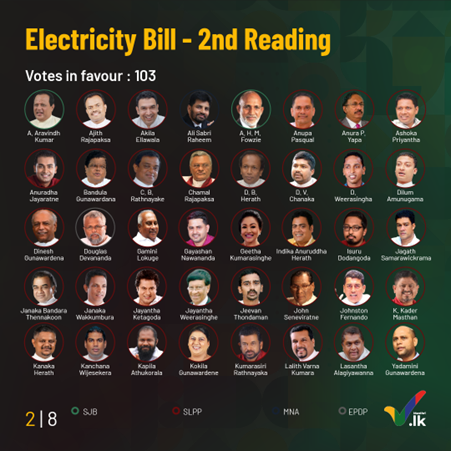
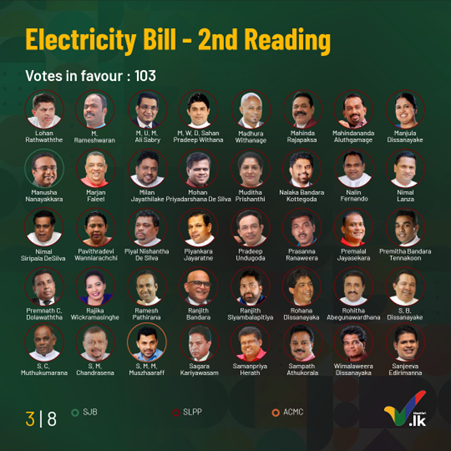
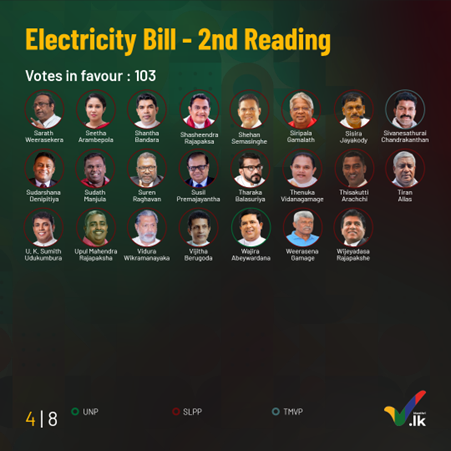
For more information, please see https://economynext.com/tisl-raises-concerns-over-adanis-sri-lanka-power-deal-demands-transparency-166391/.
02. The Language Divide
Signposts the differences and nuances in reporting between Sinhala and Tamil language newspapers
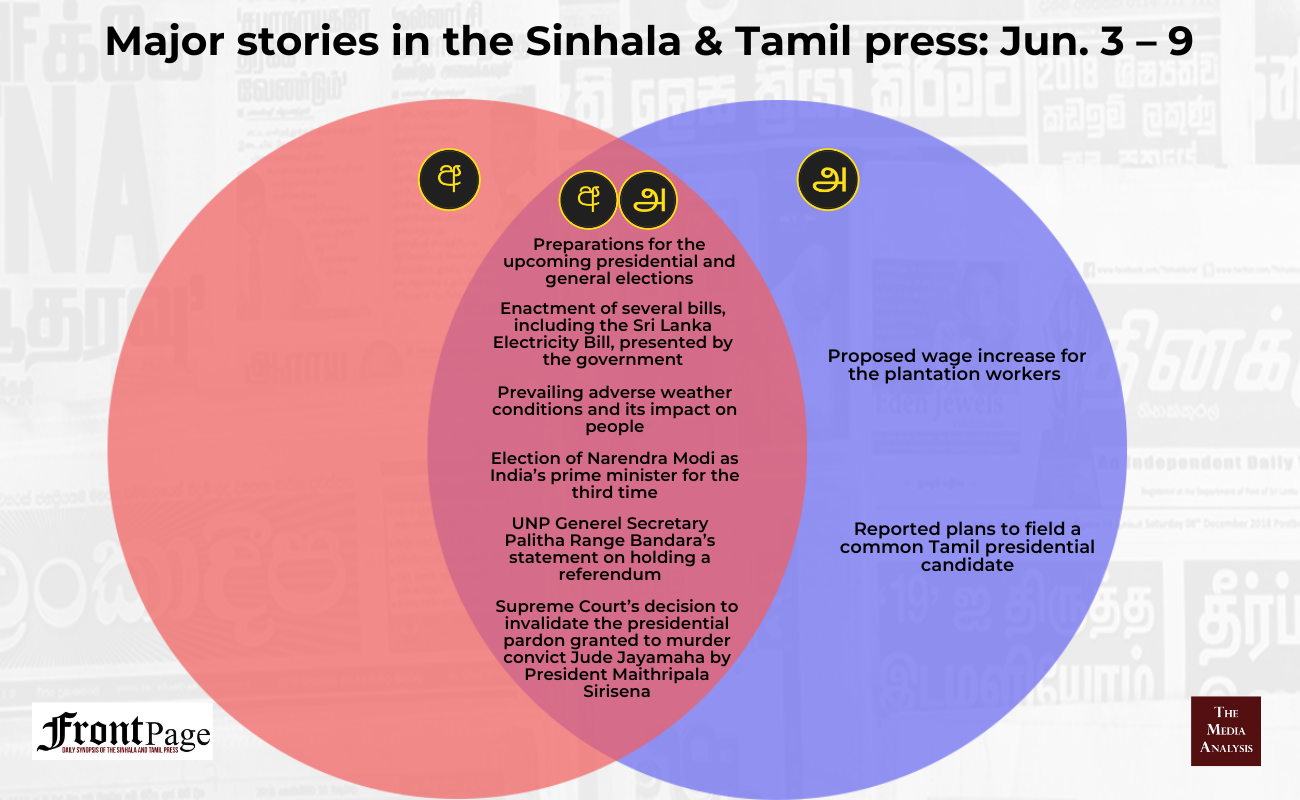
Last week’s Sinhala and Tamil press converged in relation to six main stories. The six stories were on the: (i) enactment of several bills, including the Sri Lanka Electricity Bill, presented by the government; (ii) preparations for the upcoming presidential and general elections; (iii) prevailing adverse weather conditions and its impact on people; (iv) election of Narendra Modi as India’s prime minister for the third time; (v) Supreme Court’s decision to invalidate the presidential pardon granted to murder convict Jude Jayamaha by President Maithripala Sirisena; and (vi) UNP Generel Secretary Palitha Range Bandara’s statement on holding a referendum. The Tamil press exclusively featured two main stories, and they were on the: (i) proposed wage increase for the estate workers and (iii) reported plans to field a common Tamil presidential candidate. There were no main stories featured exclusively in the Sinhala press during this period.
43 years since the burning of the Jaffna public library: How did TV channels cover it?
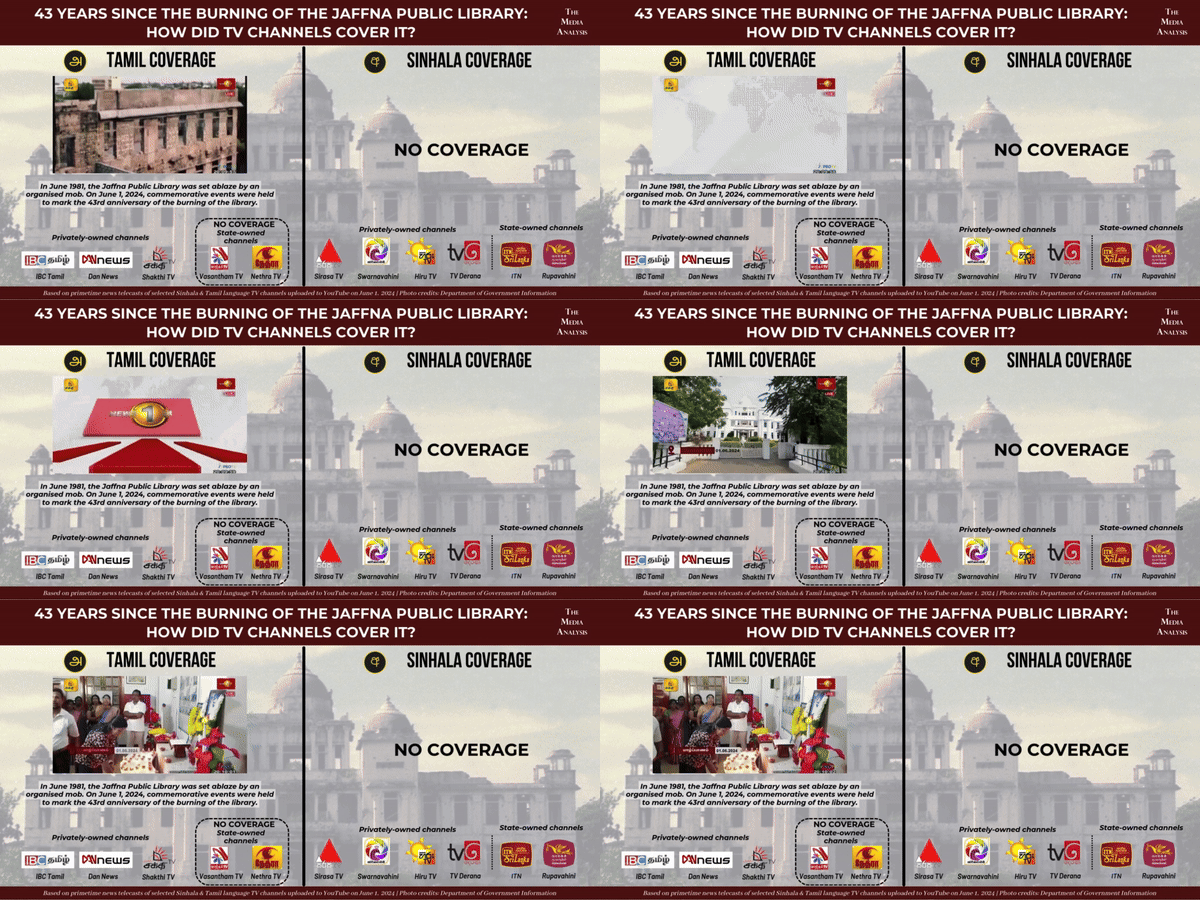
In June 1981, the Jaffna Public Library was set ablaze by an organised mob. On June 1, 2024, commemorative events were held to mark the 43rd anniversary of the burning of the library. Privately-owned Tamil TV channels IBC Tamil, Dan News and Shakthi TV afforded coverage to the commemorative events in their primetime news telecasts. By contrast, no coverage was afforded to the events by state-owned Tamil TV channels Vasantham TV and Nethra TV, privately-owned Sinhala TV channels Sirasa TV, Swarnavahini, Hiru TV and TV Derana, and state-owned Sinhala TV channels ITN and Rupavahini. For more information, click here
03. The TV coverage of the issue
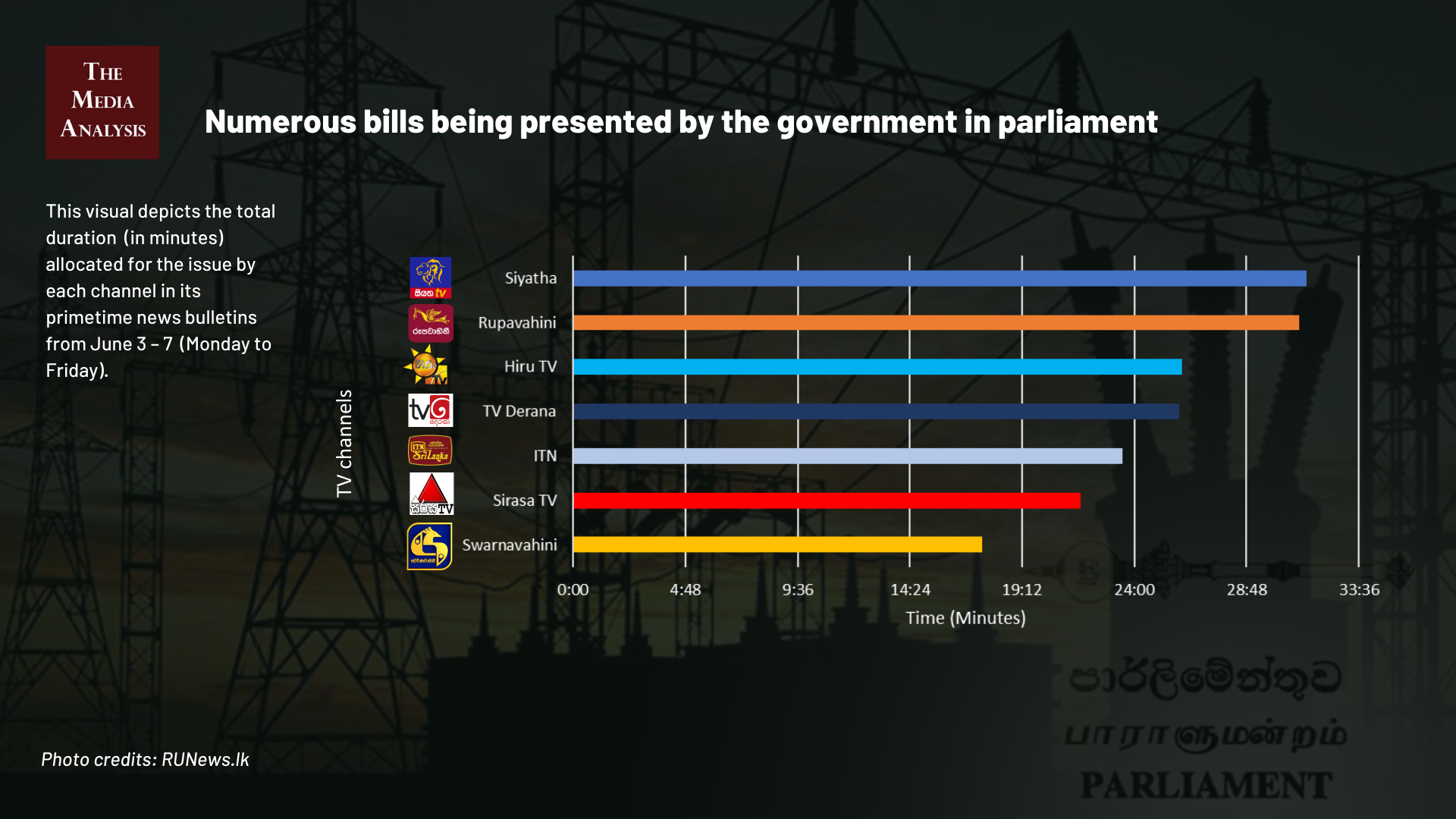
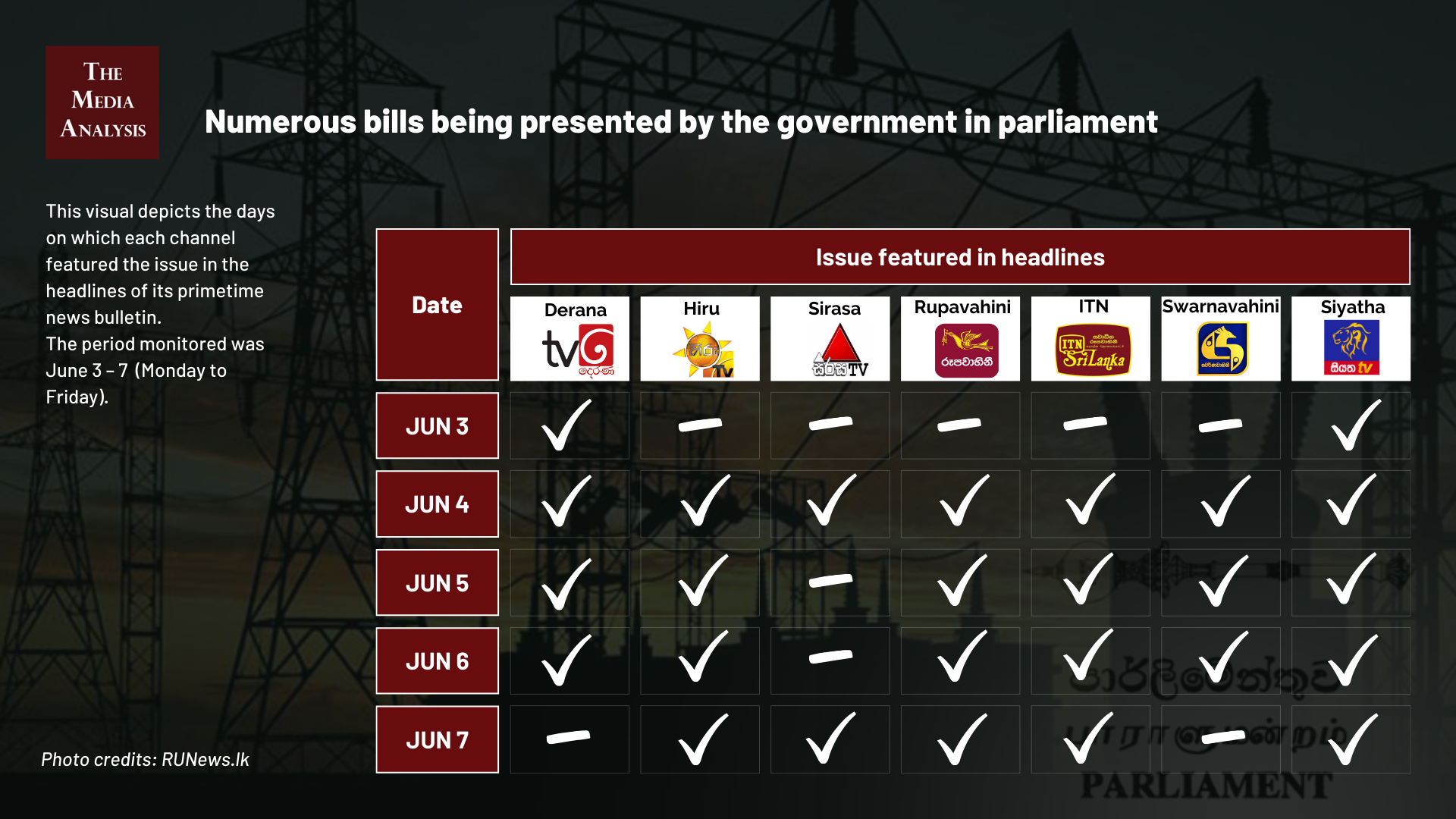
The data on television coverage is based on the monitoring of the primetime news telecasts of selected Sinhala language TV channels uploaded to YouTube.
04. This week’s cartoons
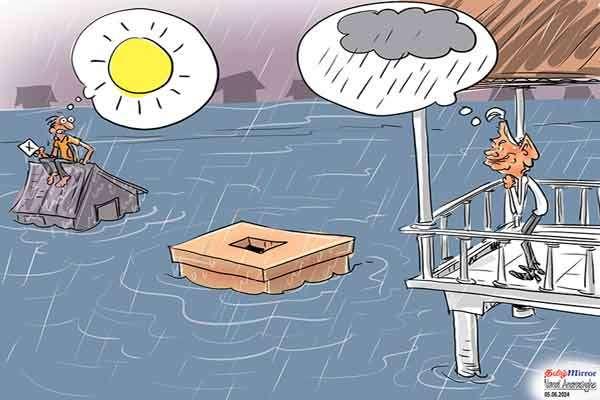
Courtesy of Tamil Mirror, Jun.5, 2024
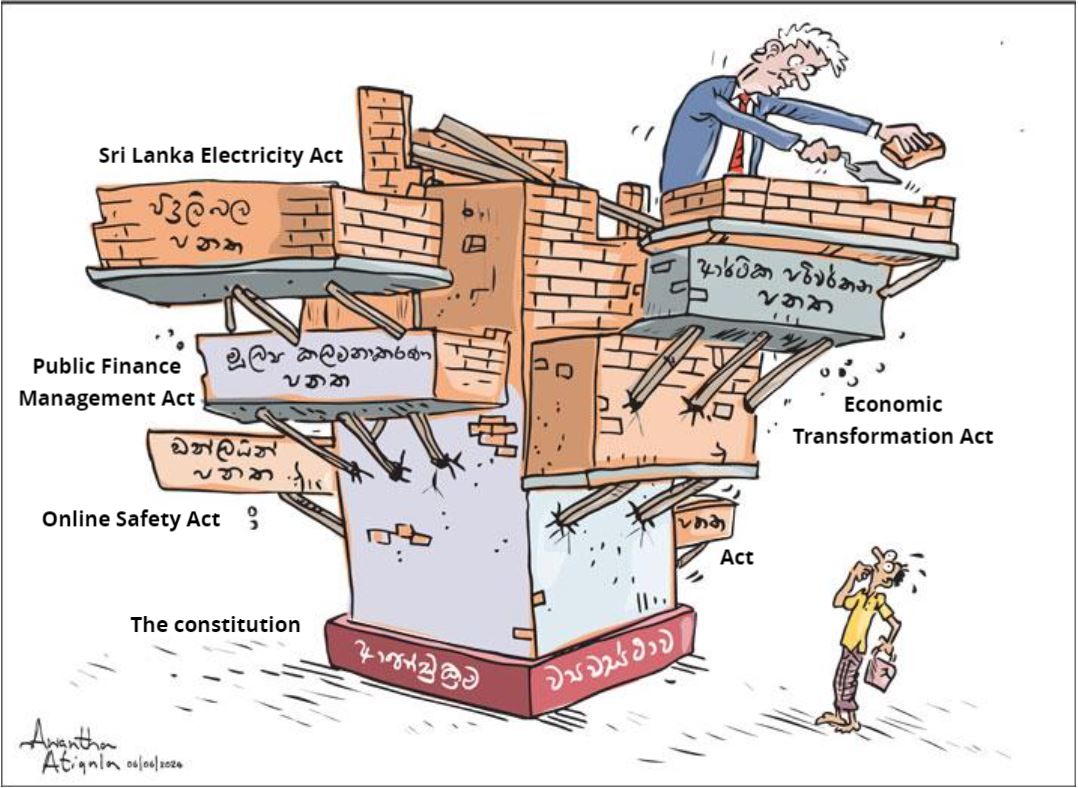
Courtesy of Ada, Jun.6, 2024
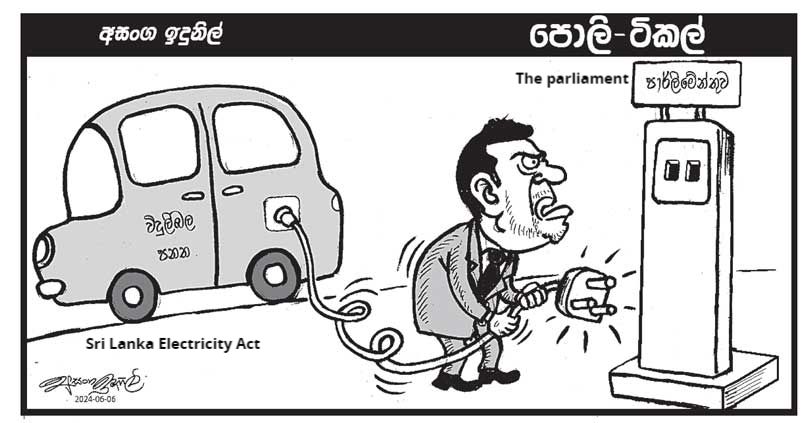
Courtesy of Lankadeepa, Jun.6, 2024
05. This week’s memes
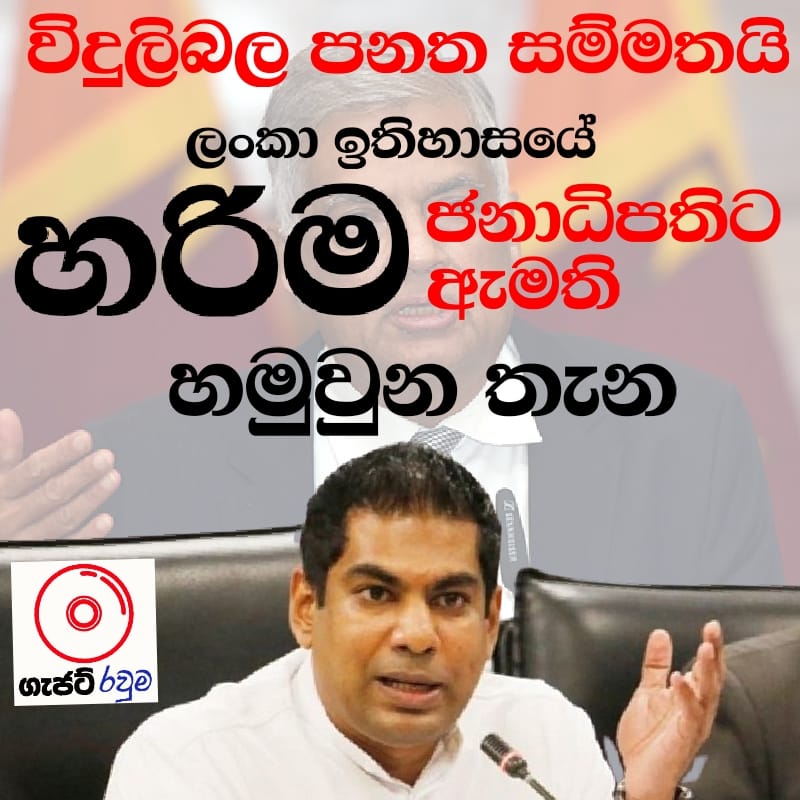
The Sri Lanka Electricity Bill has been passed; a moment in Sri Lanka’s history where the right president met the right minister
06. Other topics covered in reportage
- Reported disputes within the SLFP
- Alleged assault of SLPP MP Gunathilaka Rajapaksa by SLPP MP Mahindananda Aluthgamage
- Formation of numerous alliances in preparation for upcoming elections
- Reported rise of dengue in the country
- Continued postponement of the debate between the NPP’s and the SJB’s economic committees
To view this week’s news summaries, please click here