
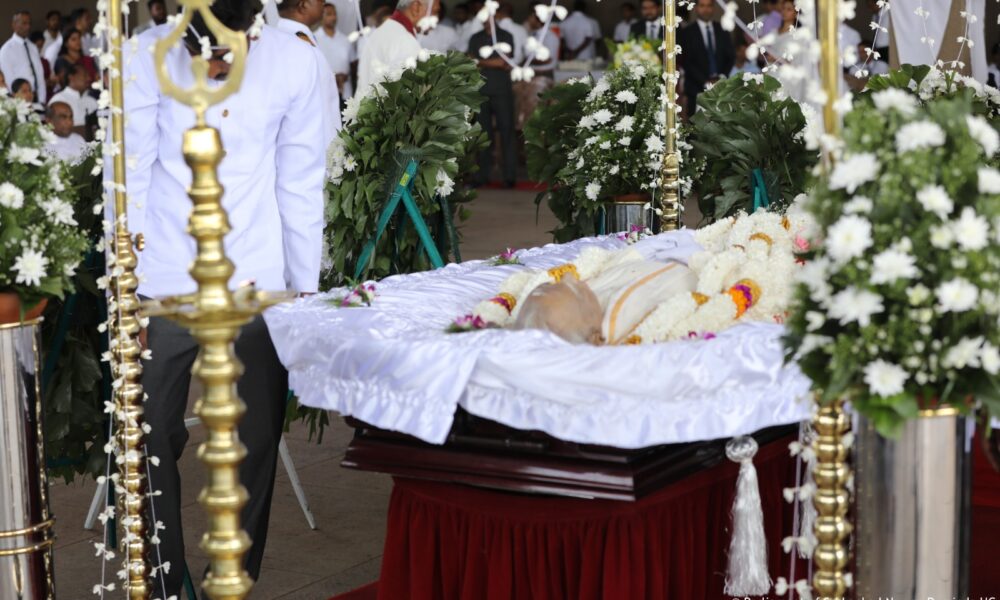
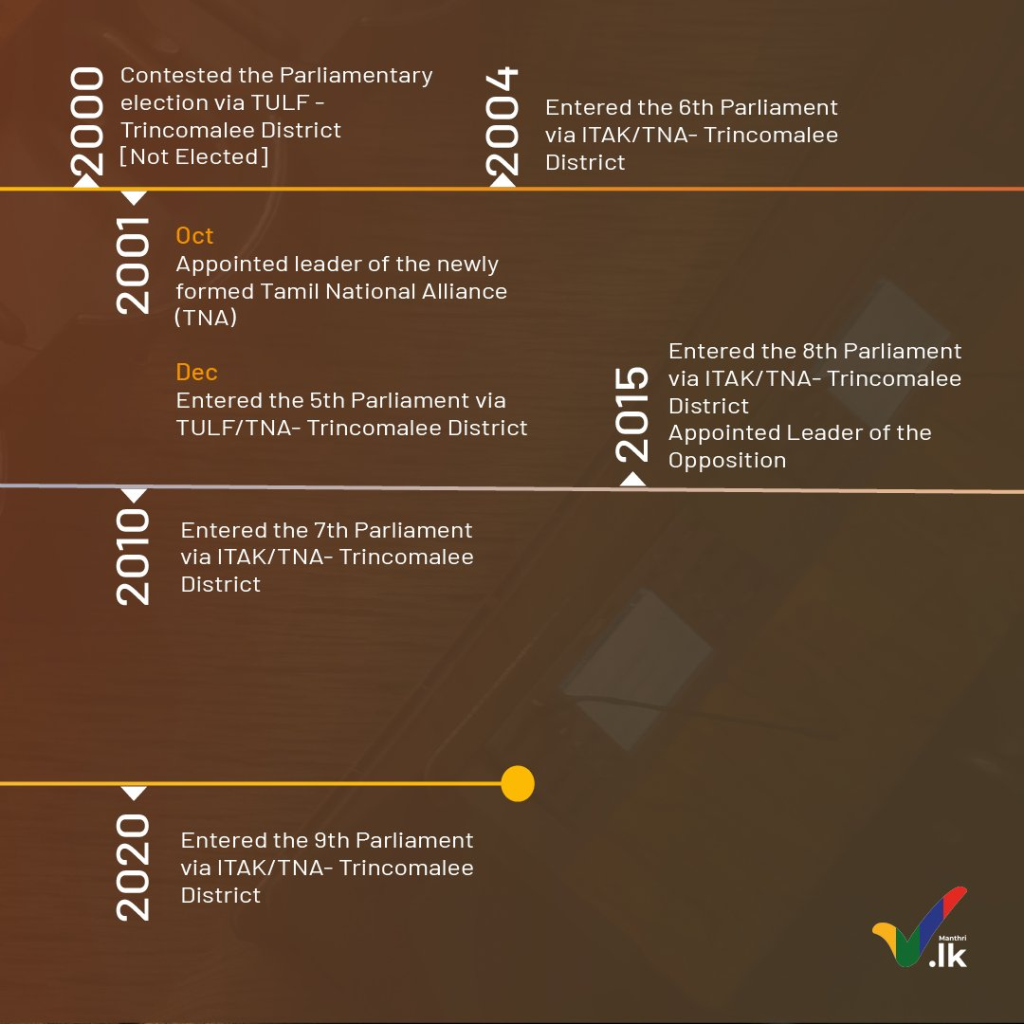
Event: On June 30, former opposition leader and Tamil National Alliance (TNA) leader, Illankai Tamil Arasu Kachchi (ITAK) MP Rajavarothiam Sampanthan passed away at the age of 91.[1][2]
Analysis
Following the passing of Sampanthan, the Sinhala media – including print, TV and social media posts – reflected on his life and legacy (please see Exhibit 1). The print media was largely appreciative and respectful of Sampanthan. In contrast, according to the findings from CrowdTangle, a social media monitoring tool, reactions on social media were mixed. Some expressed condolences, while others displayedsentiments of glee over his death. This was apparent from ‘haha’ emoji reactions and comments such as ‘the news is good’ or ‘next is mynah’ (implying that MP Mahinda Rajapaksa will die next).[1] TV coverage primarily consisted of reportage of the news of Sampanthan’s passing, without much commentary (please see The TV coverage of the issues for more details).
This week’s TMA answers the question of how the Sinhala and Tamil media responded to the death of Sampanthan. A difference between the Sinhala and Tamil media arose from the distinct ways in which Sampanthan was perceived and accepted in the Sinhala and Tamil societies.
An evaluation of the Sinhala media reportage highlights how Sampanthan was perceived diverges from two common characterisations of politicians in the mindset of Sinhala society.
Reaction of the Sinhala print media to the death of Sampanthan
1. Sampanthan as a simple and law-abiding politician
Sinhala media voices, including former Secretary of the Opposition Leader Deepika Subasinghe, ITAK MP Mavai Senathirajah and privately-owned Mawbima, praised Sampanthan for being a ‘simple, just and law-abiding’ politician. For example, commentators cited instances where Sampanthan refused luxurious vehicles and lived in a ‘house with broken windows and leaky roof’, despite being the leader of the opposition at the time.
This perception of Sampanthan can be juxtaposed with the general perception of a member of parliament, as that of a ‘chauvinist politician’, as analysed in previous TMAs.[2] This term captures that in the Sinhala mindset a politician is typically perceived asunruly, disrespectful of the law, entitled, aggressive, corrupt and even violent.[3] In this context, Sampanthan stands out as an exception to the general perception ofpoliticians. He is admired for his simplicity and adherence to the law. A closer reading of the Sinhala media suggests that there is a high level of respect, and an ascription of honour, towards politicians who embody these qualities that were associated with Sampanthan.
2. Sampanthan as having moderate political views
In the Sinhala psyche, Tamil community demands for a separate state have often come under strong criticism and are labelled as extreme views harmful to the country. The Sinhala media has often labelled Tamil politicians with such views as ‘extremists’ and ‘separatists’ to discredit or delegitimise them.[4]
However, in this instance, Sinhala media voices, including political commentators featured in Divaina, praised Sampanthan for not holding such extreme political positions, and for being a politician with whom a political solution could have been reached on the Tamil community grievances in Sri Lanka. Sampanthan was compared with political actors such as MP Gajendrakumar Ponnambalam who was portrayed as one with ‘extreme views’ pushing positions contrary to Sinhala national interests.[5]
Reactions of the Tamil print media to Sampanthan’s death
In the Tamil print media, the life and legacy of Sampanthan were discussed in both apositive and negative light.
On the positive side, Sampanthan was appreciated for dedicating his life to resolving the problems of the Tamil people and advocating for devolution of power in the North and the East. His commitment to these causes earned him respect and recognition within the community.
On the negative side, Sampanthan came under criticism for failing to maintain unity within Tamil politics, including within his own party. The Tamil print media viewed him as being ‘too soft’ in his response to the “Sinhala” state and ‘not effective’ in addressing the grievances of the Tamil people including issues of ‘Buddhistisation’ in the North and the East. These criticisms highlight a perception that he was not effective in representing the Tamil people’s problems and securing solutions.
Overall, the positive sentiment about Sampanthan in the Sinhala press and the acceptance of him as an iconic Tamil leader suggest that he was regarded as a rare figure with the potential to build trust and foster a political agreement between the Sinhala and Tamil people. However, this opportunity appears to have passed with his death.
[1] In accordance with TMA’s methodology to monitor social media, the TMA team filtered the 10 posts with the highest interactions on Facebook in Sinhala for the term deceased and the name R. Sampanthan using CrowdTangle, from July 1 to 7.
[2] See TMA Vol.13, #33 & 34, Vol.13, #23 and Vol.12, #17.
[3] See TMA Vol.13, #33 & 34, Vol.13, #23 and Vol.12, #17.
[4] See TMA Vol.13, #25.
[5] See TMA Vol.14, #23.