
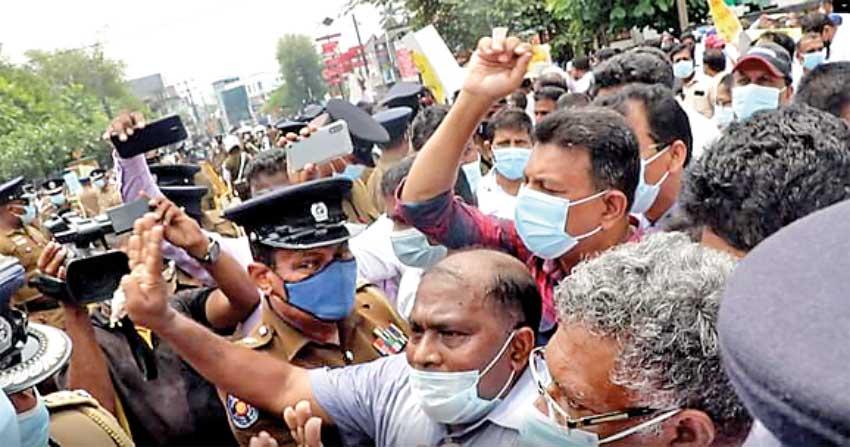
Event: On June 26, teachers and principals launched an island-wide trade union action by reporting sick and staging a protest near the Fort Railway Station over several demands, including solutions for salary disparities.[1][2] The police fired water cannons and tear gas to disperse the protest.[3][4]
On June 27, teachers and principals continued the island-wide strike as a response to police action against the protest the previous day.[5][6]
Analysis
Over the past few days, the state print media has been overwhelmingly critical of the teachers’ and principals’ strike, condemning both the trade union action and the teachers involved.[1] By contrast, social media posts filtered through CrowdTangle have offered support for teachers (please refer to this week’s memes).[2]
Two diverging views emerged from the Sinhala media coverage of the strike: (1) an unsympathetic view and (2) a sympathetic view toward teachers and principals.
1. The unsympathetic view
The state print media adopted an unsympathetic lens to delegitimise the teachers’ and principals’ trade union action on two fronts.
First, the strikes were framed as inconveniencing the public, particularly schoolchildren. For instance, state media voices criticised the teachers and principals for ‘sacrificing the future of the children’ and ‘taking revenge on the children’ to advance their interests. Within the Sinhala psyche, public support for trade union action tends to plummet when the actions lead to widespread public inconvenience, casting them in a negative light.[3]
Second, the teachers and principals were framed as failing to uphold the ideals expected of the profession. Within the Sinhala psyche, teachers are revered as guru devivaru or deities of teaching, expected to prioritise children and their education.[4] Accordingly, state media voices criticised their trade union action, accusing them of having betrayed the dignity of the profession. This criticism extended to blaming the teachers for prioritising private tuition over proper school teaching, labelling them as guru horu (trans. thieving teachers). In this context, within the Sinhala media, it can be understood that teachers are expected to be self-sacrificing and maintain the dignity of their profession rather than compromising it.[5]
2. The sympathetic view
Social media commentary and editorials of several privately owned newspapers adopted a sympathetic lens in their support of the strike. This support was underpinned by two narratives of injustice.
First, these voices sympathised with the teachers and principals whose salaries were framed as insufficient to meet basic needs in post-economic crisis Sri Lanka. The pay scale for teachers was viewed as unfairly low, with social media users and some newspapers calling their salary demands ‘reasonable’ under the circumstances.
Second, they sympathised with the teachers and principals, whose union action was seen as being unjustly suppressed by the government. Editorials in privately-owned newspapers such as Divaina and Lankadeepa condemned the government’s harsh/excessive response, expressing indignation at the violence used against teachers, who, they argued, deserve respect. This line of criticism against aligns with past accusations of the government deploying a ‘toolkit for suppressing’ protests.[6]
In sum, the Sinhala media coverage diverged between the state print media which was unsympathetic, and social media posts (and some privately owned print media outlets) which showed sympathy towards the teachers and principals.
[1] The discussion on the strike was primarily led by state-owned media voices. However, Sinhala TV broadcasts also provided coverage to teachers’ views on the issue.
[2] In accordance with TMA’s methodology to monitor social media, the TMA team filtered the 10 posts with the highest interactions on Facebook in Sinhala for the terms teacher, schools and teachers using CrowdTangle, from June 24 to 30.
[3] See TMA Vol.08, #31, Vol.08, #32, Vol.13, #17 and Vol.13, #35.
[4] For more information, see https://www.sundaytimes.lk/201122/education/be-a-quality-teacher-423264.html and https://mawratanews.lk/news/do-not-change-the-teachers-sari/.
[5] See TMA Vol.12, #46 & 47.
[6] See TMA Vol.12, #28, Vol.12, #39 and Vol.13, #11.